Catalytic Converter vs Muffler: What Is the Difference?
The difference in a catalytic converter vs muffler comparison is simple: the catalytic converter chemically cleans harmful exhaust gases, while the muffler only reduces engine noise. Both sit in the exhaust system, with the converter close to the engine and the muffler near the rear bumper. A muffler replacement usually costs $150 to $600, while a catalytic converter replacement typically runs $800 to $2,500 or more. They are separate parts that cannot stand in for each other, and removing a converter from a road vehicle is illegal under federal law. Here is how to tell them apart and what each repair costs.

James Mitchell
Senior Automotive Writer
12+ years writing clear, practical guides on vehicle maintenance and emissions systems.
Catalytic Converter vs Muffler: How Do the Two Parts Compare Side by Side?
A catalytic converter treats exhaust chemistry and a muffler treats exhaust sound. The converter sits near the engine, contains a ceramic core coated with platinum, palladium and rhodium, and costs far more to replace. The muffler sits toward the rear, uses chambers and perforated tubes to quiet the exhaust, and is much cheaper to fix.
This table sets the catalytic converter vs muffler differences side by side using typical 2026 figures for the United States.
| Feature | Catalytic converter | Muffler |
|---|---|---|
| Main job | Converts carbon monoxide, hydrocarbons and nitrogen oxides into carbon dioxide, water and nitrogen | Absorbs and cancels sound waves to quiet the exhaust |
| Typical location | Between the exhaust manifold and the muffler, close to the engine | Toward the rear of the vehicle, before the tailpipe |
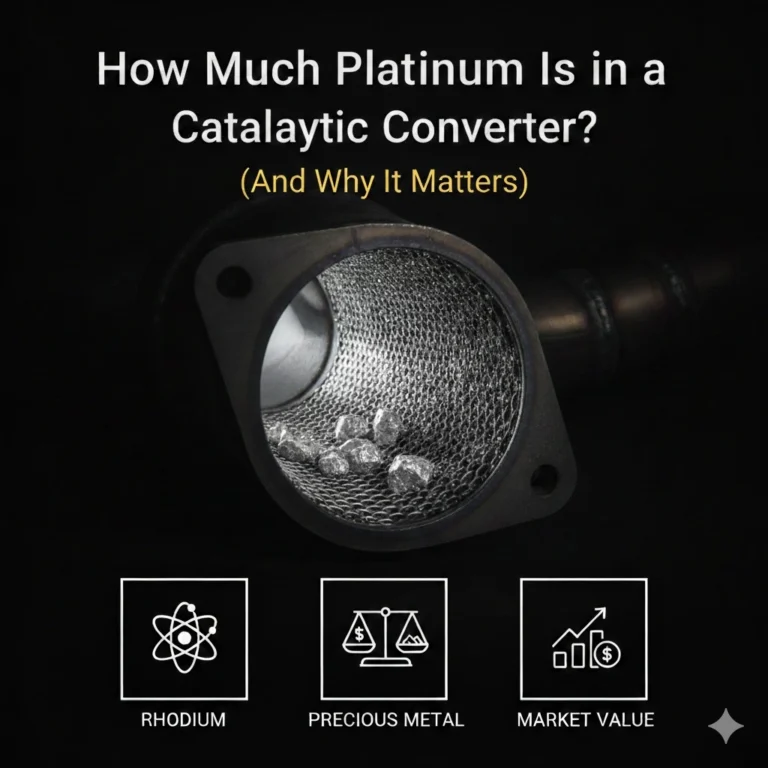
| What is inside | Ceramic honeycomb coated with platinum, palladium and rhodium | Steel or aluminized chambers, baffles and perforated tubes |
| Regulated by | Federal Clean Air Act and EPA, plus CARB rules in California and other adopting states | State and local noise rules |
| Typical failure signs | Check engine light, rotten egg smell, weak acceleration | Loud roar, rattling, rust holes |
| Affects the check engine light | Yes, through oxygen sensor monitoring | Normally no, because it has no sensors |
| Typical replacement cost | $800 to $2,500 or more | $150 to $600 for most cars |
Most drivers confuse the two because both look like metal canisters hanging under the car. Position and size help: the converter is usually the shorter unit closer to the engine, often with a heat shield and oxygen sensors threaded into the pipes nearby, while the muffler is the larger, longer canister toward the back. The sections below cover what each part does, where it sits, how to tell which one is failing, and what each repair costs.
What Does Each Part Do Inside the Exhaust?
Exhaust gas leaves the engine hot, toxic and loud. The catalytic converter handles the toxic part by triggering chemical reactions that turn pollutants into less harmful gases. The muffler handles the loud part by forcing sound waves through chambers and perforated tubes that cancel much of the noise before it reaches the tailpipe.
Understanding the two jobs makes the catalytic converter vs muffler distinction much easier to see, because neither part can do the work of the other.
What Does a Catalytic Converter Do?
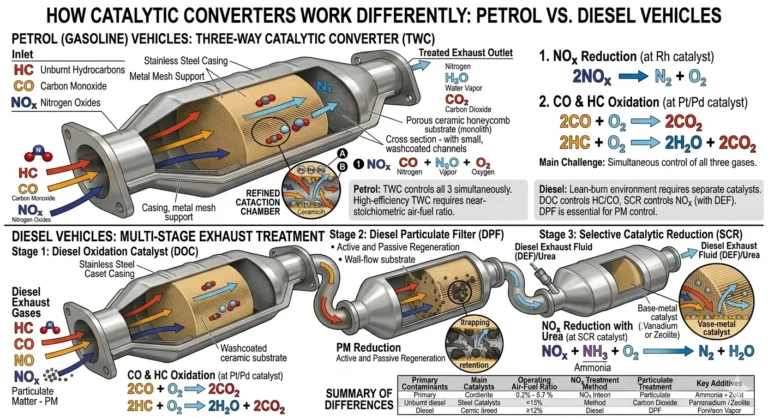
A catalytic converter uses precious metal catalysts to turn carbon monoxide, unburned hydrocarbons and nitrogen oxides into carbon dioxide, water vapor and nitrogen. The reactions happen inside a ceramic honeycomb with thousands of tiny channels, and the metals speed up the chemistry without being used up.
If you are not yet familiar with what a catalytic converter does, what a catalytic converter is and how it works covers that in full detail.
Three practical points matter for this comparison. First, the converter only works once it is hot, roughly 500 to 600 degrees Fahrenheit, which is why a car used only for very short trips can leave it underperforming. Second, it depends on the engine computer holding the air and fuel mixture in a narrow range. In a catalytic converter exhaust system, one oxygen sensor usually sits before the converter and another after it, and the second sensor tells the computer how well the converter is cleaning.
Third, anything that floods the converter with unburned fuel, oil or coolant can ruin it. A misfire or a rich running engine can overheat and melt the ceramic core, and burning oil can coat it with deposits. That is why a failed converter is often a symptom of an engine problem, not the root cause.
What Does a Muffler Do?
A muffler reduces exhaust noise by sending gas through baffles, chambers and perforated tubes that bounce sound waves against each other so they partly cancel out. It does not clean the exhaust or change its chemistry, so a damaged muffler makes the car louder but does not directly treat pollutants.
The muffler vs catalytic converter split is easy to remember: one handles sound, the other handles chemistry. Mufflers also come in different designs. Chambered mufflers redirect sound through internal walls and tend to be the quietest. Straight through designs use perforated tubes and sound packing, which restrict flow less and give a louder, sportier tone. Glasspack designs are generally louder and higher pitched.
A muffler cannot fix every noise complaint. A low drone inside the cabin at highway speed is often tuned out with a resonator, which is a separate part covered below.
Where Are the Catalytic Converter and the Muffler Located in the Exhaust System?
Exhaust gas flows from the engine through the exhaust manifold, then the catalytic converter, then a resonator if the car has one, then the muffler and tailpipe. The converter is the early, hot stop near the front of the car, and the muffler is the late stop near the rear.
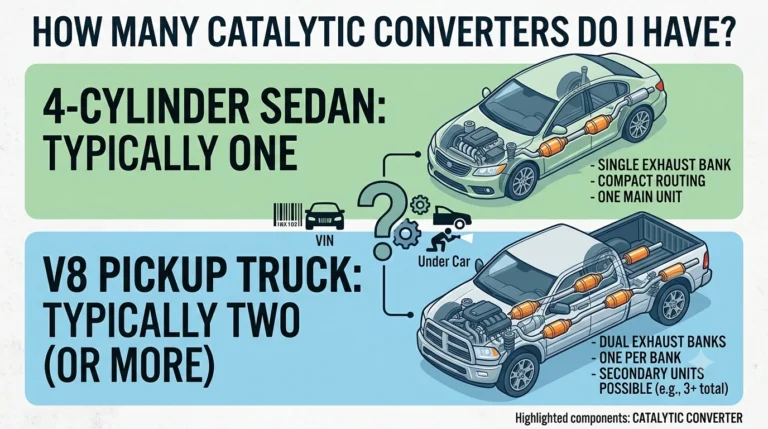
Following the pipe back from the engine is the easiest way to confirm which part you are looking at. Vehicles with dual exhaust often have two converters, one per side, and some vehicles have a small converter near the manifold plus a larger one under the floor. Always let the exhaust cool completely before you touch or inspect anything.
Is the Catalytic Converter Part of the Exhaust System?
Yes. The catalytic converter is part of the exhaust system, specifically its emissions control section. Gas has to flow through it to be treated, so it sits in the exhaust path between the manifold and the muffler. It is one piece of a larger assembly, not the whole assembly.
When a shop says the catalytic converter exhaust system needs work, the job could involve the manifold, front pipe, converter, mid pipe, resonator, muffler, hangers, gaskets or tailpipe. Asking which exact part is failing keeps the quote honest, because the catalytic converter exhaust system covers parts that cost $20 or $2,000.
Where Does the Resonator Fit Between Them?
A resonator is a smaller sound tuning chamber that usually sits between the catalytic converter and the muffler. Not every vehicle has one. It removes certain sound frequencies and works with the muffler, so a car can have a muffler without a resonator but not the other way around.
If a shop recommends replacing the resonator, treat it as a separate line item. It is not a catalytic converter and it is not a muffler, and its replacement cost is normally lower than either.
Is the Catalytic Converter Part of the Engine?
No. The catalytic converter is not part of the engine itself, because it does not sit inside the engine or bolt to the engine block. It is an emissions component of the exhaust system, but it works closely with the engine through oxygen sensors and the engine computer, which is why engine problems can ruin it.
The confusion is understandable. The engine computer adjusts fuel delivery based on oxygen sensor signals so the exhaust arrives in a chemical balance the converter can clean. Some vehicles also have a converter built into the exhaust manifold, which bolts directly to the cylinder head. That integrated design makes replacement more expensive because the whole manifold assembly is often replaced.
So whether a catalytic converter is part of the engine depends on how you define it. Mechanically it belongs to the exhaust, while functionally it is tied to engine management. A muffler has no sensors and no link to engine management at all.
How Can You Tell Whether the Muffler or the Catalytic Converter Is the Problem?
Noise points to the muffler, and emissions symptoms point to the converter. A loud roar, rattling or visible rust holes usually mean the muffler, while a check engine light, rotten egg smell or sluggish acceleration usually mean the catalytic converter. A scan tool reading and a visual exhaust inspection confirm which one it is.
This catalytic converter vs muffler symptom table shows what each common sign most often means.
| Symptom | Most likely part | What it usually means |
|---|---|---|
| Loud roar that gets worse when you accelerate | Muffler or a leaking joint | Rust has opened a hole or a gasket or clamp has failed |
| Visible rust holes or a hanging pipe | Muffler or exhaust piping | Corrosion has weakened the metal and hangers |
| Rattle from underneath at idle or low speed | Either part, so inspect both | Loose muffler baffles, a loose heat shield or broken ceramic inside the converter |
| Check engine light with a catalyst efficiency code such as P0420 | Catalytic converter or oxygen sensor | The computer sees the converter cleaning below its threshold, though a bad sensor can cause the same code |
| Rotten egg smell from the tailpipe | Catalytic converter | Sulfur compounds are not being processed properly |
| Weak acceleration or hesitation under load | Catalytic converter | A clogged core is restricting exhaust flow |
Do not replace a converter on a code alone. An oxygen sensor replacement typically costs $150 to $400, compared with $800 or more for a converter, so confirming the sensor readings first is worth the diagnostic fee. For a full diagnosis of a failing converter, how to tell if a catalytic converter is bad walks through the tests.
Picture a customer who rolls into a shop with a sedan that suddenly sounds like a tractor. Because a neighbor just paid for a new converter, they are convinced theirs failed too. The technician lifts the car and finds a rusted muffler seam split wide open, plus a leaking flange gasket just ahead of it. There is no warning light, no smell and normal acceleration, all of which point away from the converter. A new muffler and gasket cost a fraction of a converter job. That kind of catalytic converter vs muffler mix up is common, and the shop rule of thumb holds: noise alone rarely means the converter, while a warning light plus a smell rarely means the muffler.
How Much Does Muffler vs Catalytic Converter Replacement Cost in 2026?
Muffler replacement usually costs $150 to $600 for most vehicles, while catalytic converter replacement typically costs $800 to $2,500 or more. A national repair cost estimator lists an average of $2,280 to $2,480 for a converter as of September 2026, so the upper half of that range is common.
The table below shows typical installed prices by repair type, and your actual quote will vary with vehicle, region and shop labor rate.
| Repair | Typical cost in the US, 2026 | What changes the price |
|---|---|---|
| Muffler patch or weld repair | $80 to $200 | Extent of rust and shop labor rate |
| Muffler replacement, economy car | $150 to $350 | Direct fit versus universal part |
| Muffler replacement, truck or SUV | $250 to $550 | Larger part and extra pipe work |
| Performance or luxury muffler | $500 to $1,200 or more | Brand, material and tuned design |
| Catalytic converter, aftermarket EPA compliant, installed | $800 to $2,500 | Vehicle, labor and precious metal load |
| Catalytic converter, OEM direct fit from a dealer | $1,500 to $4,000 | Dealer pricing and vehicle model |
| Catalytic converter, luxury or hybrid vehicle | $2,000 to $4,000 or more | Metal content and the number of converters |
| Catalytic converter, CARB compliant part only | $400 to $1,200 for the part | Required in California, New York and other CARB states, before labor |
The muffler vs catalytic converter price gap comes from the metals and the certification, not from the labor. Three factors move a converter bill more than anything else: whether you choose an OEM or aftermarket unit, whether your state requires a CARB approved part, and whether the job also involves the manifold or other pipes. One 2026 pricing guide puts aftermarket converters at roughly 40 to 60 percent below OEM, but they may not last as many years.
Theft replacements often cost several hundred dollars more because thieves damage nearby pipes and sensors, and theft is typically covered under comprehensive insurance. Get at least two written quotes that name the exact part, because a catalytic converter exhaust system repair can bundle in manifold or sensor work you may not need. In a catalytic converter vs muffler repair, the converter bill is the one worth shopping around.
Is It Legal to Drive Without a Catalytic Converter or a Muffler?
Driving without a catalytic converter is illegal under federal law for any road vehicle that came with one, because the Clean Air Act bans removing emission controls. Muffler rules come from state and local noise laws, so they vary, but many places require a working muffler.
The catalytic converter vs muffler rules differ in who enforces them. Federal law and the EPA cover the converter, while states, counties and cities cover noise. Because local rules change, check your state and city regulations before you modify or delete either part.
What Does Federal Law Say About Removing a Catalytic Converter?
Section 203(a)(3)(A) of the Clean Air Act prohibits tampering with emission controls, and the EPA treats removing a converter as tampering. EPA guidance also says a repair shop that replaces a missing converter with a plain pipe takes part in that violation, so a legitimate shop will install a replacement converter.
If your vehicle is newer, check your warranty before paying. Federal rules are commonly described as requiring converter coverage for 8 years or 80,000 miles on 1995 and newer vehicles, and EPA compliant aftermarket converters commonly carry a 25,000 mile emissions warranty. Your warranty booklet or the EPA emissions warranty fact sheet has the exact terms for your vehicle.
What Rules Apply to the Muffler?
Muffler rules mostly come from state and local noise laws rather than the Clean Air Act. Many jurisdictions require a working muffler and some set decibel limits, so a muffler delete can draw a ticket even though it does not touch the emission controls. Confirm your local rules before changing it.
A loud exhaust can also bring unwanted attention from inspectors and neighbors even where the law is vague. If your muffler is rusted through, repairing it early is usually cheaper than waiting until the surrounding pipes also need replacing.
James Mitchell
Senior Automotive Writer
12+ years writing clear, practical guides on vehicle maintenance and emissions systems.
Frequently Asked Questions
Conclusion:
Catalytic converter vs muffler comes down to one question: is the problem noise or emissions? Loud sounds and visible rust point to the muffler, while a check engine light, a sulfur smell or weak acceleration point to the converter. Get a scan tool reading and a visual exhaust inspection before approving work, and ask for a written quote that names the exact part. Compare two shops if the quote passes $800.