Downstream vs Upstream O2 Sensor: What’s the Difference?
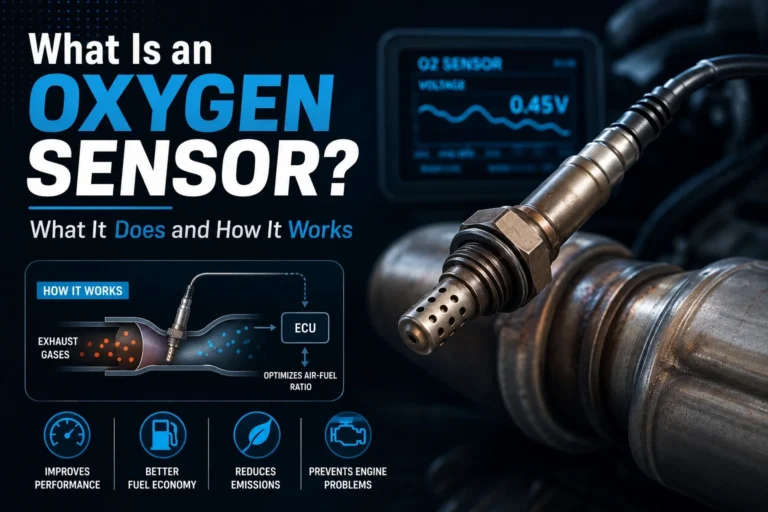
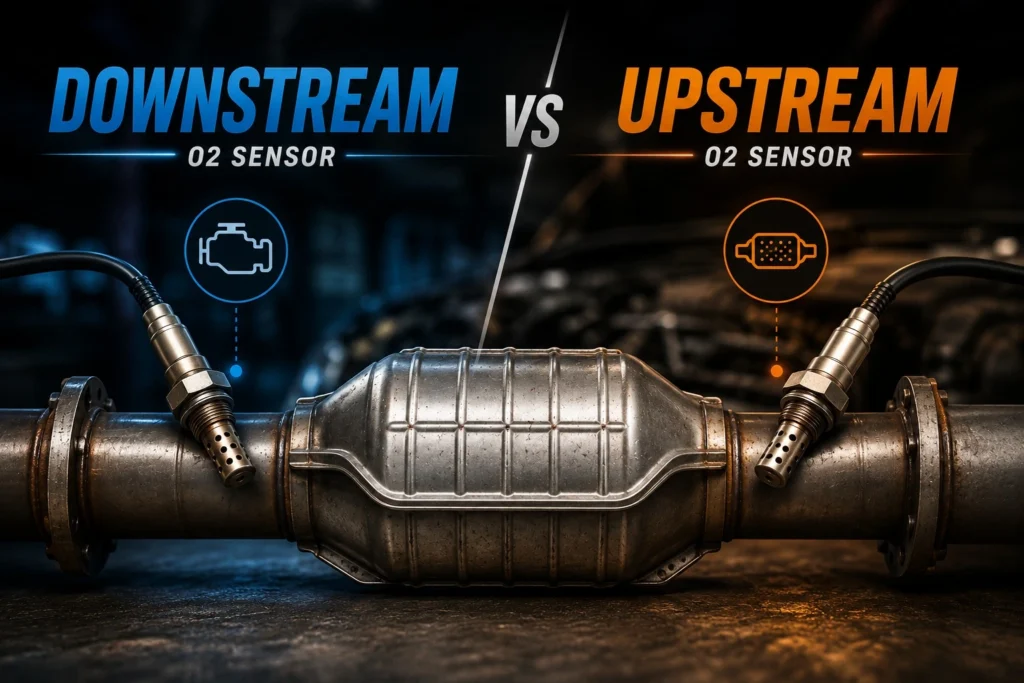
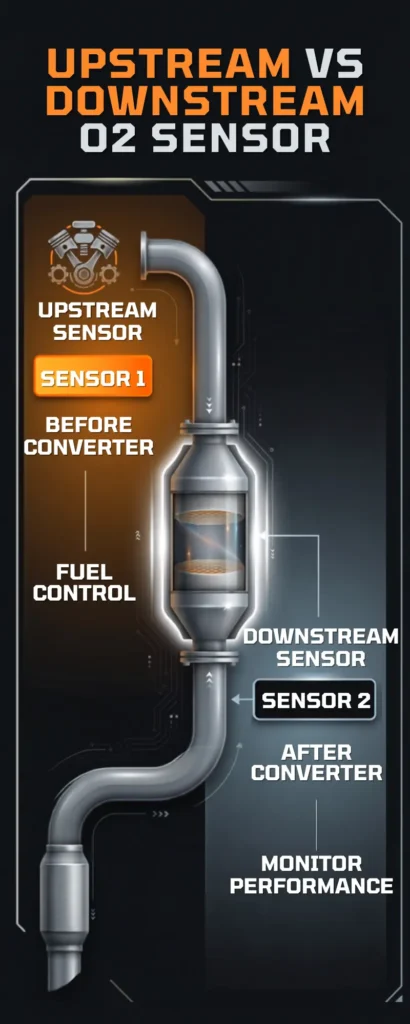
An upstream O2 sensor sits before the catalytic converter and helps the engine computer manage the air and fuel mixture, while a downstream O2 sensor sits after the converter and mainly checks how effectively the converter is processing exhaust gases. On most vehicles, Sensor 1 identifies the front sensor and Sensor 2 identifies the rear sensor. Knowing which sensor you are dealing with matters because their signals serve different purposes, their failure symptoms can differ, and replacing the wrong sensor can leave the original check engine light and drivability problem unchanged.

James Mitchell
Senior Automotive Writer
12+ years writing clear, practical guides on vehicle maintenance and emissions systems.
Upstream O2 Sensor vs Downstream O2 Sensor: The Core Difference
The easiest way to separate the two is by location and purpose. The upstream O2 sensor reads exhaust before the catalytic converter and provides information used for fuel control. The downstream O2 sensor reads exhaust after the converter and is used mainly to evaluate converter performance. Many newer vehicles use a wide band air fuel ratio sensor in the front position, but it still serves the upstream monitoring role.
| Comparison point | Upstream O2 sensor | Downstream O2 sensor |
|---|---|---|
| Typical position | Before the catalytic converter | After the catalytic converter |
| Common sensor number | Usually Sensor 1 | Usually Sensor 2 |
| Primary purpose | Provides mixture feedback for fuel control | Monitors catalytic converter performance |
| Typical signal use | Helps the computer adjust fueling | Helps the computer evaluate catalyst efficiency |
| Failure impact | Can affect fuel economy, emissions, and drivability | Usually affects emissions monitoring more than drivability |
| Common diagnostic focus | Fuel trim, response, heater, wiring, exhaust leaks | Catalyst monitor, response, heater, wiring, exhaust leaks |
Why Sensor Location Changes Its Job
Exhaust reaches the front sensor before the converter has changed its oxygen content. That makes the front signal useful for determining whether combustion is trending rich or lean. After the gases pass through the converter, the rear sensor sees the result of the converter’s oxygen storage and chemical reactions. The engine computer compares those patterns to judge whether the emissions system is behaving as expected.
How the Upstream O2 Sensor Affects Engine Operation
Fuel Control and Closed Loop Operation
Once operating conditions are met, the computer can enter closed loop fuel control. Information from the upstream O2 sensor then helps correct injector delivery as conditions change. A narrow band sensor switches around the stoichiometric mixture, while a wide band air fuel ratio sensor reports mixture more precisely across a broader range. Signal formats vary by vehicle, so compare scan data with the correct service specification.
Common Symptoms of an Upstream Sensor Problem
A faulty o2 sensor upstream can contribute to poor fuel economy, rough running, hesitation, increased emissions, or a check engine light because the computer may receive inaccurate mixture feedback. Those symptoms do not prove the sensor is bad. Vacuum leaks, exhaust leaks, weak fuel pressure, leaking injectors, ignition faults, and wiring problems can make a healthy sensor look suspicious.
Codes That Point Toward the Front Sensor
Codes in the P0130 through P0135 family often involve Bank 1 Sensor 1 circuits or heater operation. Lean or rich mixture codes can also involve front sensor data without proving the sensor caused the condition. Check wiring and live data before replacing parts.
What the Downstream O2 Sensor Tells the Computer
Catalyst Monitoring Is Its Main Responsibility
The downstream O2 sensor is primarily a diagnostic sensor. It monitors exhaust after the catalytic converter so the computer can evaluate converter performance. Once the engine and converter are hot, the rear signal is normally steadier than the front signal. If both patterns become too similar, the computer may detect reduced catalyst efficiency, although exhaust leaks, mixture problems, and sensor faults must also be checked.
Why a Rear Sensor Fault Does Not Automatically Mean a Bad Converter
Catalyst efficiency codes such as P0420 or P0430 do not automatically mean the downstream O2 sensor should be replaced. The code reflects a monitoring result, not a direct parts verdict. Check exhaust leaks, misfires, mixture problems, wiring, and sensor response before condemning the converter.
A customer once brought me a V6 SUV after another shop replaced the rear oxygen sensor for a recurring catalyst code. The light returned two days later. Live data showed the rear sensor was responding normally, but the front sensor on that bank was reporting a mixture pattern that did not match the opposite bank. A smoke test found a small intake leak affecting that side of the engine. After repairing the leak and confirming fuel trim returned to normal, the catalyst monitor completed without the code returning. The lesson was simple: sensor position tells you what the computer is watching, not which part must be replaced.
How to Identify Sensor 1, Sensor 2, and the Correct Bank
Sensor 1 Usually Means Upstream
On most modern gasoline vehicles, Sensor 1 is before the catalytic converter, so it is normally the upstream O2 sensor. Sensor 2 is usually after the converter and is normally the downstream O2 sensor. Complex exhaust layouts may use additional sensors, so confirm the vehicle specific diagram.
Bank Numbers Depend on Cylinder Number 1
Bank 1 is the side of the engine that contains cylinder number 1. Bank 2 is the opposite side on engines with two cylinder banks. The physical left or right side can vary with engine design and installation, so guessing from the driver side or passenger side can lead to the wrong part.
How to Diagnose an O2 Sensor Before Replacing It
Start With Codes, Freeze Frame, and Live Data
Read all stored and pending codes before disconnecting anything. Freeze frame data shows conditions present when a fault was recorded, while live data lets you compare sensor behavior, fuel trim, and engine temperature. On two bank engines, comparing both sides can show whether the problem is isolated or system wide.
| Live data or code pattern | What it may suggest | Best next check |
|---|---|---|
| Front sensor appears fixed rich or lean | Sensor fault or a real mixture problem | Check fuel trim, intake leaks, fuel delivery, exhaust leaks, and wiring |
| Front sensor responds slowly | Aged sensor, contamination, or testing conditions | Verify engine temperature, sensor type, response specification, and contamination |
| Rear sensor closely follows front sensor when hot | Possible reduced catalyst oxygen storage | Check converter condition, exhaust leaks, mixture control, and both sensor signals |
| Rear sensor heater or circuit code | Electrical or sensor heater fault | Test power, ground, resistance where specified, connector condition, and harness routing |
| P0420 or P0430 with no sensor circuit code | Catalyst monitor detected low efficiency | Rule out misfires, mixture faults, exhaust leaks, sensor errors, and converter damage |
| Similar abnormal data on both banks | System wide engine condition may be present | Check shared air, fuel, temperature, and electrical inputs before replacing sensors |
Inspect the Exhaust and Wiring
Check the connector, harness routing, heater circuit, and exhaust system for damage. An exhaust leak ahead of a sensor can draw outside oxygen into the stream and distort the reading. Oil, coolant, silicone, and other deposits can damage the sensing element. Correct the contamination source before installing a new sensor.
Do Not Judge Every Sensor by the Same Voltage Pattern
Traditional narrow band sensors and wide band air fuel ratio sensors do not report mixture information in the same way. Some front sensors use current based strategies or manufacturer specific scan values rather than the familiar switching voltage pattern. Use the correct service specification and a capable scan tool before deciding that a signal is abnormal.
Upstream and Downstream O2 Sensor Replacement Cost
Professional oxygen sensor replacement commonly runs about $275 to $700 on many vehicles, although access, sensor type, labor rates, and parts pricing can move the total outside that range. Wide band front sensors may cost more, and seized threads can add labor. Because the upstream O2 sensor and downstream O2 sensor may use different connectors and calibrations, ordered by exact vehicle, engine, emissions package, bank, and sensor position.
James Mitchell
Senior Automotive Writer
12+ years writing clear, practical guides on vehicle maintenance and emissions systems.
Frequently Asked Questions
Conclusion:
The upstream O2 sensor and rear oxygen sensor may look similar, but they do different jobs and should be diagnosed differently. The front sensor supports mixture control, while the rear sensor mainly watches catalyst performance. Before buying a replacement, confirm the bank and sensor number, inspect wiring and exhaust leaks, and review live data with the correct specifications. That process is far more reliable than replacing whichever sensor appears in a code description.