Signs of a Bad Catalytic Converter: Symptoms, Causes & What to Do
A catalytic converter does not announce its failure loudly or dramatically in most cases. It degrades quietly, over days or weeks, and by the time most drivers notice something is wrong, the internal damage has already progressed well beyond the early stage. Knowing how to tell if a catalytic converter is bad before it causes secondary damage to your engine is one of the most practical things any vehicle owner can understand.
This guide covers all eight symptoms you need to recognise, explains exactly what causes a converter to fail internally, walks through a complete step by step diagnostic process, and tells you what to do once the diagnosis is confirmed.

James Mitchell
Senior Automotive Writer
12+ years writing clear, practical guides on vehicle maintenance and emissions systems.
How to Tell If Your Catalytic Converter Is Bad: The Quick Answer
If your check engine light is on and an OBD2 scanner shows a P0420 code, your exhaust smells of sulfur, and your vehicle feels sluggish under acceleration, your catalytic converter is very likely failing or has already failed. These three indicators together point to a converter whose internal precious metal catalyst has lost efficiency and can no longer process exhaust gases at the conversion rate the engine control module expects.
That said, a P0420 code alone does not automatically confirm the converter is the problem. An exhaust leak, a faulty downstream oxygen sensor, or an upstream engine issue causing rich or lean running can trigger the same code. Proper diagnosis matters before spending money on a replacement.
8 Signs of a Bad Catalytic Converter You Should Never Ignore
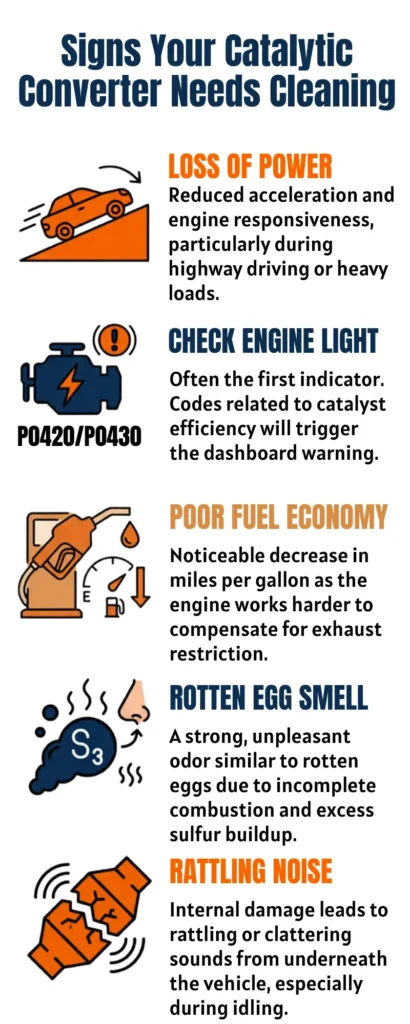
1. Check Engine Light and the P0420 or P0430 Code
For the majority of drivers, the check engine light is the first and often the only visible sign of a converter problem in its early stages. The engine control module continuously monitors catalytic converter working efficiency by comparing the electrical output of the upstream oxygen sensor, which sits before the converter, and the downstream oxygen sensor, which sits after it.
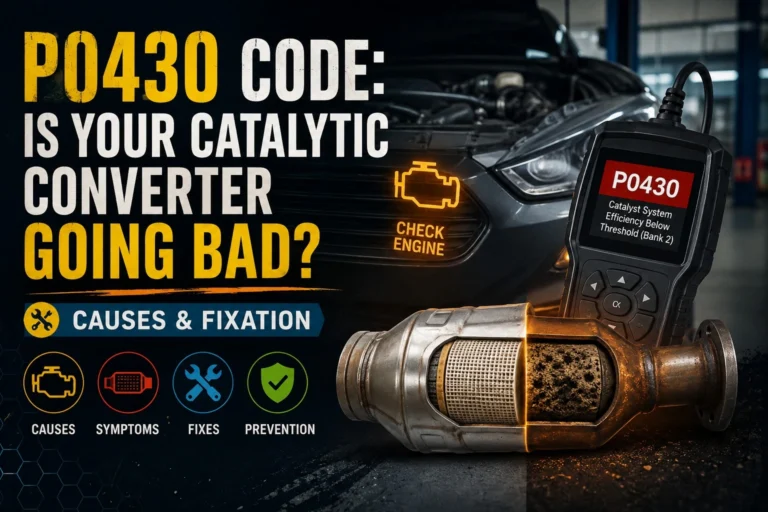
A properly functioning converter stores and releases oxygen efficiently, which means the downstream sensor should show a relatively stable signal compared to the constantly fluctuating upstream sensor. When converter efficiency drops, the downstream sensor starts mimicking the upstream signal, switching rapidly between rich and lean readings. The ECM detects this pattern and stores fault code P0420 for Bank 1 or P0430 for Bank 2 on V6 and V8 engines that have two separate converter systems.
The critical point most guides miss is this: the ECM only sets a P0420 code when both oxygen sensors are confirmed to be functioning. So the code is not a sensor failure signal. It is a converter efficiency signal. The most common mistake vehicle owners make is replacing the oxygen sensors to resolve P0420. In the overwhelming majority of cases, this does nothing because the sensors were working correctly and accurately reporting low converter efficiency all along.
2. Rotten Egg or Sulfur Smell from the Exhaust
Fuel contains small amounts of sulphur compounds. A healthy converter oxidises these compounds as part of its normal function, converting them into sulphur dioxide before they exit the tailpipe. Sulphur dioxide has a faintly sharp smell, but it dissipates quickly and is not typically noticeable to vehicle occupants.
When the converter loses efficiency, these sulphur compounds pass through partially converted, producing hydrogen sulphide gas, which is responsible for the unmistakable rotten egg odour. The stronger and more persistent the smell, the greater the degree of converter degradation. A faint occasional smell may indicate early inefficiency. A strong constant smell that enters the cabin through the ventilation system suggests the converter is close to or already at the point of complete failure.
This symptom is particularly valuable as a diagnostic indicator because it does not depend on a scan tool or warning light. If your vehicle consistently smells of rotten eggs from the exhaust and has no other plausible explanation such as a recently parked vehicle nearby, the converter is the most likely source.
3. Loss of Engine Power and Poor Acceleration
A catalytic converter that has reached the stage of physical restriction, whether from melted substrate, carbon buildup, or fragmented ceramic material partially blocking the honeycomb channels, creates exhaust back pressure that the engine was never designed to manage.
The engine’s exhaust stroke depends on the ability to push spent gases out of the cylinders cleanly and quickly. When that exit path is partially blocked, some exhaust gas remains in the cylinder at the start of the next intake stroke. This dilutes the incoming air and fuel charge, reduces combustion quality, and lowers the amount of power each cylinder produces. The result is an engine that feels weak, hesitates under load, struggles to accelerate onto a motorway or overtake at speed, and in severe cases limits the vehicle to low speeds even with the accelerator fully depressed.
The pattern of this power loss is often characteristic: the vehicle may feel reasonably normal at light throttle and low speed, but noticeably loses power when the engine is asked to work harder. This is because higher engine load requires a greater volume of exhaust gas to exit quickly, and a restricted converter creates proportionally more resistance under those conditions.
4. Rattling Noise from Under the Vehicle
A rattling or metallic shaking sound from under the car, particularly noticeable during cold starts or at idle, is a strong physical sign that the internal substrate has broken apart. The ceramic honeycomb core of a catalytic converter, though engineered for durability, can crack and fragment as a result of thermal overload, physical road impact, or the structural damage that follows substrate melt from excess unburned fuel.
Once the substrate breaks into pieces, those fragments move freely inside the steel housing. At cold start, before the metal casing has expanded thermally, the fragments are more prone to movement, which is why rattling is often loudest in the first moments after starting a cold engine. As the engine and exhaust system reach operating temperature and the steel casing expands slightly, the rattling may reduce or disappear, which sometimes leads drivers to dismiss the symptom incorrectly.
A simple test is to tap the converter casing gently with a rubber mallet while the engine is cold. If the substrate is intact, the sound will be dull and solid. If it has fragmented, the tapping will produce a distinctly hollow or rattling response from the loose material inside.
5. Failed Emissions Test
A catalytic converter that has degraded to the point of measurable inefficiency will typically cause a vehicle to fail an emissions inspection. Modern state and national emissions tests fall into two categories. The tailpipe test measures the actual concentration of carbon monoxide, hydrocarbons, and nitrogen oxides in the exhaust stream directly. The OBD2 plug-in test checks whether the ECM has stored any active fault codes and whether the catalyst monitor has completed its self-test without registering a failure.
A worn converter that triggers P0420 will fail the OBD2 test because the check engine light is commanded on. A converter that is severely degraded but has not yet triggered a code may still fail a tailpipe test because the concentration of regulated pollutants in the exhaust exceeds legal limits even without a stored fault code.
From a legal standpoint, driving a vehicle with a known emissions failure in states that require periodic testing creates compliance risk and, in some jurisdictions, civil liability if the vehicle is involved in a situation where emissions certification is examined.
6. Increased Fuel Consumption
This symptom is less dramatic than the others but measurable over time. When a converter begins to restrict exhaust flow, the engine management system detects changes in oxygen sensor feedback and exhaust back pressure that alter its fuelling calculations. In some cases the ECM compensates by enriching the fuel mixture, which means more fuel is injected per combustion cycle than the engine actually requires.
Separately, the mechanical inefficiency caused by exhaust back pressure means the engine must work harder to produce the same output, which inherently consumes more fuel. Vehicle owners who track their fuel consumption carefully may notice a gradual decline in kilometres or miles per litre or gallon weeks or even months before any other symptom becomes obvious. If your fuel economy has dropped without a clear reason such as a change in driving conditions or season, and no other fault codes are present, a partially degraded converter is worth investigating.
7. Engine Misfires and Difficulty Starting
In advanced cases of converter blockage, exhaust back pressure builds to a level that interferes with the engine’s ability to complete the exhaust stroke cleanly. When exhaust gases cannot escape the cylinder efficiently, they create resistance against the piston as it travels upward on the exhaust stroke. This increases the mechanical load on the engine and can contribute to misfires, particularly at idle when exhaust gas velocities are lowest and back pressure effects are proportionally greater.
A severely blocked converter can in extreme cases prevent the engine from starting at all. If the exhaust path is almost entirely obstructed, the engine builds enough back pressure within the first few seconds of cranking that combustion becomes impossible to sustain. This is a less common scenario but it does occur in high-mileage vehicles where a melted or collapsed substrate has created near-total restriction.
8. Visible Heat Discolouration or a Glowing Red Converter
This symptom represents a serious and immediate concern rather than a gradual warning sign. If a converter is glowing red or orange when the vehicle is running, the internal temperature has exceeded its safe operating range by a significant margin. Normal converter operating temperature falls between 400 and 800 degrees Celsius depending on engine load. A glowing unit has surpassed 900 degrees Celsius.
This typically occurs when large amounts of unburned fuel reach the converter, most commonly from a cylinder misfire or a fuel system fault that is delivering excessive fuel into the exhaust stream. The converter attempts to oxidise this excess fuel, but the exothermic reaction generates more heat than the substrate and precious metal coating can safely handle. The result is thermal runaway, which can melt the internal substrate, destroy the precious metal catalyst sites permanently, and in worst case scenarios create a fire risk, particularly if the converter sits close to heat-sensitive components or plastic trim.
A glowing converter is a stop-and-investigate situation, not a continue-and-monitor one.
Catalytic Converter Symptoms at a Glance
Not all converters are built the same way, and understanding the differences matters whether you are maintaining a vehicle or replacing a failed unit.
|
Symptom |
Internal Cause |
Severity Level |
Recommended Action |
|---|---|---|---|
|
|
|
Moderate |
|
|
|
|
|
|
|
|
|
High |
|
|
|
|
High |
Physical inspection; replacement likely required |
|
|
Converter efficiency below legal threshold |
Regulatory |
Diagnose root cause, then replace converter |
|
|
|
|
|
|
|
|
Very high |
|
|
|
Thermal runaway from excess unburned fuel |
|
Stop driving; address misfire or fuel fault first |
What Causes a Catalytic Converter to Go Bad?
Understanding what causes a catalytic converter to go bad is not just academic. It is the most important step in the repair process. A converter that is replaced without addressing the root cause of its failure will typically fail again within a short period, often within a few thousand miles. Every experienced technician who has worked in exhaust systems long enough has seen this happen more than once.
Engine Misfires: The Number One Root Cause
An engine misfire sends unburned fuel directly into the exhaust system on every affected combustion cycle. When this unburned fuel reaches the converter, the catalyst attempts to oxidise it. The oxidation reaction is exothermic, meaning it releases heat. A properly functioning engine produces a predictable and manageable amount of unburned compounds for the converter to process. A misfiring engine floods the converter with far more than it was designed to handle.
Even a minor misfire that does not trigger the check engine light can raise converter temperature significantly over sustained driving. The substrate begins to thermally degrade, the washcoat loses surface area, and the precious metal catalyst sites sinter together, reducing their effective surface area. This process is largely irreversible. Fault codes P0300 through P0308 appearing alongside P0420 are a strong indication that misfires caused the converter damage rather than the converter failing independently.
Oil Contamination from Worn Engine Components
When an engine consumes oil due to worn piston rings, degraded valve stem seals, or a malfunctioning positive crankcase ventilation system, that oil enters the combustion chamber and burns along with the fuel charge. The combustion products of engine oil include metallic ash compounds and carbon deposits that travel through the exhaust into the converter.
These deposits coat the washcoat layer of the substrate, physically smothering the precious metal catalyst sites and preventing exhaust gas molecules from reaching them. Unlike heat damage, which is primarily a function of temperature, oil contamination is a progressive physical blockage that accumulates over time. Blue smoke from the exhaust is the clearest early warning sign that oil consumption is occurring and that the converter is at risk.
Coolant Leaks via a Failed Head Gasket
A compromised head gasket can allow engine coolant to enter the combustion chamber, where it burns and travels through the exhaust system. Coolant contains silicate compounds and other additives that, when deposited on the converter substrate, form a glassy coating over the catalyst surface that is extremely difficult to remove.
White smoke from the exhaust, a sweet or glycol-like smell from the tailpipe, and unexplained coolant level drops are all indicators that coolant is entering the combustion chamber. If a converter fails in a vehicle that also shows these signs, the head gasket must be inspected and repaired before any converter replacement is considered.
Rich Air to Fuel Mixture and Faulty Oxygen Sensors
An upstream oxygen sensor that is reading incorrectly, a mass airflow sensor providing inaccurate data, leaking fuel injectors, or a faulty fuel pressure regulator can all drive the engine into a rich running condition, meaning more fuel is being burned than the combustion process can efficiently consume. The excess fuel that does not combust in the cylinder exits into the exhaust stream and arrives at the converter in concentrations that exceed its thermal capacity.
Fuel trim codes such as P0172 or P0175 appearing alongside P0420 are a strong diagnostic signal that a rich running condition has been damaging the converter over time.
Physical Damage from Road Impact
The ceramic honeycomb substrate inside a catalytic converter is mechanically strong under compression but relatively brittle under sharp impact loads. A significant road impact, such as grounding the undercarriage on a steep driveway, striking a large pothole at speed, or hitting road debris, can transmit enough shock through the exhaust system to fracture the substrate internally without leaving any visible external damage to the steel casing.
This type of failure often produces the rattling symptom described earlier. The converter may still pass an initial emissions check after impact damage because even fragmented substrate retains some catalytic surface area, but performance degrades progressively as the fragments shift and block channels.
Poor Fuel Quality and Incorrect Fuel Additives
Fuel quality matters directly to converter health. Sulphur content in fuel is a well-documented catalyst poison. High-sulphur fuel coats the precious metal surfaces with sulphate compounds that physically block active catalyst sites. Modern fuel standards in most developed countries limit sulphur content significantly for this reason, but fuel quality varies in markets where regulations are less strictly enforced.
Certain fuel additives, particularly those containing manganese, phosphorus, or lead compounds, are acutely damaging to precious metal catalysts. Using the correct grade of fuel for the vehicle and avoiding non-approved fuel system additives is a meaningful long-term protective measure.
Age and Normal Wear
Even a well-maintained converter in a mechanically sound engine does not last forever. Thermal cycling across hundreds of thousands of kilometres gradually fatigues the washcoat, causes sintering of precious metal particles, and reduces the overall surface area available for catalytic reactions. Most OEM converters are engineered to maintain certified performance for 150,000 to 200,000 kilometres under normal conditions, but this figure assumes consistent maintenance, correct fuel, and no upstream engine problems throughout the service life. Real-world service lives vary considerably.
How to Diagnose a Bad Catalytic Converter
UnderKnowing how to diagnose a bad catalytic converter correctly prevents the single most expensive mistake in this area: replacing the converter when the actual problem is something else entirely. A structured diagnostic approach follows these steps.
Step 1: Read All OBD2 Fault Codes
The first tool to reach for is an OBD2 scanner. Read every stored and pending code, not just P0420. The codes present alongside P0420 tell a more complete story than P0420 alone.
If misfire codes P0300 through P0308 are present, address the misfire first. If air to fuel ratio codes such as P0171, P0172, P0174, or P0175 are stored, investigate the fuel system and oxygen sensors before condemning the converter. Only when all supporting engine codes have been investigated and resolved should the converter itself be treated as the confirmed fault.
Step 2: Exhaust Temperature Test with an Infrared Thermometer
An infrared thermometer is an inexpensive and highly informative diagnostic tool for converter evaluation. With the engine fully warmed to operating temperature and running, point the thermometer at the inlet pipe entering the converter, then at the outlet pipe exiting it.
A functioning converter produces an exothermic reaction that raises exhaust gas temperature as it passes through. The outlet temperature should be measurably higher than the inlet temperature. For older vehicles, this difference might exceed 150 degrees Fahrenheit, while for modern cars even a 20 degree difference can indicate a properly operating converter. If there is no difference in temperature, or if the outlet temperature is cooler than the inlet, the converter is likely no longer catalysing.
Step 3: Vacuum Gauge Test for Exhaust Back Pressure
This test reveals whether the converter is creating abnormal resistance to exhaust flow. Connect a vacuum gauge to an intake manifold vacuum port. Start the engine and allow it to idle. The vacuum reading at idle should be between 18 and 22 inches of mercury. Have a helper snap the throttle open and quickly release it. There should be a brief drop in vacuum as the throttle opens, but the reading should return to baseline almost instantly. If recovery takes longer than a few seconds, the converter is likely clogged.
Step 4: Back Pressure Gauge Test
For a direct measurement of restriction, remove the upstream oxygen sensor and thread a back pressure gauge into the sensor port. Normal back pressure should remain below 1.5 PSI at idle and under 3 PSI at 2,500 RPM. Excessive back pressure at either condition confirms that the honeycomb structure has melted or collapsed and is blocking exhaust flow.
Step 5: Visual Inspection of the Converter
A physical inspection will not reveal internal chemistry, but it does identify mechanical damage quickly. Check the external casing for dents, cracks, or severe heat discolouration, particularly a blue-grey or dark oxidation pattern consistent with sustained overheating. Tap the casing with a rubber mallet and listen for the hollow rattle of fragmented substrate. Inspect the inlet and outlet pipes for carbon deposits or unusual residue that might indicate oil or coolant contamination upstream.

DIY vs. Professional Diagnostic Methods
|
Method |
Tools Required |
What It Reveals |
Skill Level |
Approximate Cost |
|---|---|---|---|---|
|
|
|
P0420, P0430, supporting engine codes |
|
20 to 80 USD for a basic scanner |
|
|
|
|
|
15 to 40 USD |
|
|
|
Exhaust restriction and back pressure symptoms |
|
20 to 50 USD |
|
|
|
Direct PSI measurement of exhaust restriction |
Intermediate |
30 to 60 USD |
|
|
Four or five gas analyser |
Actual pollutant concentration in exhaust stream |
Professional |
Labour charge at workshop |
|
|
|
|
|
Included in professional diagnosis fee |
What to Do If Your Catalytic Converter Is Bad
Address the Root Cause First
This point cannot be stated firmly enough. Replacing a catalytic converter without first identifying and resolving the upstream engine condition that caused its failure is not a repair. It is a delay before the same failure happens again to the new unit. Before any converter is ordered, the following should be confirmed as healthy: spark plugs and ignition coils, fuel injectors and fuel pressure, oxygen sensors, the positive crankcase ventilation system, head gasket integrity, and mass airflow sensor accuracy.
If misfire codes are present, resolve them completely and confirm with a test drive before proceeding. If fuel trim data shows the engine was running rich, find and correct the source of the enrichment.
Can You Clean a Catalytic Converter Instead of Replacing It?
Fuel-additive converter cleaners are widely marketed and work on a narrow set of circumstances. If the converter has lost efficiency due to a thin layer of carbon buildup from short-trip driving or mild fuel quality issues, a commercially available cleaner added to a full tank of fuel and driven through a sustained motorway run may restore enough function to pass an emissions test temporarily.
The “Italian tune-up”, which refers to a sustained high-RPM motorway drive that raises exhaust temperatures and burns off surface deposits, follows the same principle and costs nothing.
Neither approach works on a converter that has suffered substrate melt, physical fragmentation, oil or coolant contamination, or precious metal depletion from sustained overheating. In those cases, cleaning products will not produce any meaningful improvement, and the converter requires replacement.
How Long Can You Drive with a Bad Catalytic Converter?
The answer depends entirely on the type of failure. A converter that is chemically degraded but not physically restricted will allow the engine to run normally. The vehicle will fail an emissions test and the check engine light will remain on, but driving it is not immediately harmful to the engine and does not create a mechanical safety concern.
A converter that is physically clogged or partially blocked is a different matter. Sustained driving with significant exhaust back pressure accelerates engine wear, increases oil temperatures, and can eventually damage piston rings and valves. The longer the restriction is ignored, the greater the risk of secondary engine damage that far exceeds the cost of the converter itself.
A glowing converter should not be driven under any circumstances without first resolving the cause of the excess heat.
OEM vs. Aftermarket Replacement
For most vehicles, a direct-fit OEM or OEM-equivalent converter is the most reliable replacement choice. The engine management system was calibrated to expect the specific oxygen storage capacity and conversion efficiency of the original converter design. Fitting a converter with significantly different catalyst characteristics can cause the ECM to re-trigger P0420 even with a brand new unit installed.
Universal fit converters require custom welding or adaptor fittings and, while suitable in some applications, introduce additional variables. In California and other CARB-regulated states, the replacement converter must carry a specific California Air Resources Board executive order number for the vehicle application. Using a federal-only converter in a CARB state is both a technical and a legal compliance issue.
James Mitchell
Senior Automotive Writer
12+ years writing clear, practical guides on vehicle maintenance and emissions systems.