
Catalytic Converter Theft: Why It Happens, How to Prevent It, and What to Do
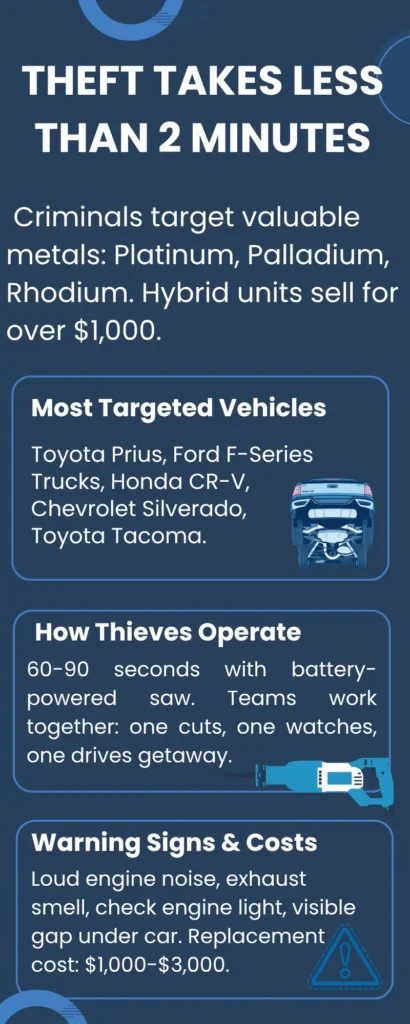
If you have ever walked out to your car in the morning, turned the key, and been blasted by a thunderous roar from underneath your vehicle, there is a good chance you already know the sinking feeling of realizing your catalytic converter is gone. Catalytic converter theft is not a new problem, but it remains one of the most financially painful and frustrating crimes a vehicle owner can experience. Replacement costs routinely run between $1,000 and $3,000, and the theft itself can take a skilled criminal under two minutes.
Understanding why catalytic converters are stolen, which vehicles are most at risk, and most importantly how to prevent catalytic converter theft is the single most effective thing you can do to protect your vehicle right now. This guide covers everything from the root cause of the theft epidemic to a step-by-step plan for exactly what to do if your catalytic converter is stolen.

James Mitchell
Senior Automotive Writer
12+ years writing clear, practical guides on vehicle maintenance and emissions systems.
Why Are Catalytic Converters Stolen?
The short answer is money. Your catalytic converter sits in the exhaust system and contains a ceramic honeycomb substrate coated with precious metals. Those metals are the same ones traded on commodity markets at prices that rival and often exceed gold. So the answer to why steal a catalytic converter is because it is one of the easiest high-value targets on any vehicle, accessible with basic tools and removable in minutes.
What Precious Metals Make Them So Valuable?
Three metals sit at the core of every catalytic converter: platinum, palladium, and rhodium. Each one plays a chemical role in converting toxic exhaust gases into less harmful emissions, and each one carries significant market value. Rhodium in particular has seen prices exceed $10,000 per troy ounce at peak demand. A single converter from a standard gasoline vehicle contains a few grams of each metal, making it worth anywhere from $50 to $300 at a scrap yard. A hybrid vehicle converter, which retains more of these metals because the combustion engine runs less frequently, can fetch up to $1,400 from recyclers.
How Much Do Thieves Actually Make Per Converter?
A thief stealing a converter from a standard passenger car typically walks away with $50 to $300 in scrap value. That number climbs dramatically for hybrid vehicles and large trucks. When a crew targets a parking lot and steals five or six converters in a single night, the total payout becomes significant. The stolen parts are sold to scrap dealers or metal recyclers, some of whom ask few questions. This financial chain is precisely why people are stealing catalytic converters at such an alarming rate and why the problem has proven difficult to stop entirely.
Which Vehicles Are Most at Risk?
One question comes to mind: which vehicles are most vulnerable to theft of catalytic converters? Why would someone steal a catalytic converter from one vehicle over another? The answer is ground clearance, precious metal content, and the ease of accessing the exhaust system are the three primary factors thieves consider. A vehicle that sits higher off the ground allows a thief to slide underneath without needing a jack, which dramatically reduces the time required and the risk of being noticed.
Why Trucks, SUVs, and Hybrids Are Prime Targets
Pickup trucks and full-size SUVs top the list of most targeted vehicles because their elevated ride height makes the exhaust system immediately accessible. A thief can crawl underneath a Ford F-Series truck in seconds without any lifting equipment. Hybrid vehicles, particularly the Toyota Prius, are targeted even more aggressively because their converters contain higher concentrations of precious metals in better condition. Since the combustion engine in a hybrid runs less often, the catalytic metals degrade more slowly and retain more of their original value.
Most Targeted Car Models for Catalytic Converter Thefts
|
Vehicle |
Why Targeted |
Approx. Converter Scrap Value |
|---|---|---|
|
|
|
$700 to $1,400 |
|
|
|
|
|
|
|
$100 to $250 |
|
|
|
$75 to $200 |
|
|
Common on roads, easy resale of parts |
$75 to $200 |
|
|
|
|
|
|
|
$100 to $250 |
|
|
|
$100 to $300 |
How Fast Can a Catalytic Converter Be Stolen?
This is the detail that shocks most people. An experienced thief with a reciprocating saw or battery-powered angle grinder can remove a catalytic converter in as little as 60 to 90 seconds on vehicles with easy undercarriage access. On harder-to-reach models it may take three to five minutes. Either way, the entire crime can be completed before a bystander even processes what they are witnessing. Theft crews often operate in teams: one person watching for activity, one person underneath the vehicle cutting, and a getaway driver circling nearby. The speed and coordination involved is exactly why people are stealing catalytic converters with such frequency and confidence.
How to Tell If Your Catalytic Converter Is Stolen
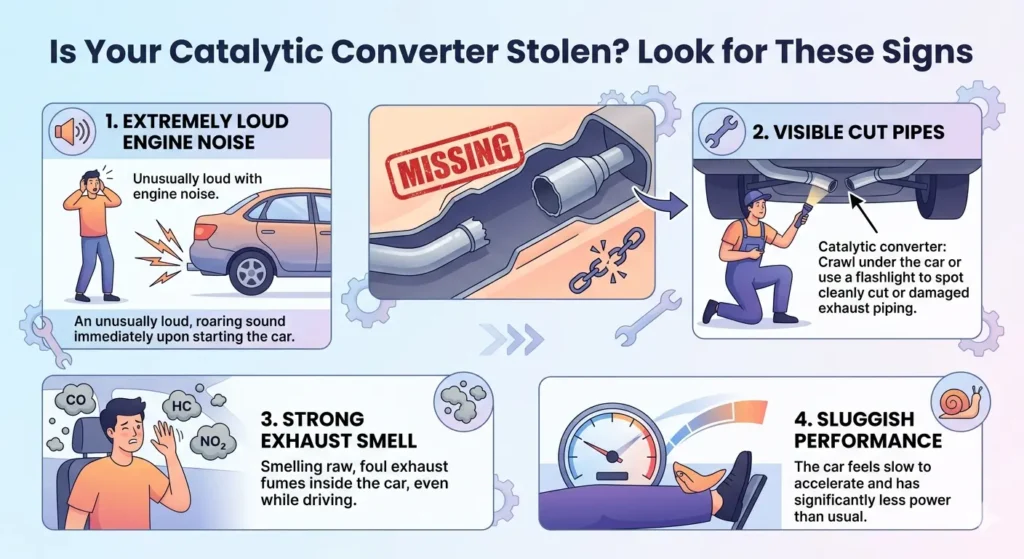
How to know if your catalytic converter is stolen is usually not a mystery for long. The signs appear the moment you start the engine. However, knowing exactly what to look and listen for helps you act quickly and avoid any further damage to your vehicle.
Warning Signs When You Start the Car
The most immediate and unmistakable sign is an extremely loud roaring or rumbling noise when the engine starts. Without the converter in place, exhaust gases exit the system without any muffling or filtration, producing a sound that is impossible to ignore. Beyond the noise, you may notice sluggish acceleration, a drop in engine power, and a strong sulfur-like or rotten egg smell coming from beneath the vehicle. The check engine light will almost certainly illuminate, and if your vehicle has an oxygen sensor tied to the converter, multiple fault codes may trigger simultaneously.
How to Visually Confirm the Theft
How to tell if someone stole your catalytic converter visually is straightforward. Look underneath your vehicle near the midpoint of the exhaust system, between the engine and the muffler. If the converter has been stolen, you will see a clean cut on both sides of the exhaust pipe where the unit was removed. There will be a visible gap in the pipe, and in some cases, dangling wiring from oxygen sensors that were cut or torn away during the removal. If you are not comfortable looking underneath the vehicle yourself, any mechanic can confirm it in seconds.
How to Prevent Catalytic Converter Theft
How to prevent catalytic converter theft does not require a single expensive solution. The most effective approach combines multiple layers of deterrence that collectively make your vehicle a far less appealing target. Thieves are opportunists who prefer easy targets. Anything that adds time, noise, or visibility to the theft process dramatically reduces your risk.
Park Smart: Lighting, Location, and Garages
Where you park is the single most impactful variable in your theft risk. Parking inside a locked garage is the gold standard of catalytic converter protection. If a garage is not available, choose well-lit areas with high foot traffic and visible security cameras. Avoid isolated corners of parking lots or quiet side streets overnight. When parking on the street, position your vehicle close to other cars, curbs, or objects that make it physically harder for someone to slide underneath. Motion-activated security lights near your driveway are a low-cost upgrade that discourages nighttime theft significantly.
Install an Anti-Theft Shield, Cage, or Clamp
Physical barriers are among the most effective ways to protect your catalytic converter. Products like the CatShield and CatClamp are purpose-built devices made from hardened stainless steel that either bolt over the converter or encase it in a cable cage. These do not make theft impossible, but they force a thief to spend additional time with power tools that create significant noise. Most thieves will move on to an easier target rather than risk the attention. Anti-theft shields typically cost between $150 and $500 depending on the vehicle make and model. Some mechanics can also fabricate custom welded steel cages directly around the converter for similar effect. Always choose steel over aluminum as aluminum is significantly easier to cut through.
Etch Your VIN on the Converter
VIN etching is a simple and inexpensive deterrent that makes your converter far harder to sell. When a converter carries a clearly etched Vehicle Identification Number, scrap dealers and recyclers can identify it as stolen, which eliminates the thief’s ability to convert it to cash. Many police departments, auto repair shops, and dealerships offer free or low-cost VIN etching events. Some states have passed laws requiring scrap dealers to record VIN information before purchasing any converter, which has increased the value of this measure significantly. Spray the etched area with bright orange or yellow heat-resistant paint to make it even more visible.
Use a Car Alarm with a Vibration Sensor
Standard car alarms that trigger only when a door or window is disturbed offer minimal protection against catalytic converter theft because the thief never touches the car body. Upgrading to an alarm system with a vibration or tilt sensor adds a meaningful layer of protection. These sensors detect the motion and vibration of cutting tools being used on the undercarriage and trigger the alarm before the theft is complete. The sudden, loud alarm in a public space is often enough to send a thief running. If you already have an alarm, check whether it has adjustable sensitivity settings, as turning the sensitivity up can help it respond to undercarriage activity.
Paint the Converter Bright Orange
High-heat resistant paint applied directly to your catalytic converter serves two purposes. It visually signals to any scrap dealer that the converter is marked, which reduces its resale value and makes thieves less likely to bother. It also helps law enforcement identify and return stolen units. This method is inexpensive and pairs well with VIN etching for maximum deterrence. Many local auto repair shops offer this service, and some community theft prevention programs provide it for free.
GPS Tracking Devices
While a GPS tracker will not physically prevent theft from occurring, it dramatically improves the odds of recovering your vehicle or identifying the thieves after the fact. Small magnetic GPS devices placed in or near the exhaust area can give law enforcement real-time location data. Some tracker systems send instant mobile alerts when the vehicle is tampered with or moved unexpectedly. This is particularly useful for fleet owners, commercial vehicle operators, and anyone who parks in high-risk areas regularly.
Anti-Theft Protection Methods Compared
|
Method |
Estimated Cost |
Effectiveness |
Difficulty to Install |
|---|---|---|---|
|
|
|
Highest |
None |
|
|
|
|
Moderate (professional install recommended) |
|
|
|
Very High |
Professional only |
|
|
|
High |
Easy |
|
|
$50 to $200 |
High |
Moderate |
|
|
|
|
Easy |
|
|
|
Moderate (recovery tool) |
Easy |
|
|
|
Low (evidence only) |
Easy |
My Catalytic Converter Was Stolen. Can I Drive?
Technically, yes, in the very short term. Your engine will still start and the car will move. However, driving without a catalytic converter is not advisable for several important reasons.
First, the noise level is extreme. Your exhaust system will produce a roar loud enough to attract attention and, in many jurisdictions, loud enough to violate local noise or emissions ordinances, which can result in a citation. Second, without the converter managing exhaust backpressure, your engine’s performance and fuel economy will degrade noticeably. Third, the oxygen sensors that were connected to the converter may have been damaged during removal, which can cause the engine to run improperly and potentially cause additional harm over time. Fourth, and most critically, driving without a catalytic converter is illegal in most states because the vehicle no longer meets emissions standards. If you are pulled over or required to pass an emissions test, the missing converter will cause an immediate failure. Have the vehicle towed or drive only as far as necessary to reach a repair shop.
What to Do If Your Catalytic Converter Is Stolen
Knowing exactly what to do if your catalytic converter is stolen before it ever happens to you means you will respond quickly, document everything correctly, and give yourself the best chance of a smooth insurance claim.
Step 1: Do Not Drive the Vehicle
Resist the urge to drive unless absolutely necessary. The missing converter may have left sharp pipe ends and severed wiring underneath the vehicle. Driving can cause exhaust fumes to enter the cabin, damage adjacent exhaust components, and create additional repair costs that complicate your insurance claim. If you must move the vehicle, keep the distance as short as possible and drive at low speed.
Step 2: File a Police Report Immediately
Call your local non-emergency police line and report the theft. Provide your vehicle make, model, year, VIN, and the location where it was parked. The police report number is a document your insurance company will almost certainly require before processing your claim. It also contributes to local theft tracking data, which helps law enforcement identify patterns and target high-risk areas for increased patrols.
Step 3: Contact Your Insurance Company
Once you have the police report number, call your insurance provider and initiate a claim. Have your policy number, the police report number, and photographs of the damage ready. Your claims representative will walk you through the process and confirm what your policy covers. If you have comprehensive coverage, the theft and related repair costs are typically included, subject to your deductible.
Step 4: Get the Converter Replaced
Take the vehicle to a reputable mechanic or dealership for a full assessment. The theft may have damaged oxygen sensors, exhaust hangers, or adjacent pipe sections during removal. Get a complete itemized estimate that covers all related damage, not just the converter itself, as your insurance adjuster will need a full accounting of the repair scope.
Does Insurance Cover Catalytic Converter Theft?
Yes, the insurance does cover Catalytic Converter theft, but only if you carry comprehensive coverage on your auto insurance policy. Comprehensive coverage is the portion of your policy that protects against losses that are not caused by a collision, including theft, vandalism, fire, and weather damage. If your converter is stolen and you have comprehensive coverage, your insurer will typically pay for the replacement converter and any related repair work caused by its removal, minus your deductible.
Does car insurance cover catalytic converter theft if you only have liability coverage? No. Liability-only policies do not cover your own vehicle from theft of any kind. If you are unsure what coverage you carry, check your insurance declarations page or call your agent directly. Given that catalytic converter replacement costs average between $1,000 and $3,000, the value of carrying comprehensive coverage far outweighs its monthly premium cost for most vehicle owners.
One important note: if your deductible is $1,000 and the repair estimate is $1,100, filing a claim nets you only $100 while potentially raising your future premiums. Always compare your deductible against the total repair cost before deciding whether to file.
James Mitchell
Senior Automotive Writer
12+ years writing clear, practical guides on vehicle maintenance and emissions systems.