Comprehensive Guide on P0430 Code: Causes, Symptoms, Diagnosis & Fixation
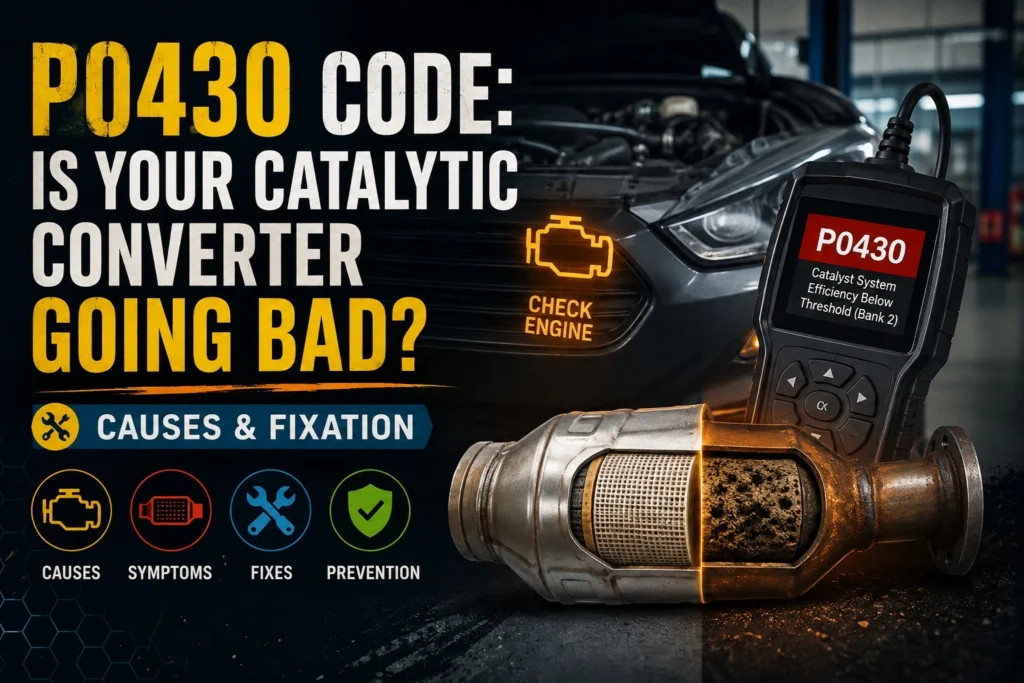
The p0430 code means your vehicle’s computer has detected that the catalytic converter on the Bank 2 side of the engine is no longer cleaning up exhaust gases as efficiently as it should. This is officially known as p0430 catalyst system efficiency below threshold bank 2, and it almost always points to a converter that has lost some of its ability to convert harmful gases, though sensor problems and exhaust leaks can trigger the same code. The fix depends entirely on what is actually causing the drop in efficiency, not just on replacing parts blindly.

James Mitchell
Senior Automotive Writer
12+ years writing clear, practical guides on vehicle maintenance and emissions systems.
What Triggers a P0430 Code and Why Bank 2 Matters
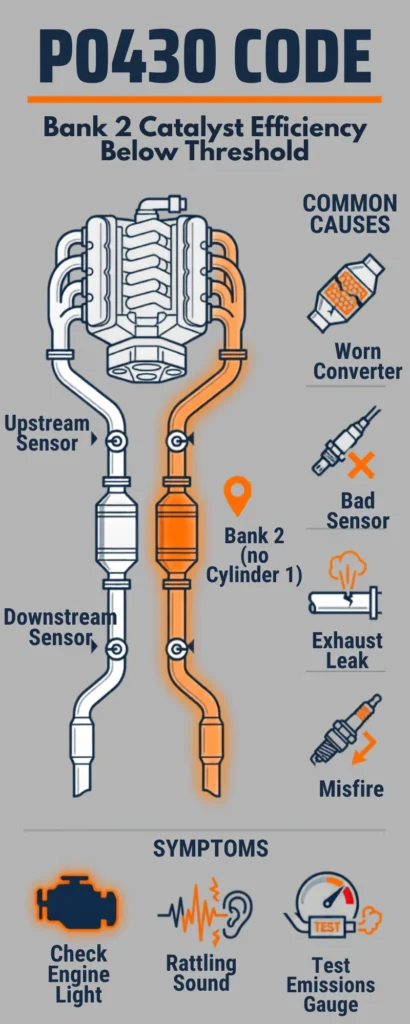
Dtc p0430 is a generic OBD-II trouble code, meaning it applies across nearly every gasoline vehicle built after 1996, regardless of manufacturer. The engine code p0430 specifically refers to Bank 2, which is the side of the engine that does not contain the number one cylinder. On a four cylinder engine there is usually only one bank, so this code will not apply. On V6 and V8 engines, however, Bank 2 has its own dedicated catalytic converter, oxygen sensors, and exhaust path, completely separate from Bank 1.
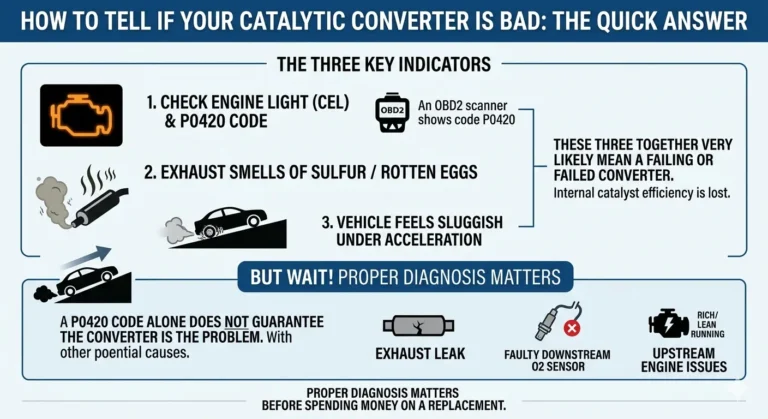
The p0430 code bank 2 location is downstream of the Bank 2 exhaust manifold, usually mounted close to where the manifold meets the rest of the exhaust system. The powertrain control module compares readings from the upstream oxygen sensor, positioned before the converter, against the downstream oxygen sensor, positioned after it. When the downstream sensor’s readings start to mirror the upstream sensor too closely, the computer concludes the converter is no longer scrubbing pollutants the way it should, and it sets the code.
Common Symptoms That Show Up Alongside the P0430 Code
Many drivers only find out about a p0430 engine code because the check engine light comes on, with no other noticeable change in how the car drives. That is actually one of the more frustrating parts of this code: a failing Bank 2 converter often does not cause rough running, stalling, or a dramatic loss of power in its early stages. Over time, though, secondary symptoms tend to develop as the converter degrades further or as a related component starts failing alongside it.
| Symptom | Likely Cause | Urgency |
|---|---|---|
| Check engine light only, car runs normally | Early stage catalyst efficiency drop or a lazy oxygen sensor | Low, but should be diagnosed within a few weeks |
| Sulfur or rotten egg smell from the exhaust | Converter overheating or partially clogged | Moderate, get it inspected soon |
| Reduced fuel economy over several fill ups | Converter no longer processing exhaust efficiently, forcing rich fuel trim | Moderate |
| Rattling noise from underneath the vehicle | Broken honeycomb substrate inside the converter | High, physical damage is present |
| Failed emissions or smog test | Converter efficiency has dropped below the legal threshold | High, required for registration in many states |
| Hesitation or slight power loss under acceleration | Partial exhaust restriction from converter clogging | Moderate to high depending on severity |
The Real Causes Behind a Bank 2 Catalyst Efficiency Failure
Code p0430 does not always mean the catalytic converter itself is bad. In a lot of cases the converter is a victim of something else going wrong upstream, and replacing it without fixing the root cause just results in the same code coming back within a few months. The most common causes fall into a handful of categories: a genuinely worn out converter, a failing oxygen sensor giving false readings, an exhaust leak upstream of the sensor, a misfire dumping unburned fuel into the exhaust, or an engine running rich for an unrelated reason.
I had a customer bring in a Nissan Maxima with a stubborn p0430 that kept returning after two converter replacements from a different shop. Turns out a small exhaust manifold leak near the Bank 2 upstream sensor was letting outside air skew its readings, making the converter look inefficient when it was actually fine. Once we sealed the leak and cleared the code, it never came back. It was a good reminder that the sensor data has to be trusted before parts get swapped.
A worn oxygen sensor is one of the most overlooked causes because it is far cheaper than a converter, and shops sometimes skip straight to the converter since that is what the code technically references. Contaminated fuel, using the wrong grade of oil, or towing heavy loads for extended periods can also accelerate converter wear on engines that would otherwise easily go 100,000 miles or more without an issue.
How to Properly Diagnose a P0430 Code Before Replacing Anything
Diagnosing eobd p0430 correctly starts with pulling live data, not just reading the code and moving straight to parts. A technician will typically check the freeze frame data captured when the code was set, compare upstream and downstream oxygen sensor voltage patterns on a scan tool, and physically inspect the Bank 2 exhaust manifold, gaskets, and converter housing for leaks, cracks, or rattling.
How to Check O2 Sensor Readings for P0430
The upstream sensor should show constant, rapid voltage fluctuation as it reacts to the engine’s fuel mixture. The downstream sensor should show a much flatter, slower moving signal if the converter is working properly. When both sensors show similar fluctuating patterns, that is the clearest sign the converter itself is not doing its job.
Checking for Exhaust Leaks Near the Sensor
A small leak in the exhaust manifold gasket or a cracked flex pipe near the upstream sensor can pull in outside air and throw off the readings entirely, mimicking a failed converter. This is quick to check with a smoke machine or simply by listening for a ticking or hissing sound at cold start.
How Much Does It Cost to Fix a P0430 Code?
Once the actual cause is confirmed, the fix for p0430 code bank 2 fix ranges widely depending on what is actually wrong. Replacing an oxygen sensor is the cheapest scenario, while a full catalytic converter replacement, especially on vehicles that require a factory or CARB compliant unit, sits at the higher end.
| Repair | Typical Parts and Labor Cost | Notes |
|---|---|---|
| Oxygen sensor replacement | $150 to $400 | Often resolves the code if the converter itself is healthy |
| Exhaust manifold gasket or leak repair | $120 to $350 | Cheaper on inline engines, more labor intensive on some V6 layouts |
| Aftermarket catalytic converter | $300 to $900 | Legal in most states but not California, New York, or a few others |
| CARB compliant or OEM converter | $700 to $2,200 | Required in emissions strict states, price varies heavily by vehicle |
| Misfire related repair, coils or plugs | $150 to $600 | Fixing the misfire prevents repeat converter damage |
| Full exhaust system inspection and repair | $100 to $250 for diagnosis alone | Recommended before any converter purchase |
P0430 Code by Vehicle Brand: Toyota, Honda, Nissan & Dodge
While the underlying code definition is the same across manufacturers, certain brands see this code more often for specific, predictable reasons. P0430 toyota owners frequently see this code on V6 models like the Camry and Highlander, often tied to converter age rather than a defect, since these vehicles are known for high mileage longevity that eventually outlasts the factory converter’s efficiency.
P0430 honda cases are common on V6 Accords, Odysseys, and Pilots, and are frequently traced back to a failing downstream oxygen sensor rather than the converter itself. P0430 nissan tends to show up on the Maxima, Altima, and Pathfinder, sometimes linked to exhaust manifold gasket leaks as described earlier. P0430 dodge appears often on Ram trucks and the Durango, where towing and heavy load use accelerates converter wear over time compared to lighter duty driving.
James Mitchell
Senior Automotive Writer
12+ years writing clear, practical guides on vehicle maintenance and emissions systems.
Frequently Asked Questions
Conclusion:
Once a converter has been replaced or a sensor issue resolved, a few habits help prevent the p0430 code from returning. Using the correct fuel octane for the vehicle, addressing misfires immediately instead of driving on them, and avoiding excessive idling with a check engine light already on all reduce unnecessary strain on the converter. Regular oil changes with the correct oil also matter more than most drivers realize, since oil that burns off and enters the exhaust stream can coat and damage the converter’s internal substrate over time.