Detailed Guide on P0430 Code on a Chevy: Causes, Fixes & Repair Cost
A p0430 ford code means the powertrain control module has detected that the Bank 2 catalytic converter is not cleaning up exhaust gases efficiently enough, but on Ford vehicles this code is frequently caused by a failing oxygen sensor, a loose exhaust connection, or a software calibration issue rather than a genuinely dead converter. Ford’s V6 and V8 engines are known for triggering this code more often than some competing brands, which means jumping straight to a converter replacement is usually the wrong first move. Confirming the actual cause first can save several hundred dollars.

James Mitchell
Senior Automotive Writer
12+ years writing clear, practical guides on vehicle maintenance and emissions systems.
What the P0430 Chevy Code Means on Bank 2
P0430 is an OBD II catalyst efficiency fault for Bank 2. The powertrain control module compares oxygen sensor signals before and after the converter. A healthy converter stores and releases oxygen, so the downstream sensor normally reacts more slowly. When its pattern begins to resemble the upstream pattern enough to cross the programmed threshold, the computer can set P0430.
On Chevrolet engines with two cylinder banks, Bank 2 is opposite Bank 1. Its physical side varies by engine and vehicle layout, so confirm cylinder numbering and converter location for the exact year, engine, and model before ordering parts. Not driving a Chevy? The Bank 1 equivalent is covered in our P0420 code guide, and Ford owners can read the P0430 code on a Ford article
Common symptoms you may notice
Many vehicles with a p0430 code chevy fault still drive normally. The most common sign is a steady check engine light, sometimes with no obvious loss of power. If the converter is physically restricted or the engine problem that damaged it is still active, the driver may also notice sluggish acceleration, reduced fuel economy, a sulfur like exhaust odor, excessive heat under the vehicle, or additional misfire and fuel trim codes.
| What you notice | What it can suggest | Priority |
|---|---|---|
| Check engine light with normal driving | Converter efficiency has fallen, but flow may still be adequate | Diagnose soon |
| P0430 plus a misfire code | Unburned fuel may be overheating or damaging the converter | Repair misfire first |
| Rattle from the converter area | Internal catalyst substrate may be broken | Inspect promptly |
| Weak acceleration at higher engine speed | Converter may be restricted or another airflow problem may exist | Test exhaust restriction |
| Exhaust ticking or soot near Bank 2 | Leak may be affecting oxygen sensor readings | Repair leak before condemning converter |
Most Common Causes of P0430 Chevy
The catalytic converter is often the final failure on a higher mileage vehicle, but it should not automatically be the first part replaced. Efficiency can fall with age, contamination, overheating, or physical damage. Another engine problem can also ruin a converter, so replacing it without correcting the root cause can lead to another failure.
A worn or contaminated catalytic converter
A converter can lose oxygen storage capacity as its internal coating degrades. Coolant contamination, heavy oil burning, prolonged rich operation, and repeated misfires can also coat or overheat the catalyst material. If Bank 2 sensor data shows the downstream sensor closely following the upstream sensor after the engine is fully warm, and no leak or engine fault is present, converter deterioration becomes much more likely.
Oxygen sensor problems and exhaust leaks
A lazy or damaged downstream oxygen sensor can misreport converter performance. Wiring faults can do the same. An exhaust leak near the Bank 2 sensors can also distort readings by pulling outside air into the system. Check for soot marks, ticking noises, damaged fasteners, and leaking gaskets before ordering an expensive converter.
Misfires, fuel control problems, and oil consumption
Ignition misfires, leaking injectors, incorrect fuel pressure, intake leaks, and heavy oil consumption can change exhaust chemistry and converter temperature. Repair those problems first.
| Mechanic example: A Silverado came into the shop with P0430 and an owner who had already priced a passenger side converter. The truck drove well, so it would have been easy to blame the catalyst and move on. A cold start inspection showed a faint tick and a small soot trail near the Bank 2 exhaust connection. Once the leak was repaired, I cleared the code and watched the oxygen sensor data through a complete drive. The downstream signal settled down and the code did not return. That repair cost a fraction of a converter. The lesson is simple: prove the converter is bad before replacing it. |
How to Diagnose P0430 Code Chevy Correctly
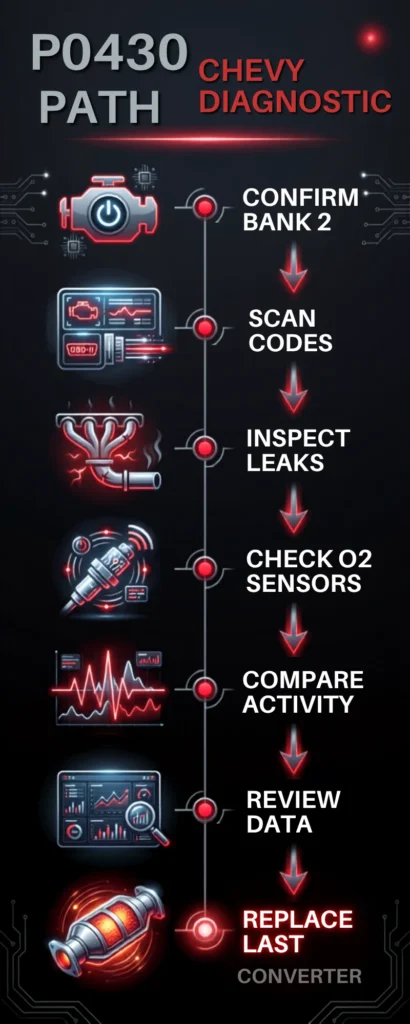
Start by scanning every stored and pending code, then review freeze frame information, fuel trims, and misfire counters. Active misfire, mixture, oxygen sensor, or temperature faults should be corrected before P0430 is used to justify a converter replacement.
Inspect the Bank 2 exhaust path for cracks, loose connections, damaged sensor wiring, and impact damage. With the engine fully warm, compare upstream and downstream oxygen sensor activity. A healthy downstream signal is normally steadier than the upstream signal. Exact limits vary by vehicle, so use service information for the final test.
Use test results to separate the likely causes
The goal is to match the code with physical evidence and scan data. A leak, abnormal fuel trim, weak sensor response, and a degraded converter should not be treated as the same failure.
P0430 Chevy Silverado: What to Check Before Buying a Converter
With a p0430 chevy silverado fault, verify Bank 2, check related codes, inspect for exhaust leaks, evaluate oxygen sensor behavior, and make sure the engine is not misfiring or burning enough oil to damage the catalyst. On a truck with an ignition problem history, that history matters as much as the stored code.
If P0430 appears soon after a converter replacement, do not assume the new part has failed. General Motors service information notes that a fresh converter may need a proper break in drive before catalyst efficiency diagnostics settle. Repair history should therefore be part of the diagnosis.
Silverado pricing can be much higher than a passenger car estimate because some configurations use larger or integrated pipe and catalyst assemblies. Verify the engine, emissions certification, and required converter before comparing prices.
Repair Options and P0430 Chevy Repair Cost
The p0430 chevy repair cost depends on the confirmed failure, not the code alone. Paying for proper diagnosis can prevent an expensive guessing exercise. The ranges below are realistic planning figures for United States repair shops, but labor rates, engine layout, part quality, and emissions requirements can move the final invoice substantially.
Typical repair cost ranges
Converter prices vary the most. A smaller Chevrolet car or crossover may use a less expensive direct fit unit, while a p0430 chevy silverado repair involving an original equipment exhaust assembly can reach several thousand dollars. Before approving the repair, ask whether the quoted part meets the emissions requirements for your vehicle and whether the shop has confirmed the engine is not damaging the new converter.
| Repair or service | Typical installed range | When it makes sense |
|---|---|---|
| Diagnostic scan and testing | $100 to $250 | Best first step when the cause is not proven |
| Minor exhaust leak repair | $150 to $500 | When a flange, gasket, weld, or connection leaks near Bank 2 |
| Oxygen sensor replacement | $250 to $550 | When testing confirms a sensor or circuit problem |
| Ignition or misfire repair | $150 to $900 or more | When plugs, coils, injectors, or related faults are causing misfire |
| Catalytic converter on many Chevrolet cars and crossovers | $800 to $2,500 or more | When converter efficiency is confirmed and a compliant part is available |
| Silverado or large SUV converter assembly | $1,500 to $4,000 or more | When the configuration uses larger or integrated original equipment style assemblies |
Can You Drive With P0430 on a Chevy and Prevent It From Returning
A steady check engine light with only P0430 usually does not require immediate parking, but the fault should be diagnosed soon. Stop driving if the light flashes, the engine misfires badly, power drops sharply, the converter glows, or severe heat or odor appears. A flashing light can indicate a misfire that may damage the converter quickly.
Protect the converter by fixing misfires quickly, correcting rich fuel operation, repairing exhaust leaks, and addressing heavy oil or coolant consumption.
Before paying for a converter on a newer vehicle, check warranty coverage. Federal emissions rules generally cover specified major emissions components, including catalytic converters, for 8 years or 80,000 miles, whichever comes first, on eligible light duty vehicles. Confirm coverage for the exact vehicle before authorizing repair.
James Mitchell
Senior Automotive Writer
12+ years writing clear, practical guides on vehicle maintenance and emissions systems.
Frequently Asked Questions
Conclusion:
A p0430 chevy code should be treated as a diagnosis problem, not an automatic converter replacement. Confirm Bank 2, scan for related faults, inspect the exhaust, review fuel trims and misfires, and compare oxygen sensor behavior before approving expensive parts. If the converter is truly worn, replace it with the correct emissions compliant unit and correct any engine issue that may have damaged it. That approach gives the repair the best chance of lasting.

One Comment