P0420 Code Nissan: Causes, Fixes & Replacement Cost
The p0420 code Nissan owners see is a catalyst system efficiency fault on Bank 1, and in plain terms it means your vehicle’s onboard computer has determined the catalytic converter is not cleaning exhaust gases as well as it should. This does not automatically mean the converter is dead. In many cases, a faulty oxygen sensor, a small exhaust leak, or a previous engine misfire is the real culprit. Before spending money on a new converter, you need to diagnose this code properly, because the repair cost difference between a bad O2 sensor and a failed catalytic converter is measured in hundreds of dollars.

James Mitchell
Senior Automotive Writer
12+ years writing clear, practical guides on vehicle maintenance and emissions systems.
What the Nissan P0420 Code Means
How Your Nissan Monitors Catalyst Efficiency
Your Nissan uses two oxygen sensors on the engine’s Bank 1 side: one upstream, positioned before the catalytic converter in the exhaust stream, and one downstream, positioned after it. The upstream sensor monitors the raw exhaust coming out of the engine. The downstream sensor monitors what exits the converter. When the converter is working correctly, the downstream O2 sensor should show a much steadier voltage signal than the upstream sensor, because the converter has already processed most of the harmful gases. When that downstream signal starts to look too similar to the upstream signal, oscillating more than it should, your Nissan’s ECM (engine control module) flags a p0420 code nissan and turns on the check engine light.
Bank 1: Which Side Does It Refer To?
The term p0420 bank 1 nissan refers specifically to the bank of cylinders that contains cylinder number one. On four-cylinder Nissan engines (like those found in the Versa, Sentra, and most Altima trims), there is only one bank, so Bank 1 is the only bank to worry about. On V6 engines such as those in the Maxima, Murano, or Frontier, Bank 1 is typically the front bank of cylinders. If you own a V6 and see a P0430 code alongside or instead of P0420, that refers to Bank 2 and means the other converter may also be affected.
Every Possible Cause of a P0420 on a Nissan
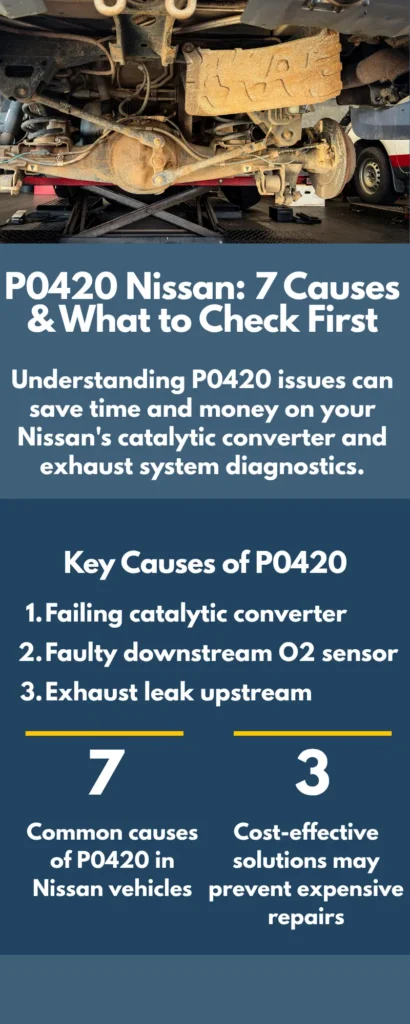
The Catalytic Converter Itself
The converter is the most obvious suspect when the p0420 code nissan appears, but it should not be the first part you replace without ruling out other causes. Converters fail for a reason: they get poisoned by oil or coolant leaking into the combustion chamber, they get overloaded by prolonged misfires that dump raw fuel into the exhaust, or they simply wear out after high mileage. A converter that has physically deteriorated, either with cracked or melted substrate inside, will consistently fail the efficiency test and needs to be replaced. One that has been contaminated by an underlying engine problem may fail again shortly after replacement if that root cause is not fixed first.
The Downstream Oxygen Sensor
The downstream O2 sensor (Bank 1, Sensor 2) is responsible for reporting the converter’s output to the ECM. If this sensor is lazy, slow to respond, or reading incorrectly due to age or contamination, it can mimic the pattern of a failing converter and trigger the dtc p0420 nissan fault. This is one of the most common misdiagnoses for this code. An O2 sensor replacement costs a fraction of a catalytic converter, so it is worth testing the sensor carefully with live data before assuming the converter is at fault.
Exhaust Leaks and Engine Problems
An exhaust leak located between the upstream O2 sensor and the catalytic converter allows outside air to enter the exhaust stream, which skews the readings the ECM relies on to judge converter efficiency. This can trigger the p0420 code nissan even on a perfectly healthy converter. Similarly, engine misfires that allow unburned fuel into the exhaust can overheat and damage the converter. Oil consumption or a leaking head gasket that allows coolant into the combustion chamber are known to poison the catalytic substrate over time.
The table below summarizes the most common causes alongside their associated symptoms and most likely fixes:
|
Cause of P0420 on Cause |
Symptoms |
Likely Fix |
|---|---|---|
|
Failing catalytic converter |
Check engine light, failed emissions |
Replace catalytic converter |
|
Faulty downstream O2 sensor |
Poor fuel economy, rough idle |
Replace O2 sensor (Bank 1, Sensor 2) |
|
Exhaust leak near sensor |
Ticking noise, inaccurate readings |
Repair exhaust leak first |
|
Engine misfires (prolonged) |
Rough running, rich exhaust smell |
Fix misfires, inspect converter |
|
Oil or coolant burning |
Blue/white smoke, sweet exhaust smell |
Fix source leak; converter may need replacement |
|
Contaminated fuel (leaded or rich mixture) |
Sulfur smell, sluggish acceleration |
Fix fueling issue; replace converter if damaged |
How to Diagnose a P0420 Code on a Nissan the Right Way
Start with a Full Code Scan, Not Just P0420
When diagnosing the p0420 code nissan, resist the temptation to read only that one code and immediately price a catalytic converter. Pull all stored and pending codes first. If you see misfires (P030X codes), lean or rich conditions (P0171, P0172), or oxygen sensor circuit faults (P0136, P0141), those problems must be addressed before the converter can pass the efficiency test. The P0420 is often the final symptom of an upstream problem that has been quietly damaging the converter for miles.
Reading Live O2 Sensor Data
A quality OBD-II scan tool that shows live data is essential here. With the engine warmed up and at highway speed, watch both O2 sensors on Bank 1. The upstream sensor should switch voltage rapidly between roughly 0.1 and 0.9 volts. The downstream sensor should hold a relatively steady voltage in the 0.6 to 0.8 volt range. If the downstream sensor is also switching rapidly and mimicking the upstream pattern, the converter is genuinely not doing its job. If the downstream sensor signal looks abnormal, sluggish, or stuck, the sensor itself is the more likely culprit behind the dtc p0420 nissan.
A Real-World Example That Saves You Money
A customer once brought in a Nissan Altima with 87,000 miles, convinced she needed a new catalytic converter after a shop quoted her nearly $900 for the job. Before touching anything, I pulled live O2 sensor data at highway speeds. The downstream sensor was barely moving at all, which is not what a dead converter looks like. A genuinely failed converter makes the downstream sensor oscillate like the upstream one. A stuck downstream sensor does not. Forty-five minutes and a $95 O2 sensor later, the car passed its emissions test without issue. Always read the data before you replace the part.
Use the following step-by-step diagnostic process to work through the code systematically:
|
Step |
Action |
Tool Needed |
|---|---|---|
|
1 |
Scan all stored and pending codes with OBD-II scanner |
OBD-II scan tool |
|
2 |
Check for exhaust leaks upstream and downstream of the converter |
Visual / smoke test |
|
3 |
Test downstream O2 sensor live data; verify it oscillates less than upstream |
Scan tool with live data |
|
4 |
Inspect for misfires or engine issues that could overheat the converter |
OBD-II scan tool |
|
5 |
Check for oil or coolant consumption that could poison the converter |
Visual inspection |
|
6 |
Perform converter temperature test (inlet vs outlet temp differential) |
Infrared thermometer |
|
7 |
Replace faulty components and clear codes; retest after 1 full drive cycle |
OBD-II scanner |
P0420 Nissan Rogue: Model-Specific Notes Worth Knowing
The p0420 nissan rogue is one of the most commonly reported instances of this code in online forums, largely because the Rogue is one of Nissan’s highest-volume sellers. The 2.5L QR25DE and later 2.0L MR20DD engines in the Rogue are generally reliable, but the downstream O2 sensor on these platforms is a known weak point after 80,000 to 100,000 miles. Rogue owners should also check for the CVT fluid cooler leaking internally and contaminating coolant, which can eventually lead to coolant entering the combustion chamber and poisoning the converter if left unaddressed. This is a separate issue from the P0420 itself, but it is worth inspecting on higher-mileage Rogues while you are diagnosing.
Nissan Versa Code P0420: Why This Model Pops the Code Early
The nissan versa code p0420 tends to appear earlier in vehicle life than on larger Nissan models, and there is a simple reason: the Versa’s small-displacement engine (1.6L HR16DE in most trims) runs a smaller catalytic converter that has less thermal mass. That means it reaches operating temperature quickly but also heats up more aggressively under hard driving. Prolonged city driving, frequent short trips, and any tendency for the engine to run slightly rich can shorten converter life on this model. If you own a Versa and are seeing this code before 80,000 miles, check for rich fuel trim conditions and confirm there are no misfires in the history before replacing the converter.
What It Costs to Fix a P0420 Code on a Nissan
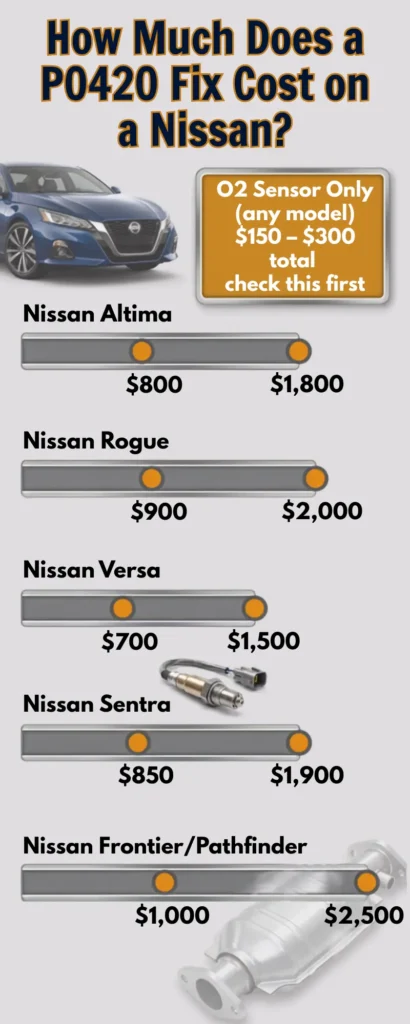
The actual repair cost for the p0420 code Nissan depends heavily on what the diagnostic process reveals. If the problem is a faulty downstream O2 sensor, you are typically looking at $80 to $200 in parts, plus an hour of labor. If the catalytic converter is genuinely worn out, costs rise significantly depending on whether you choose an OEM part, a direct-fit aftermarket converter, or a universal unit that requires welding. Note that in states with stricter emissions laws, particularly California and states that follow CARB standards, you may be required to use a CARB-compliant converter, which typically costs more than standard federal-spec aftermarket units. Here is a realistic cost range by Nissan model and repair type:
|
Nissan Model |
OEM Converter Cost |
Labor Cost |
Total Estimate |
|---|---|---|---|
|
Nissan Altima |
$350 – $600 |
$150 – $300 |
$500 – $900 |
|
Nissan Rogue |
$400 – $700 |
$150 – $300 |
$550 – $1,000 |
|
Nissan Versa |
$250 – $500 |
$100 – $200 |
$350 – $700 |
|
Nissan Sentra |
$300 – $550 |
$150 – $250 |
$450 – $800 |
|
Nissan Frontier / Pathfinder |
$450 – $800 |
$200 – $400 |
$650 – $1,200 |
|
Aftermarket (any model) |
$100 – $350 |
$100 – $300 |
$200 – $650 |
If you choose to use an aftermarket converter to save money, select a direct-fit unit from a reputable brand rather than a cheap universal fit. A universal converter requires cutting and welding the exhaust pipes, and a poor weld introduces the exact type of exhaust leak that can cause a false p0420 code nissan to return shortly after the repair.
Can You Drive with a P0420 Code and When Should You Act?
The short answer is yes, technically you can drive with a p0420 code nissan active, because this code does not typically affect drivability in any immediate or dangerous way. Your engine will continue to run, your fuel economy may suffer slightly, and you will not pass an emissions test while the code is stored. However, ignoring it is not a great long-term strategy. If the underlying cause is an engine misfire or oil burning that has not yet destroyed the converter, driving further with those conditions will accelerate the damage. And if your state requires a clean emissions test for annual registration, you will eventually be forced to address it.
One common mistake is clearing the code and hoping it does not come back before an emissions test. Most emissions inspection systems check for recently cleared codes, and a vehicle that shows a cleared code history with insufficient drive cycles since the clear will fail the readiness check. The monitors need to complete a full drive cycle before they report ready.
James Mitchell
Senior Automotive Writer
12+ years writing clear, practical guides on vehicle maintenance and emissions systems.
Frequently Asked Questions
Conclusion:
The p0420 code nissan is one of the most misdiagnosed trouble codes in automotive repair, and replacing the catalytic converter without proper diagnosis is how people spend $700 on a fix that a $100 O2 sensor would have solved. Pull all active codes, read live sensor data, check for exhaust leaks and engine problems, and only then commit to a part. Whether you drive a Rogue, Versa, Altima, or anything else in the Nissan lineup, a systematic approach to this code saves time, money, and frustration.

One Comment