How Much Does a Catalytic Converter Cost?
Few repair estimates land on a driver’s desk with quite the same shock as the one for a catalytic converter. The numbers can look alarming at first glance, and without context they often are misunderstood. The reality is that there is no single answer to how much does a catalytic converter cost because the price is built from several overlapping variables that push the final figure in very different directions depending on the vehicle, the parts chosen, and where the work is done. A universal converter fitted to an older economy car at a muffler shop and a factory-original unit installed at a dealership on a luxury SUV sit at completely opposite ends of the cost spectrum, yet both fall under the same question.
This guide breaks down every variable that determines the total bill, provides real pricing data for the most common vehicles on the road today, explains the genuine trade-offs between OEM and aftermarket options, and shows you where the realistic opportunities to reduce cost exist without compromising quality or emissions compliance. If you want to know the detailed working of a Catalytic Converter, you can check our resources.

James Mitchell
Senior Automotive Writer
12+ years writing clear, practical guides on vehicle maintenance and emissions systems.
How Much Does a Catalytic Converter Cost? The Real Price Range
Understanding the Broad Range Before Getting Vehicle-Specific
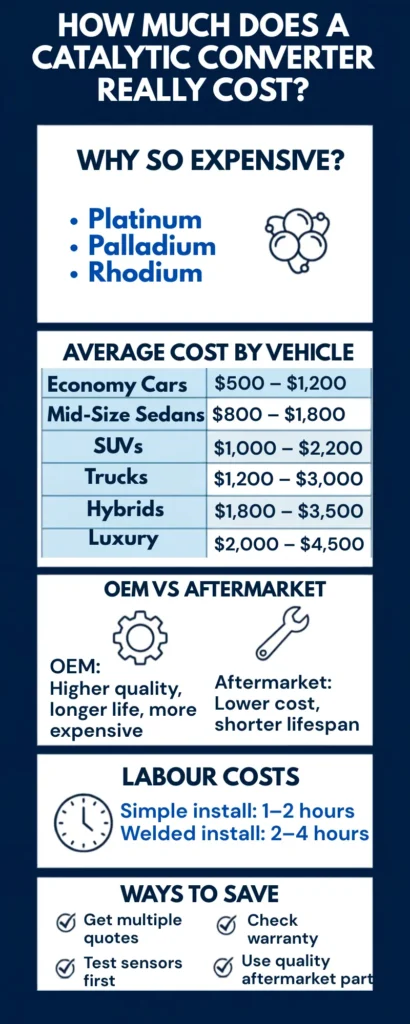
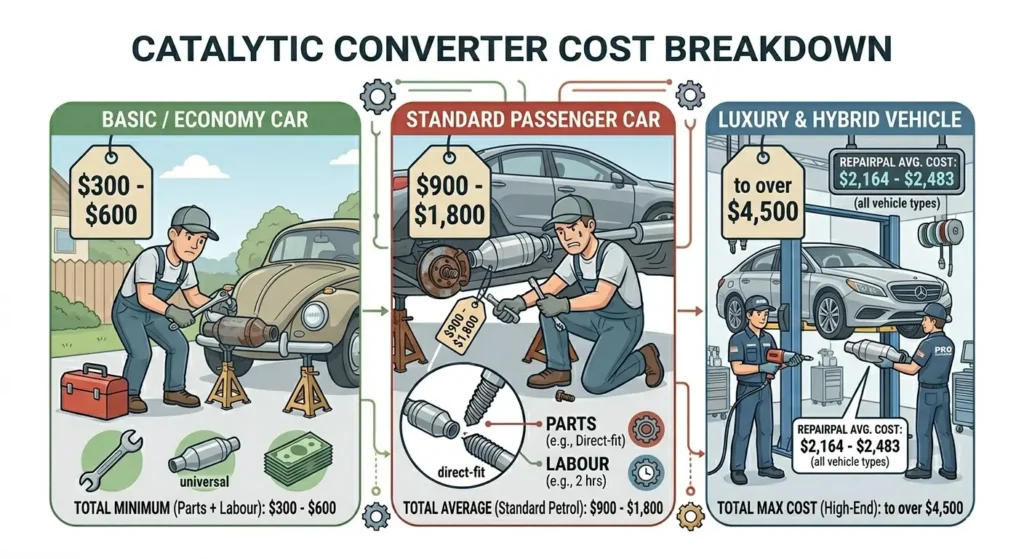
The honest answer spans a very wide range. Parts alone can run from as little as $80 for a basic universal converter on an older economy car to over $3,000 for a factory-original unit on a luxury or hybrid vehicle. When professional installation labour is added, the total replacement bill typically falls somewhere between $300 on the low end and $4,500 on the high end, with the majority of standard petrol passenger vehicles sitting between $900 and $2,500 for a complete repair at an independent shop.
According to RepairPal data, the average total catalytic converter cost for replacement including both parts and labour sits between $2,164 and $2,483 across all vehicle types. That average is pulled upward by hybrid and luxury vehicles. For the average non-hybrid sedan or crossover, a realistic total budget is $900 to $1,800 at most independent shops. The key to understanding where your vehicle sits in that range comes down to breaking the job into its component costs and evaluating each one separately.
How Much Is a Catalytic Converter in Parts Alone?
The part itself is where most of the cost lives. How much is a catalytic converter as a standalone part depends entirely on the type and grade of unit purchased. A budget universal converter for a small pre-OBD2 engine starts around $80. A mid-range aftermarket direct-fit unit for a common economy car such as a Honda Civic or Toyota Corolla runs between $200 and $450. A premium OEM-equivalent direct-fit unit for a mid-size family sedan or crossover falls in the $400 to $900 range. And an OEM or dealer-supplied unit for a hybrid or luxury vehicle can reach $1,500 to $3,000 or more for the part alone before a single hour of labour is charged.
The precious metals inside the converter, specifically platinum, palladium, and rhodium, are the primary driver of part cost. These metals are recovered during refining, and their spot prices on global commodity markets flow directly through to manufacturing costs. A vehicle that requires more precious metal loading to meet its emissions standard, such as a hybrid with an intermittently operating engine, will always carry a more expensive converter than a standard petrol vehicle that runs continuously at operating temperature.
|
Vehicle Category |
Part Cost (Aftermarket) |
Part Cost (OEM) |
Total Repair Estimate |
|---|---|---|---|
|
|
|
$400 to $700 |
|
|
|
|
|
|
|
|
|
$700 to $1,200 |
|
|
|
|
$800 to $1,500 per unit |
$1,200 to $3,000 |
|
Hybrid vehicle (e.g. Prius) |
$500 to $900 |
$1,200 to $2,500 |
$1,800 to $3,500 |
|
Luxury or European import |
$600 to $1,200 |
$1,500 to $3,000+ |
$2,000 to $4,500 |
How Much Does It Cost to Replace a Catalytic Converter? Labour Breakdown
What Labour Costs Are Included in the Replacement Bill?
The total answer to how much does it cost to replace a catalytic converter always includes both the part and the labour to install it. Labour costs at independent shops typically run between $70 and $130 per hour depending on geographic location and shop type. A straightforward direct-fit converter replacement on a modern vehicle with accessible, non-seized hardware usually takes one to two hours. At $100 per hour, that translates to $100 to $200 in labour on top of the part cost. Dealer labour rates run higher, often between $120 and $180 per hour, which is one of the reasons dealer quotes for the same job regularly come in $300 to $600 higher than independent shop quotes.
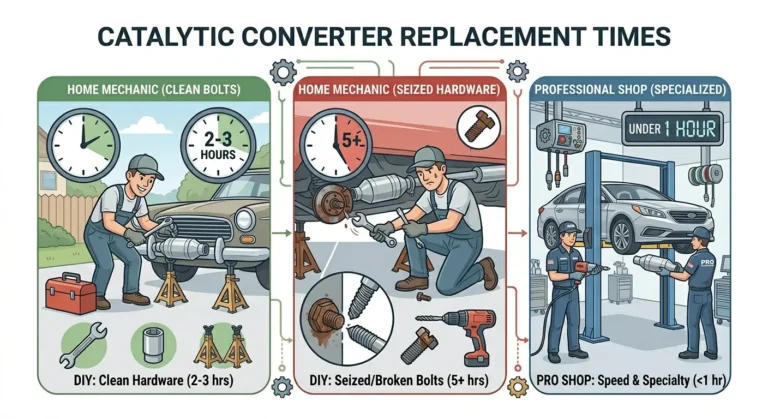
Labour costs escalate significantly in several situations. If exhaust hardware is badly corroded or seized, the time required to remove the old unit safely doubles or triples. If the converter is integrated with the exhaust manifold, requiring manifold removal, labour charges can exceed five hours on complex engine configurations. If the universal converter route is taken, the cutting, fitting, and welding process adds one to two hours compared to a bolt-on direct-fit installation. These are the scenarios that push the labour portion of the bill from $150 to $400 or more. If you want detailed guidelines for replacing a catalytic converter, you can check out our dedicated article.
How Much to Fix Catalytic Converter vs. Full Replacement?
Not every converter situation calls for full replacement. When people ask how much to fix catalytic converter issues, they often mean addressing a specific failure mode rather than swapping the entire unit. A converter that is mildly fouled from carbon buildup due to a rich-running engine may respond to a fuel-based cleaning treatment that costs $15 to $30 and avoids replacement entirely. A converter producing a P0420 code because of a failing downstream oxygen sensor rather than actual converter inefficiency requires a sensor replacement at $150 to $300, not a converter. These diagnostic steps should always precede a replacement decision because the savings potential is substantial.
Where physical replacement is genuinely required, the welded-in universal converter approach at a muffler shop is consistently the lowest-cost route for vehicles where that option is available. Many muffler shops can weld a universal converter into an older vehicle’s exhaust for a total bill of $250 to $400 for parts and labour combined, which is dramatically lower than a dealer quote for an OEM direct-fit unit on the same car. The trade-off is fitment precision, potential check engine light issues on OBD2 vehicles, and emissions compliance restrictions in CARB states.
How Much Does It Cost to Fix a Catalytic Converter at Different Shop Types?
Independent Mechanic vs. Dealership vs. Muffler Shop
Where you take the car is as important as what you buy. How much does it cost to fix a catalytic converter at three of the most common service options:
Independent mechanic:
For most non-warranty repairs, an independent shop offers the best balance of quality and price. They can source premium aftermarket direct-fit converters from suppliers like MagnaFlow or Eastern Catalytic, charge competitive labour rates, and have no incentive to steer you toward OEM pricing. Total bills at a reputable independent shop for a mid-size sedan typically run $700 to $1,500.
Franchised muffler shop (Midas, Meineke, Monro):
Muffler chains handle more converter replacements than almost any other shop type, giving their technicians specific expertise in exhaust work. They often have aggressive pricing on universal converters and can weld new units in quickly. Total bills typically run $300 to $900 for standard vehicles. The caveat is that universal converters are not appropriate for every application, particularly OBD2 vehicles in CARB-regulated states.
Dealership service department:
Dealerships use OEM parts and charge OEM labour rates. For a vehicle under the federal eight-year emissions warranty, this is the correct destination because the repair should be covered at no cost. For out-of-warranty vehicles, dealer quotes typically run $400 to $700 higher than an independent shop for the same repair. The OEM part quality is reliable, but the premium is meaningful on older vehicles where longevity expectations may not justify the extra cost.
How Much Is It to Replace a Catalytic Converter by Specific Model?
To give more actionable context on how much is it to replace a catalytic converter on specific vehicles, here are real-world estimates based on current market data:
|
Vehicle |
Aftermarket Total |
OEM Total |
Notes |
|---|---|---|---|
|
|
|
$2,200 to $3,500 |
|
|
|
|
|
|
|
|
|
$1,000 to $1,600 |
|
|
|
|
H$1,400 to $2,200 |
Dual converters; each must be assessed separately |
|
|
$700 to $1,200 |
$1,200 to $2,000 |
Dual converters on V8 configurations |
|
|
|
|
|
|
|
|
$1,200 to $2,000 |
|
|
Honda CR-V (2017 to 2022) |
$600 to $1,000 |
$1,000 to $1,600 |
Close-coupled manifold cat on newer models |
How Much Is a New Catalytic Converter? OEM vs. Aftermarket Cost Comparison
Why OEM Converters Cost More and When the Price Is Justified
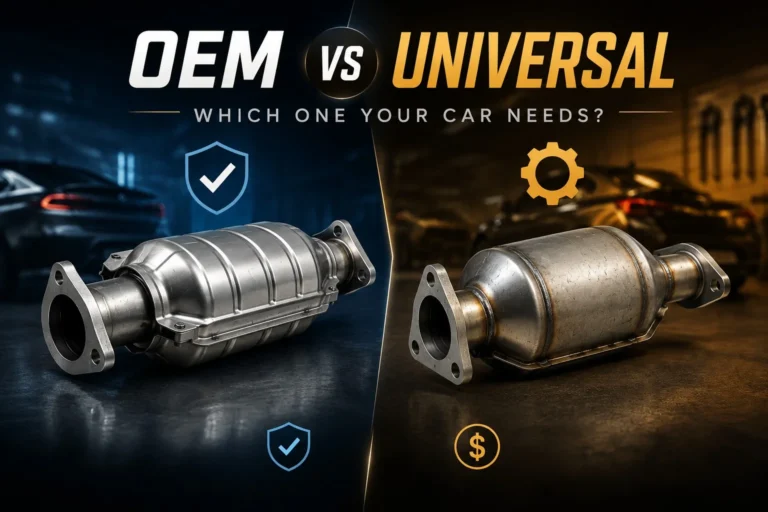
The gap between OEM and aftermarket pricing is real and substantial. How much is a new catalytic converter from the original manufacturer? For a Toyota Camry, an OEM unit from a Toyota dealer runs $800 to $1,200 for the part alone. A premium aftermarket equivalent from MagnaFlow or Walker runs $300 to $500. The OEM unit costs two to three times more. The reason is not merely brand markup. OEM converters are engineered to the exact precious metal loading, substrate configuration, and oxygen sensor interaction parameters the engine management system was calibrated around. They are tested to the vehicle’s specific OBD2 diagnostic thresholds and are less likely to produce borderline efficiency codes after installation.
The OEM premium is most clearly justified on newer vehicles still within or near the emissions warranty period, on vehicles with sensitive OBD2 systems known to trigger check engine lights from aftermarket converters, and on hybrid vehicles where the unique demands of intermittent combustion operation require precisely engineered catalyst loading. On a high-mileage vehicle where the owner expects to drive it for another two or three years, a quality aftermarket unit from a reputable brand is often the more sensible economic decision. The key word is quality. Choosing the cheapest aftermarket unit available is a false economy that frequently results in a check engine light returning within months and a second replacement bill.
How Much Does a New Catalytic Converter Cost for CARB vs. Federal Applications?
State emissions regulations add another layer to the cost equation. How much does a new catalytic converter cost in California, Colorado, or New York compared to other states? A CARB-approved converter for a given vehicle costs between 20 and 40 percent more than the equivalent EPA-compliant federal version. The price premium reflects the higher precious metal loading required to meet California’s more stringent emissions standards and the additional testing and certification costs manufacturers absorb to obtain CARB executive order approval. For a vehicle registered in a CARB state, paying this premium is not optional. Installing a federal-only converter in California is illegal and will result in a failed smog test regardless of how well the converter functions.
How Much Is a Catalytic Converter Replacement? Factors That Shift the Final Number
Engine Size, Configuration, and the Multi-Converter Variable
One of the most significant variables that inflates the real-world bill is the number of converters the vehicle carries. When the question is how much is a catalytic converter replacement on a V6 or V8 engine, the answer frequently involves two units rather than one, one for each exhaust bank. A V8 Ford F-150 with dual converters can require two direct-fit units totalling $1,000 to $1,800 in parts before a single hour of labour. Some hybrid configurations carry three converters, including a pre-catalyst close to the manifold and a main converter further back in the exhaust. Diagnosing and replacing only the failed unit rather than all of them requires proper fault code interpretation and oxygen sensor data analysis, which adds diagnostic time to the bill but prevents unnecessary expenditure on healthy components.
How Much to Replace Catalytic Converter When Hardware Is Seized?
In rust-belt states and coastal regions where road salt accelerates corrosion, the question of how much to replace catalytic converter gains an unpredictable variable: seized exhaust hardware. Exhaust bolts, studs, and flanges that have been baking in heat and corroding in moisture for years routinely refuse to release without a fight. When bolts snap during removal, extracting them adds significant labour time to the job. In extreme cases, a straightforward converter replacement becomes a half-day job when hardware complications are accounted for. Getting an estimate that includes a contingency for corroded hardware, or asking the shop to inspect the hardware condition before committing to a price, is particularly important on vehicles with over 100,000 miles in high-salt environments.
How Much for a Catalytic Converter When Oxygen Sensors Also Need Replacing?
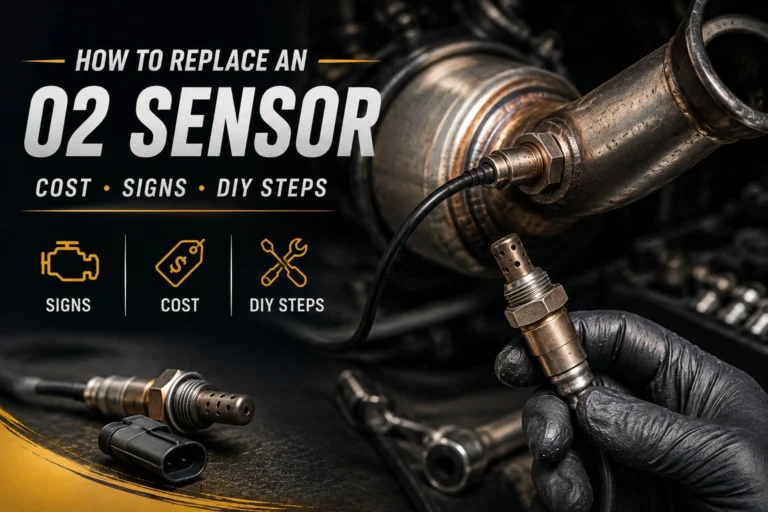
The question of how much for a catalytic converter often needs to include oxygen sensor costs to give a complete picture. Many experienced mechanics recommend replacing the upstream and downstream oxygen sensors at the same time as the converter, particularly when the vehicle has high mileage. The logic is sound: aged oxygen sensors with slow response times are often a contributing cause of the converter failure in the first place, and a new converter running on inaccurate sensor data from worn sensors will perform below its potential and may trigger efficiency codes prematurely. Upstream oxygen sensors cost $80 to $200 each. Downstream sensors run $60 to $150 each. On a vehicle with four sensors, adding sensor replacement to the converter job can increase the total bill by $300 to $600 but significantly reduces the risk of repeat failures.
How Much Does Catalytic Converter Cost to Fix? Smart Ways to Reduce the Bill
Steps to Take Before Authorising Any Replacement
Before accepting any quote, a few steps can either eliminate the replacement cost entirely or significantly reduce it. When considering how much does catalytic converter cost to fix, start here:
Confirm the fault code is genuinely converter-related.
P0430 and P0420 codes indicate converter inefficiency but are also triggered by failing oxygen sensors, exhaust leaks, and engine faults. Have the oxygen sensors tested before proceeding. Replacing a perfectly good converter because a $120 sensor was not tested first is an expensive and entirely avoidable mistake.
Try a quality cleaner treatment first if the substrate is intact.
For a converter that rattles or has confirmed physical damage, cleaning is not relevant. But for a converter producing borderline efficiency codes on a vehicle with no other symptoms, a fuel-based cleaner like Cataclean costs $20 to $30 and has resolved P0420 codes on many mildly fouled converters. It is always worth attempting before committing to a replacement.
Get at least three quotes before deciding.
Price variation between shops for the same converter job is substantial. An independent exhaust specialist, a general independent mechanic, and a dealer quote for the same vehicle and same OEM part frequently differ by $500 to $1,000 on a single job.
Check your federal emissions warranty status.
If your vehicle is within eight years and 80,000 miles of its original sale date, the converter replacement may be covered at no cost under the federal emissions warranty. Present the failure at the dealership service department before paying anyone else.
Consider the OEM vs. aftermarket trade-off honestly for your specific vehicle.
On a five-year-old vehicle you plan to keep for another decade, the OEM premium is often justifiable. On a twelve-year-old vehicle with 130,000 miles, a quality aftermarket unit from a reputable brand is a sound and cost-effective choice.
How Much Is It to Fix a Catalytic Converter? Repair vs. Replace Decision Guide
When Repair Is Viable and When Replacement Is the Only Answer
On a five-year-old vehicle you plan to keep for another decade, the OEM premium is often justifiable. On a twelve-year-old vehicle with 130,000 miles, a quality aftermarket unit from a reputable brand is a sound and cost-effective choice.
Category 1: Borderline efficiency code on an otherwise intact converter.
P0420 or P0430 with no other symptoms and no rattle. This is the best scenario. Confirm the oxygen sensors are healthy, try a cleaner treatment, and assess after a few drive cycles. Cleaning cost: $20 to $30. This category has a meaningful success rate and should always be attempted before moving to replacement.
Category 2: Fouled converter from an upstream engine fault.
Oil burning, coolant contamination, or a persistently rich mixture has coated the substrate. The converter may still have a recoverable function if the engine fault is addressed. Fix the root cause first, try a cleaning treatment, and reassess. If codes persist, replacement is necessary. Always confirm and resolve the upstream fault before installing a new converter or it will fail for the same reason.
Category 3: Physically failed converter.
Internal rattle from a broken substrate, visible collapse, melting, or physical damage from a road impact. No cleaning treatment addresses structural failure. Replacement is the only path forward. In this category, the question of how much is a catalytic converter replacement becomes the primary financial planning consideration.
James Mitchell
Senior Automotive Writer
12+ years writing clear, practical guides on vehicle maintenance and emissions systems.