Does Catalytic Converter Cleaner Work? Best Cleaners and How to Use Them
Yes, catalytic converter cleaner can work, but only if carbon buildup is reducing the converter’s efficiency. It won’t repair physical damage or restore a converter that’s been melted, cracked, or contaminated by excessive oil consumption. If your check engine light is showing a P0420 code and the converter is otherwise structurally sound, a quality catalytic converter cleaner run through a full tank of gas can restore enough efficiency to pass a test or clear the code. If the substrate is cracked, melted, or clogged with debris, no bottle from the parts store is going to bring it back.

James Mitchell
Senior Automotive Writer
12+ years writing clear, practical guides on vehicle maintenance and emissions systems.
What a Catalytic Converter Cleaner Actually Does Inside Your Exhaust
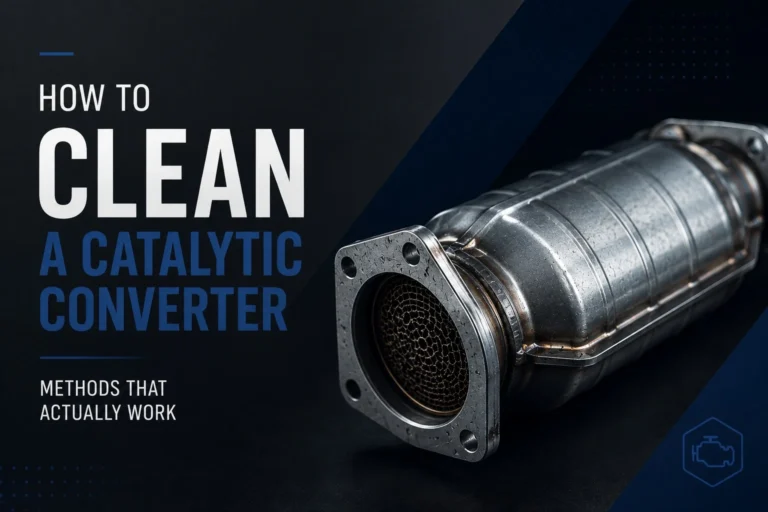
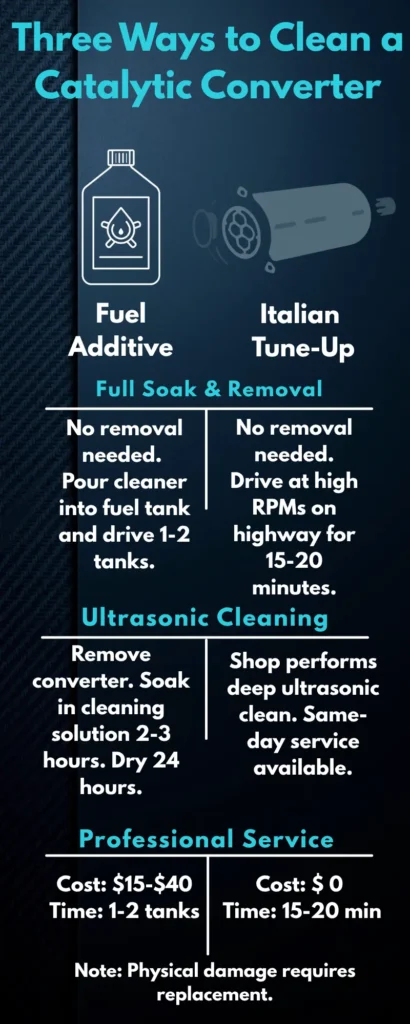
A catalytic converter cleaner is a fuel additive, usually poured directly into the gas tank, that’s designed to burn off carbon deposits and oil residue that have built up on the converter’s internal substrate. That substrate is a honeycomb structure coated with precious metals, typically platinum, palladium, and rhodium, that trigger the chemical reactions converting harmful exhaust gases into less harmful ones. When carbon and unburned fuel residue coat that surface, the metals can’t do their job as efficiently, and the converter’s ability to process exhaust gas drops.
Most catalytic converter cleaners contain detergents and combustion modifiers that help loosen carbon deposits as they pass through the fuel system and exhaust. The heat generated during normal driving then helps burn away some of those deposits. This isn’t a coating or a patch. It’s closer to running a strong solvent through a dirty filter and hoping the dirt breaks loose and flows out with the exhaust.
Limits of Catalytic Converter Cleaner
A cleaner cannot repair a cracked substrate, rebuild a converter that’s physically melted from running too hot, or clear out solid debris like broken pieces of a heat shield rattling around inside. It also won’t fix the root cause of why the converter got dirty in the first place. If you have a misfire dumping unburned fuel into the exhaust, or an oil leak from worn piston rings, the converter will just get fouled again within a few weeks of running the cleaner.
Does Catalytic Converter Cleaner Work for a P0420 Code?
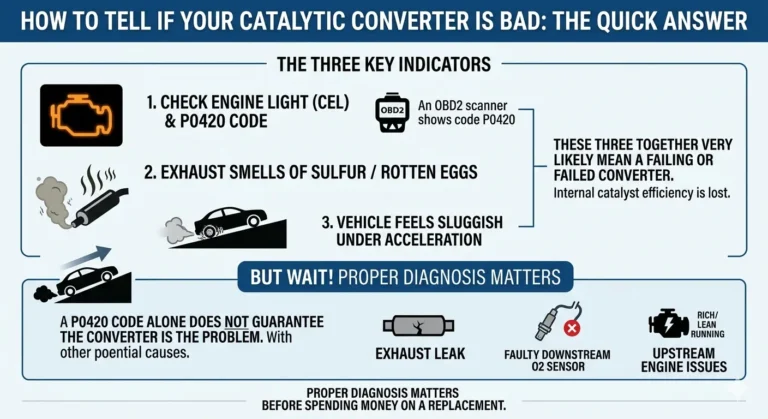
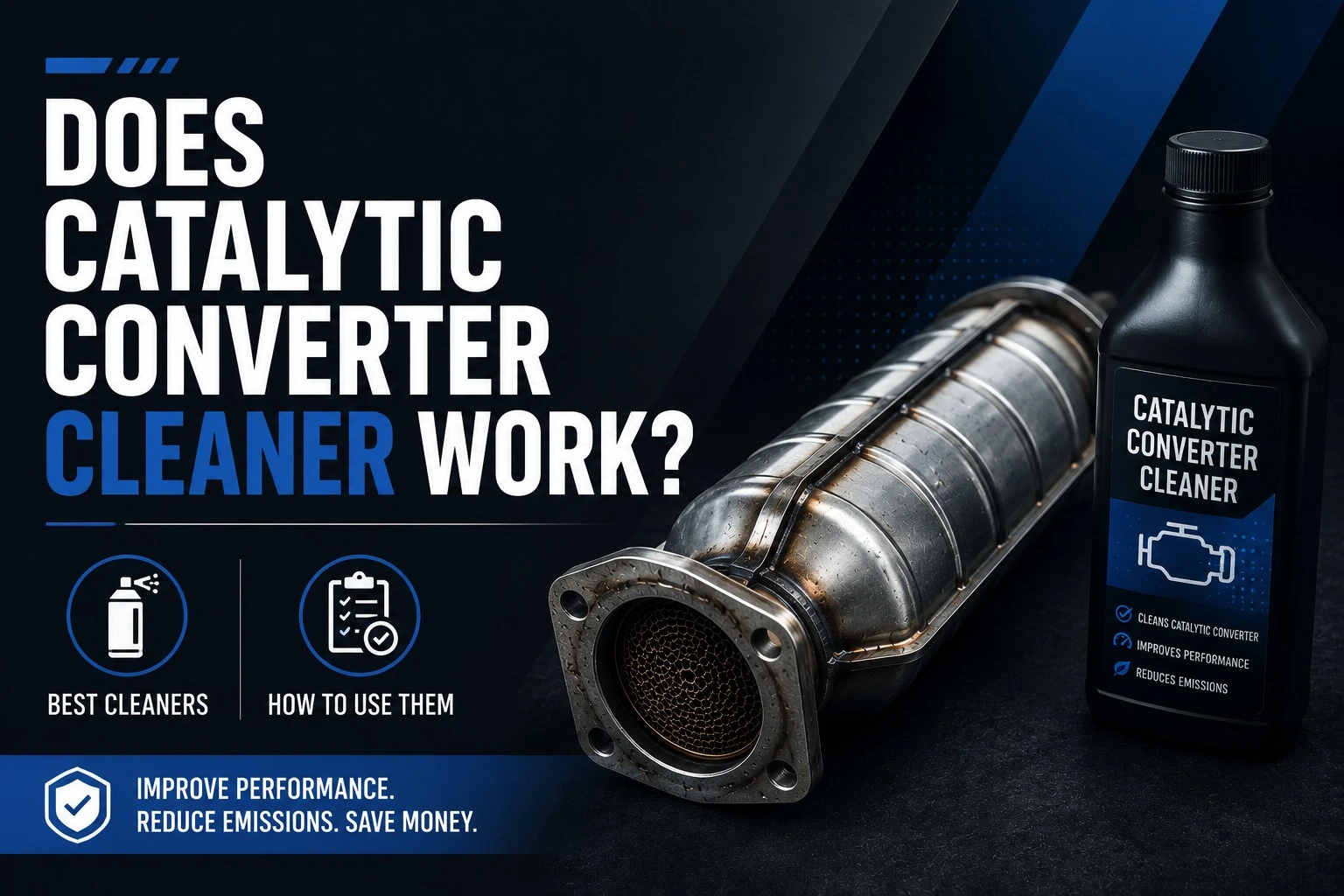
Catalytic converter cleaner can work for a P0420 code if the underlying issue is reduced catalyst efficiency caused by carbon fouling rather than physical failure. The P0420 code means your engine computer is seeing too small a difference between the readings from the upstream and downstream oxygen sensors, which it interprets as the converter not doing enough cleaning work.
In practice, a cleaner is most likely to work when the vehicle has relatively low mileage, the code appeared recently, and there are no signs of oil consumption or engine misfires. If the code has been on for months, the mileage is high, or you smell unburned fuel or notice rough idling, the odds drop significantly because you’re likely dealing with a converter that’s already past the point of cleaning.
How to Use Catalytic Converter Cleaner the Right Way
Correct usage of catalytic converter cleaner matters as much as picking a good product. Using a catalytic converter cleaner correctly is just as important as choosing the right product. For the best results, start with a nearly empty fuel tank, follow the manufacturer’s instructions, and take the vehicle on a sustained highway drive to fully heat the exhaust system. Skipping any of those three steps is the most common reason people say the product “didn’t work.”
- Clear the check engine light if your code reader allows it, then drive another 50 to 100 miles before checking whether the code returns.
2. Start with a fuel tank that’s down to a quarter tank or less, since the cleaner needs to be concentrated rather than diluted in a mostly full tank.
3. Pour the entire bottle into the tank before adding fresh fuel, then fill up at the pump as you normally would.
4. Drive the vehicle on the highway for at least 20 to 30 minutes at sustained higher RPM, since the cleaner needs sufficient exhaust heat to actually burn off deposits rather than just sit in the tank.
5. Avoid short trips and stop and go city driving for the first tank after treatment, because the converter needs sustained heat, not repeated cold starts, to get the full benefit.
I had a customer bring in a Civic with a P0420 that had been on for about three weeks, no other symptoms, decent maintenance history. We ran a full bottle of Cataclean through a quarter tank, sent him on a 45 minute highway loop, and cleared the code. It didn’t come back at his next oil change two months later. Compare that to a Tahoe that came in with the same code but was also burning a quart of oil every 1,500 miles. We tried the same approach and the code was back within a week, because the real problem was oil fouling the converter from the inside, not surface carbon a cleaner could touch.
What Is the Best Catalytic Converter Cleaner for Your Situation
There isn’t one single best product for every situation, choose a converter-specific cleaner like Cataclean if you’re trying to address a recent P0420 or P0430 code. If your goal is broader fuel-system maintenance, a high-PEA cleaner may provide better overall value.
|
Product |
Best For |
Approx. Price Range |
|
|---|---|---|---|
|
Cataclean |
P0420 codes, light to moderate carbon fouling |
$20 to $30 per bottle |
One tank, 20 to 30 min highway drive |
|
CRC Catalytic Converter Cleaner |
Budget option for mild buildup |
$10 to $15 per bottle |
One tank, similar drive cycle |
|
Dura Lube Catalytic Converter Cleaner |
Older vehicles with general fuel system grime |
$8 to $15 per bottle |
One to two tanks |
|
Sea Foam High Mileage |
General fuel and intake cleaning, secondary converter benefit |
$10 to $12 per bottle |
One to two tanks |
|
Royal Purple Max Clean |
Higher concentration PEA for broader deposit removal |
$15 to $20 per bottle |
One tank |
Cataclean vs CRC Catalytic Converter Cleaner
Cataclean vs CRC catalytic converter cleaner comes down to strength versus price. Cataclean is formulated specifically with the converter and oxygen sensors in mind, and most shops report a higher success rate clearing P0420 and P0430 codes with it. CRC is a more general purpose cleaner that costs less but tends to be milder, making it a reasonable choice for preventive maintenance rather than an active check engine light.
Cataclean vs Dura Lube
Cataclean vs Dura Lube is a similar comparison, except Dura Lube leans more toward overall fuel system cleaning with the converter benefit as a secondary effect rather than the main focus. If your only symptom is a converter related code with no other drivability issues, Cataclean’s more targeted formula generally has the edge. If you’re dealing with a generally neglected fuel system on an older vehicle, Dura Lube’s broader approach may give you more overall benefit for the cost.
Best Fuel Additive for Catalytic Converter Health Going Forward
The best fuel additive for catalytic converter longevity isn’t necessarily the same product you’d use to clear an active code. For ongoing prevention, a lower concentration PEA based fuel system cleaner used every 3,000 to 5,000 miles helps prevent the kind of carbon buildup that leads to P0420 codes in the first place. Top tier gasoline, which already contains a baseline level of detergent additives required by EPA standards, also reduces how often you’ll need a dedicated cleaner at all.
Vehicles that see mostly short trips and city driving build up carbon faster because the exhaust system rarely reaches full operating temperature long enough to self clean. If that describes your typical driving, an occasional longer highway drive does more for converter health than any bottle on the shelf.
Best Catalytic Converter Cleaner for a Check Engine Light Beyond P0420
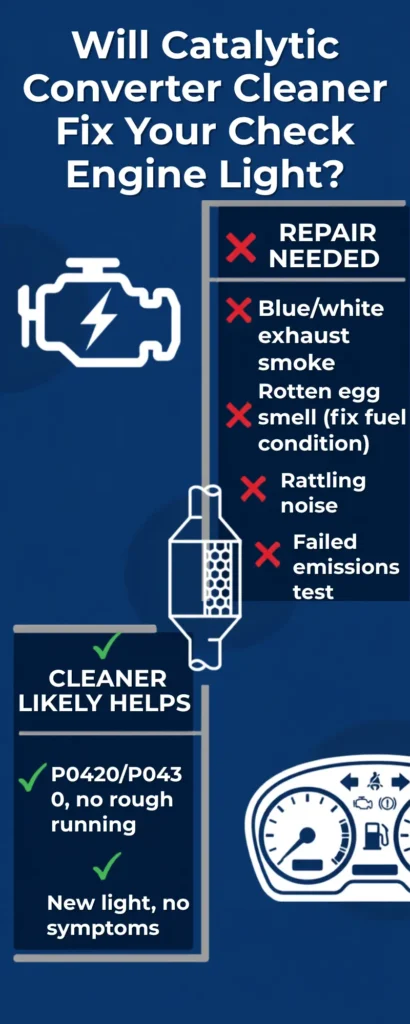
The best catalytic converter cleaner for checking engine light situations depends on which code triggered it, since not every illuminated light points to the same problem. A P0420 or P0430 specifically points to catalyst efficiency, while codes like P0300 series misfires or P0171 and P0174 lean codes mean the root cause is somewhere else in the engine, and the cleaner is treating a symptom rather than the source.
|
Symptom |
Likely Cause |
Cleaner Likely to Help? |
|---|---|---|
|
P0420 or P0430 code only, no rough running |
Carbon fouled catalyst, otherwise healthy engine |
Yes, good chance of success |
|
Check engine light plus visible blue or white exhaust smoke |
Oil burning or coolant entering exhaust |
No, mechanical repair needed first |
|
Rotten egg smell from exhaust |
Converter overheating from rich fuel mixture |
Sometimes, only if the rich condition is also fixed |
|
Rattling noise from underneath the car |
Broken honeycomb substrate inside converter |
No, physical replacement required |
|
Failed emissions test with high readings across multiple gases |
Severely degraded or dead converter |
Rarely, usually too far gone |
|
Reduced power or sluggish acceleration |
Partially clogged converter restricting exhaust flow |
Sometimes, mild restriction only |
|
Check engine light with no other symptoms, recently appeared |
Light carbon buildup |
Yes, strong candidate |
James Mitchell
Senior Automotive Writer
12+ years writing clear, practical guides on vehicle maintenance and emissions systems.
Frequently Asked Questions
Conclusion:
Catalytic converter cleaner works often enough to be worth trying before you spend money on a replacement, especially for a fresh P0420 code with no other symptoms. Continue driving normally for the next 50–100 miles before checking whether the code returns. If the check engine light returns after a proper treatment and normal driving, the converter or another part of the emissions system, likely needs a professional diagnosis. At that point, another bottle of cleaner is unlikely to solve the problem.