Can a Bad or Dead Battery Cause a Check Engine Light?
Yes, a bad battery can cause a check engine light, but the battery is rarely the whole story. Low voltage makes sensors send unreliable readings, and a dead battery wipes the engine computer’s memory, so the computer can log fault codes that switch the light on. A check engine light on after the battery dies often clears after a few drive cycles, while a light that stays on usually points to a charging fault or an unrelated problem. Below you will find the triggers, the voltage tests, 2026 repair costs and clear rules for when to stop driving.

James Mitchell
Senior Automotive Writer
12+ years writing clear, practical guides on vehicle maintenance and emissions systems.
Can a Bad Battery Cause a Check Engine Light on Your Dashboard?
Yes. A weak or failing battery drops system voltage, and that can make sensors send bad readings or make control modules lose communication. The engine computer then stores a fault code and turns the light on. The computer does not grade the battery itself, so the light signals the electrical side effect, not the battery.
Can a Low Battery Cause a Check Engine Light?
Yes. A low battery can cause a check engine light when voltage sags far enough that the engine computer or its sensors stop working correctly, most often during cranking, at idle or on cold mornings. A fully charged battery reads about 12.6 volts with the engine off, and readings near 12.0 volts mean roughly 25 percent charge and a real risk of fault codes.
How Does Low Battery Voltage Affect the Engine Computer?
The engine computer, also called the PCM or ECU, needs steady voltage to read sensors and run fuel and ignition. When voltage dips or spikes, sensor readings become unreliable, modules can reset or lose communication, and the computer logs a diagnostic trouble code (DTC). Codes such as P0562 exist specifically for low system voltage.
Many engine sensors depend on a stable 5 volt reference signal that the computer generates from system voltage. When system voltage drops, that reference wobbles and the sensor data goes wrong, even though the sensors themselves are fine. The table below shows what common voltage readings mean.
| Voltage Reading | Test Condition | What It Means |
|---|---|---|
| 12.6 to 12.8 volts | Engine off | Fully charged and healthy |
| 12.4 volts | Engine off | About 75 percent charged |
| 12.0 volts | Engine off | About 25 percent charged, weak |
| 11.9 volts or lower | Engine off | Fully discharged, needs charging and testing |
| 13.7 to 14.7 volts | Engine running | Normal charging output |
| Below 13.0 volts | Engine running | Alternator or connection problem likely |
| Above 15.0 volts | Engine running | Overcharging, voltage regulator likely failing |
The related voltage codes are P0560 (system voltage), P0561 (system voltage unstable), P0562 (system voltage low) and P0563 (system voltage high). Thresholds differ by manufacturer, and some vehicles set P0562 only after voltage stays near 10 volts for about a minute with the engine running.
Does a Weak Battery Always Cause the Check Engine Light?
No. A weak battery often shows up first as slow cranking, dim lights or the red battery warning light, and the check engine light appears only if voltage drops far enough for the computer to log a fault. Some vehicles never set a code from a mildly weak battery, so no light does not mean the battery is healthy.
In practice the check engine light will come on for battery trouble only when voltage falls below what the sensors and modules need. Most check engine light battery cases involve a deeply drained or failing battery, not one that is merely a few years old.
Why Does the Check Engine Light Come On After a Battery Dies?
A battery that dies cuts power to every control module, and the restart or jump start can cause voltage dips, lost communication and wiped memory. The computer may log temporary low voltage or communication codes and switch the light on. In most cases it is a side effect of the power loss, not a new mechanical fault.
What Happens to the Engine Computer When the Battery Completely Dies?
The engine computer loses power, which erases its volatile memory, including stored trouble codes, readiness monitor status and learned fuel adjustments. When power returns, it restarts its self tests from zero. Any voltage dip during the restart can log new codes, so a check engine light after dead battery events often appears within a few drives.
Because the learned settings are gone, the engine may idle or shift slightly differently until the computer relearns them, which can take roughly 10 cold starts. Low voltage can also light the ABS and traction control lamps, since those modules are just as sensitive to power loss. In general the check engine light comes on for battery failures in two ways: a real voltage fault, or a memory reset followed by a temporary code.
Why Does the Light Stay On After the Battery Is Recharged or Jump Started?
The light stays on when the computer still sees a fault or has not finished retesting. Temporary codes from the low voltage can remain stored, and a failing alternator or poor connection can keep creating new ones. If the light stays on after several days of normal driving, scan the codes instead of guessing.
Can the Check Engine Light Turn Off by Itself?
Yes. On many OBD II vehicles the light goes out after three consecutive drive cycles without the fault returning, and the stored code is erased after about 40 warm up cycles. If the cause was a one time voltage dip, the light often clears within days. A recurring fault will bring it back.
A warm up cycle means starting the engine and letting it heat up by at least 40 degrees Fahrenheit, to roughly 160 degrees or more.
What Does It Mean When the Check Engine and Battery Light Are On Together?
It means the computer logged a fault and the charging system may not be keeping the battery charged. Common causes are a failing alternator or voltage regulator, loose or corroded battery cables, or a dying battery. Treat it as urgent, because the car may be running on stored battery power and can stall.
What Does Each Warning Light Mean?
The check engine light is a general fault indicator from the onboard diagnostics (OBD) system, covering engine and emissions faults. The battery light, shaped like a small battery, signals a charging system problem such as low or unstable voltage. One says a code exists, and the other says the charging system needs attention.
A check engine and battery light on together usually points to the charging system as the primary suspect, with the check engine light as a secondary symptom of unstable voltage. A battery check engine light pairing is also common on cars with weak, old batteries.
How Do Alternator Problems Differ From Battery Problems?
A battery problem shows up as slow cranking or a car that will not start, especially after sitting. An alternator problem shows up while driving as dimming lights, a battery light and falling voltage. A multimeter separates them: below 13.0 volts or above 15.0 volts with the engine running points to the alternator or voltage regulator.
A weak battery also forces the alternator to work at its limit, which can shorten the alternator’s life. A quick parts store test checks the battery, not the alternator’s output under load, so a passed battery test does not clear the charging system.
When Do Both Warning Lights Require Immediate Attention?
Treat both lights as urgent when they appear with dimming headlights, stalling, a flashing check engine light or a battery light that stays on while driving. Voltage may be too low to keep the engine running. Drive only to the nearest safe stop or repair shop, because the car may not restart once you shut it off.
Why Is the Check Engine Light On After Changing the Battery?
A new battery can trigger the light because disconnecting power wipes the computer’s memory and resets its emission monitors. While those tests rerun, the computer can log temporary codes, and loose terminals or low voltage during installation can add more. A check engine light on after changing the battery usually clears after several drive cycles.
What Causes Lost ECU Memory and Unready Monitors After a Battery Change?
Replacing the battery erases stored codes, learned adjustments and readiness monitors, which are the computer’s self tests for systems such as the catalyst, oxygen sensors and EVAP. The monitors must run again during normal driving. Until they finish, the vehicle reports not ready, and that matters for emissions inspections.
A vehicle can have up to 12 readiness monitors, and there is no universal drive cycle that sets them all, so some cars need several days of mixed driving. A scan tool can clear codes but cannot make monitors ready. Under EPA guidance used by many state programs, 2001 and newer vehicles can have one monitor not ready and 1996 to 2000 vehicles can have two, but states differ, so check your local inspection rules.
Can Loose Terminals or Voltage Problems Cause a Light After Replacement?
Yes. A loose or poorly tightened terminal clamp creates high resistance, which causes voltage drops and can set both low and high voltage codes. Cars that need battery registration, including many BMW, Mercedes and Audi models, can also report charging faults if the new battery is not coded to the computer. Check the clamps first, then scan.
Picture a ten year old crossover that shows a check engine light the morning after a parts store battery swap. The technician scans it and finds a low system voltage code with no stored engine faults. A look under the hood shows the negative clamp barely finger tight, and it twists when pulled by hand. He tightens it, clears the code and tells the owner to drive normally for a few days. The light stays off. The lesson is that a ten second visual check often beats an hour of guessing, and it costs nothing.
When Does the Light Point to an Unrelated Problem?
If the light returns after several drive cycles with normal voltage readings, the cause is a separate fault, such as a loose gas cap, worn spark plugs, a failing oxygen sensor or an emissions problem. The battery swap only reset the clock. Read the stored code to find the real cause.
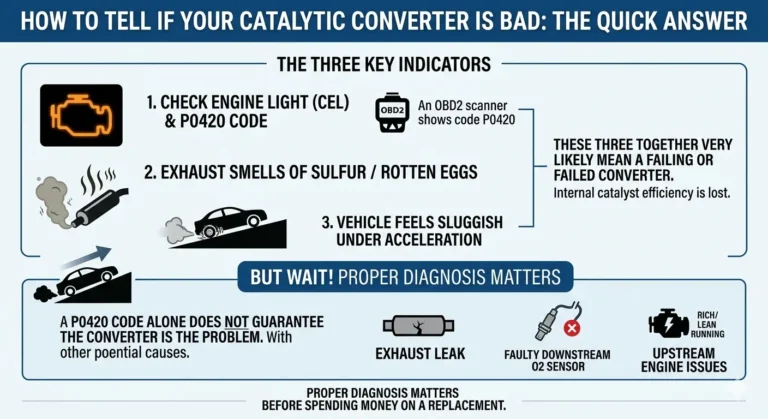
A steady light with a catalyst efficiency code needs a different diagnosis, and signs of a bad catalytic converter covers that. If the code points to an oxygen sensor, how to replace an oxygen sensor walks through the job. A flashing light indicates a misfire severe enough to damage the catalytic converter and calls for immediate attention.
How Do You Fix a Check Engine Light Caused by a Battery Problem?
Test the battery and charging voltage, clean and tighten the terminals, scan for codes, repair what the testing shows, then clear the code and drive normally so the monitors rerun. Replace the battery only if it fails a load test or will not hold a charge, and test the alternator before blaming the battery alone.
The usual order of work is below.
- Measure battery voltage with the engine off, then running, and compare it with the voltage table above.
- Inspect the terminals and cables for corrosion or looseness, then clean and tighten them.
- Replace the alternator or voltage regulator if running voltage falls outside 13.0 to 15.0 volts.
- Read every stored code with an OBD II scanner before clearing anything.
- Clear the codes after the repair and drive normally for several days to confirm the light stays off.
How Do You Test the Battery and Alternator With a Multimeter?
Set a multimeter to DC volts and touch the probes to the battery posts. With the engine off, 12.6 volts or more is healthy. Start the engine and retest: 13.7 to 14.7 volts is normal charging. Below 13.0 or above 15.0 volts points to the alternator or voltage regulator.
How Do You Scan for Codes and Clear the Light Safely?
Plug an OBD II scanner into the diagnostic port, usually under the dashboard on the driver’s side, and read every stored code. Write them down before clearing anything. Fix the cause, then clear the codes with the scanner and drive normally. Clearing codes without repairs hides the evidence, and the light returns once the computer retests the fault.
Disconnecting the battery also clears codes, but it wipes learned settings and does nothing about the cause. A code such as P0563 will come right back if the overcharging problem is still there.
How Much Does It Cost to Fix a Check Engine Light Caused by a Battery Problem?
Most battery related fixes cost $100 to $450 when the battery is the cause, while an alternator replacement usually runs $300 to $800 and can reach about $1,100 on trucks or luxury models. Tightening or cleaning terminals is the cheapest fix, and many parts stores install a new battery free with purchase.
The table below lists typical 2026 US costs, and prices vary by region, labor rate and vehicle.
| Repair | Typical 2026 US Cost | What Drives the Price |
|---|---|---|
| Standard battery (part only) | $100 to $300 | Battery type and size, most standard units cost $100 to $180 |
| Battery installed by a shop | $150 to $370 for most vehicles | Shop labor rate, free installation at many parts stores |
| Luxury, start stop or registered battery | $250 to $450 installed | AGM battery cost and computer registration |
| Hybrid 12 volt auxiliary battery | $210 to $450 installed | Battery location and dealer service |
| Alternator diagnosis | $50 to $150 | Shop diagnostic rate |
| Alternator replacement | $300 to $800 typical, up to $1,100 | OEM or remanufactured part, 1.5 to 3 hours of labor |
| Voltage regulator or brush repair | $150 to $400 | Most shops replace the whole alternator instead |
How Can You Tell If the Battery Is Really Causing the Check Engine Light?
Look for battery symptoms that appear together with the light: slow cranking, dimming headlights, clicking when you turn the key, a battery warning light or several warning lights at once. If those symptoms are absent and the light returns after the monitors rerun with normal voltage, the cause is probably a separate engine or emissions fault.
Which Symptoms Point to the Battery?
Slow or hard starting, dim lights at idle, electrical glitches, clicking when you turn the key and a battery older than four years all point to the battery, and a bad battery can cause a check engine light alongside them. Several warning lights at once, including ABS and traction control, also suggest low voltage instead of separate faults.
Use the table below to match what you see with the most likely cause.
| Situation | Most Likely Cause | Next Step |
|---|---|---|
| Light appears right after a dead battery or jump start | Voltage dip and wiped memory | Drive normally for several days, then rescan if it stays on |
| Light with slow cranking and dim headlights | Weak or old battery | Get a battery load test |
| Battery light and check engine light on while driving | Charging system failure | Test alternator output right away |
| Light appears after a battery change with no other symptoms | Reset memory and unready monitors | Complete several drive cycles before rescanning |
| Code P0563 stored | Overcharging, usually the voltage regulator | Test charging voltage and do not replace the battery first |
| Light returns after clearing with normal voltage | Unrelated fault | Read the new code and diagnose it |
| Check engine light flashing | Severe misfire | Stop driving and see a mechanic |
Can You Drive With the Check Engine Light On Because of a Battery Problem?
Often yes for a short, careful trip if the light is steady, voltage reads normal and the car runs smoothly. Do not drive if the light flashes, the battery light is on while driving, lights dim or the engine stumbles. Low voltage can stall the engine and shut down other systems, leaving you stranded.
When Is It Safe to Drive?
It is reasonable to drive when the light is steady, the car starts normally, the battery light is off and voltage tests show 13.7 to 14.7 volts with the engine running. Keep trips short, scan the codes soon and avoid long highway runs until the cause is clear.
When Should You Stop Driving?
Stop when the check engine light flashes, the battery light stays on, headlights dim, gauges act up or the engine stalls or hesitates. A failing charging system drains the battery until the engine quits, and a flashing light signals a misfire that can damage the catalytic converter.
A high voltage code such as P0563 deserves the same respect. Sustained overcharging can damage expensive electronic modules, so a driver who ignores it risks a repair bill much larger than the alternator.
James Mitchell
Senior Automotive Writer
12+ years writing clear, practical guides on vehicle maintenance and emissions systems.
Frequently Asked Questions
Conclusion:
A bad battery can cause check engine light codes, but the fix starts with testing, not guessing. Take a free battery test and a multimeter reading, tighten the terminals, then scan the codes before spending money. If the light returns after a week of normal driving with healthy voltage, treat it as a separate fault and have the stored code diagnosed.