Gas Cap Check Engine Light: Can a Loose Cap Trigger It & How to Fix It
Yes, a loose gas cap can trigger the check engine light, and it is one of the most common reasons the light appears right after a fill up. The cap seals the fuel vapor system, so a poor seal stores an emissions leak code. The fix is usually free: tighten the cap until it clicks, then drive normally while the car retests itself, which can take a few days. Below you will find how to confirm a gas cap check engine light, what each code means, what repairs cost from $0 to about $400, and when the problem is something else.

James Mitchell
Senior Automotive Writer
12+ years writing clear, practical guides on vehicle maintenance and emissions systems.
Can a Gas Cap Cause the Check Engine Light to Come On?
Yes. A gas cap can cause the check engine light because it seals the fuel tank as part of the evaporative emission control (EVAP) system. When the cap is loose, cracked, or missing, the car detects a vapor leak and stores a trouble code. The light is an emissions warning, not a sign of engine damage.
Can a Loose Gas Cap Trigger the Check Engine Light?
Yes. A loose gas cap check engine light is common because the car’s computer runs regular leak tests on the fuel vapor system. If the cap does not seal, the test fails, a code is stored, and the light comes on. Some vehicles show a Check Gas Cap message before or instead of the light. That is why the check engine light gas cap link shows up in so many repair shops.
Cars and light trucks built since 1996 or 1997 are required to test themselves for evaporative leaks, so this behavior is normal and not a sign of a defective car. The cap does not have to be visibly loose either. A cap that stopped one click short, or a tether pinched under the seal, is enough to fail the test.
How the Gas Cap Affects the EVAP System
The EVAP system traps fuel vapor from the tank so it does not escape into the air. Vapor is stored in a charcoal canister, and once the engine is warm, a purge valve opens to pull that vapor into the engine to be burned. A vent valve lets fresh air into the system during purging.
To test for leaks, the computer closes the system and watches how pressure or vacuum behaves. The gas cap is the outermost seal in that loop. If it leaks, the whole system fails the test.
Why a Loose Gas Cap Triggers an Emissions Warning
Fuel vapor is a pollutant, so a leak that lets it escape is exactly what the monitoring system is built to catch. The computer does not know whether the leak is a cap or a cracked hose, so it simply flags an EVAP fault and turns on the light.
Because the engine itself is not affected, most cars drive normally with a gas cap check engine light. That is why a check engine light for gas cap trouble often goes unnoticed until it fails an inspection or a driver sees the dashboard.
Can a Missing or Damaged Gas Cap Cause the Same Problem?
Yes. A missing cap usually produces a large leak code such as P0455, while a cracked or hardened seal tends to produce a small leak code such as P0442 or P0456, or a cap specific code such as P0457. The warning looks the same on the dashboard, so the code is what tells them apart.
A missing cap also lets dirt, water, and fuel odors reach the tank opening, so replace it the same day rather than waiting for the light to settle.
Why Did the Check Engine Light Come On After Getting Gas?
The most common reason is a gas cap that was not fully tightened or sealed after refueling. Other causes include a worn cap seal, an EVAP leak, a sticking purge or vent valve, overfilling the tank, or poor quality fuel. A steady light usually points to the vapor system, while a flashing light points to a misfire.
When the check engine light came on after getting gas, the timing is rarely a coincidence, but it is not always immediate either. The leak test runs under specific conditions, so the light can appear at the pump or several trips later. A check engine light after getting gas is worth a quick cap check before anything else, because a loose gas cap check engine light is the cheapest cause to rule out.
If your check engine light came on after getting gas, the table below sorts the usual suspects by what you will notice and what to do first.
| Likely cause | Typical clue | First step |
|---|---|---|
| Loose or poorly seated gas cap | Light appears soon after refueling, car runs normally | Reseat the cap until it clicks |
| Worn or cracked cap seal | Cap clicks but the light returns, rubber looks hard or flat | Replace the cap |
| EVAP hose or filler neck leak | New cap does not help, same EVAP code returns | Smoke test the system |
| Purge valve stuck open | Hard start or rough run for a few seconds after fueling | Scan codes, test the valve |
| Vent valve problem | Pump keeps clicking off, tank is hard to fill | Scan codes, inspect the vent valve |
| Overfilling the tank | Topped off past the first click | Stop at the first click |
| Bad gas | Rough idle, hesitation, light shows after one fill up | Scan for misfire or lean codes |
Loose Gas Cap After Refueling
This is the first thing to rule out. Rushing at the pump, letting the nozzle bump the cap, or stopping a click early are all common ways to leave a cap unsealed. On cars where the cap hangs from a tether, the strap can also get caught between the cap and the filler opening.
A loose gas cap check engine light usually clears on its own once the cap is seated properly and the car completes its retest. A gas cap loose check engine light pattern is also common after a hurried fill up.
Damaged Gas Cap Seal
The rubber seal on the cap hardens, cracks, or flattens with age and heat. The cap may still turn and click, yet leak vapor around the edge. If the light keeps returning after you tighten the cap, a worn seal is the next most likely cause.
A healthy seal feels soft and shows no cracks or flat spots. A hard or brittle seal means the cap is finished.
Fuel Vapor Leak in the EVAP System
If the cap is good, the leak is somewhere else in the EVAP system: a cracked hose, a rusted or dented filler neck, a damaged canister, or a loose connection. These leaks set the same codes a bad cap can set, which is why guessing at parts gets expensive.
A smoke test pushes harmless visible smoke through the sealed system so the leak location shows itself. Some leaks only appear under vacuum, so if codes return after a clean smoke test, ask the shop whether a vacuum check was also done.
Faulty Purge Valve or Vent Valve
A purge valve that sticks open can let extra vapor into the engine right after refueling, which causes a hard start or a stumble for the first few seconds. A vent valve that sticks closed can make the pump click off repeatedly or make the tank hard to fill. Both can set a check engine light.
Some manufacturers have extended warranty coverage for purge valves on specific models, so a dealer may repair it at no cost.
Can Bad Gas Cause the Check Engine Light?
Yes, but far less often than a loose cap. Fuel contaminated with water, or stale fuel, can cause misfires or a lean mixture that sets codes such as P0171 or P0300. Bad gas does not usually set an EVAP leak code, and it normally comes with rough idle or hesitation.
Ethanol blends such as E10 absorb moisture, and water can separate and settle at the bottom of a tank, where the fuel pump then pulls it in. In mild cases the light clears after the car burns through the tank and you refill with fresh fuel. A flashing light with loud knocking under load is not mild, so stop driving and get the car checked.
Other Problems That May Appear After Refueling
Topping off the tank after the pump clicks can push liquid fuel into the charcoal canister and mimic a leak. Refueling with the engine running can also upset the EVAP system. Stop at the first click and shut the engine off.
Sometimes the timing is simply a coincidence. Oxygen sensor and catalytic converter efficiency codes can appear at any time, so a scan is the only way to know the light is about the vapor system at all.
How to Tell If a Loose Gas Cap Is Causing the Check Engine Light
Check the cap first: remove it, inspect the seal, and reinstall it until it clicks. Then read the code. An EVAP code such as P0457, P0455, P0456, or P0442 points to the vapor system, and P0457 points to the cap itself. If the light returns after several drive cycles with a tight, undamaged cap, look elsewhere in the EVAP system.
Check Whether the Gas Cap Is Tight
Treat the cap as the first suspect whenever the check engine light for gas cap trouble is steady. Open the fuel door and see whether the cap sits flat and squarely on the filler opening. A cap that wobbles, sits crooked, or turns freely without clicking is not sealing. Turn it off and back on to feel for the click.
If the cap never clicks or clicks repeatedly with no resistance, the internal ratchet is likely worn and the cap should be replaced.
Inspect the Gas Cap Seal for Damage
Remove the cap and check the rubber seal for cracks, stiffness, flat spots, or debris. Then look at the filler neck lip, which should be round, smooth, and clean. Rust or a dented lip will not seal against even a new cap.
A gasoline smell near the fuel door when everything is closed is another sign the seal is leaking.
Look for an EVAP Leak Code
Many auto parts stores will scan your codes for free. The scanner plugs into the OBD II port, usually under the dashboard near the steering column, and reads the stored trouble code. Write the code down, because it decides what to check next.
A code with no other symptoms and a recent refueling points strongly at a gas cap check engine light. The check engine light gas cap connection is easiest to confirm this way.
Common Gas Cap Codes, Including P0455 and P0457
The following table lists the EVAP codes most often tied to a gas cap and where to look first for each one.
| Code | Common meaning | Where to look first |
|---|---|---|
| P0440 | General EVAP system malfunction | Gas cap, then hoses and valves |
| P0441 | Incorrect purge flow | Purge valve and its wiring |
| P0442 | Small EVAP leak | Gas cap seal, then hoses and filler neck |
| P0455 | Large EVAP leak | Missing or badly seated cap, then disconnected hoses |
| P0456 | Very small EVAP leak | Worn cap seal, then tiny hose cracks |
| P0457 | EVAP leak, fuel cap loose or off | Gas cap and filler neck sealing area |
If a gas cap loose check engine light appears with P0457, the cap is almost certainly the cause. P0442 and P0455 can also be the cap, but they can point to the charcoal canister, hoses, or purge valve when the cap checks out.
How to Distinguish a Gas Cap Problem From Another Fault
A gas cap problem usually shows up as a steady light, an EVAP code, no change in how the car drives, and sometimes a fuel smell near the fuel door. Other faults add symptoms such as rough running, stalling, weak acceleration, or a flashing light. Reading the code settles the question quickly.
Picture a typical shop visit. A driver arrives with the light on, sure the car needs an expensive repair because it appeared the day after a fill up. The scan shows P0457. The technician pulls the cap and finds the tether pinched under the seal, so it never sat flat. He reseats it, clears the code, and the light stays off. The reverse happens too: a brand new cap, the same code, and a cracked filler neck hose found only with a smoke test. The code tells you where to look, and the cap is only the first stop.
How to Fix a Check Engine Light Caused by a Gas Cap
Remove the cap, inspect the seal, clean the filler neck lip, and reinstall the cap until it clicks. If the cap is cracked or the seal is hard, replace it with an OEM or quality aftermarket cap for roughly $15 to $60. Then drive normally for several days so the EVAP monitor can retest and the light can clear.
Remove and Reinstall the Gas Cap Correctly
These steps cover the free fix that resolves most gas cap check engine light cases.
- Turn the engine off and open the fuel door.
- Unscrew the cap completely and look at the seal and the tether.
- Make sure the tether is not trapped under the seal.
- Screw the cap back on and turn it until you hear it click, then stop.
- Close the fuel door and drive normally for the next few days.
More turning does not make the cap tighter. The click is the signal that the cap is seated, and the number of clicks varies by design, so follow your owner’s manual.
Clean the Gas Cap and Filler Neck
Wipe dirt, grit, and debris off the cap seal and the filler neck lip with a clean cloth. Grit on either surface can keep the cap from sealing even when it clicks.
Also check that the drain in the fuel door pocket is clear, because standing water and debris can end up around the opening.
Replace a Damaged or Worn Gas Cap
Buy a cap that matches your vehicle by VIN or OEM part number whenever possible. Most modern EVAP systems need a sealed cap rather than a vented one unless the manufacturer calls for vented. Locking caps can behave differently, so use only models listed for your vehicle. Quality aftermarket brands such as Stant and Gates generally work, but very cheap no name caps can keep the light on.
Some vehicles from brands such as Ford and GM use a capless filler with an internal flap, so there is no cap to replace unless the flap or filler neck is damaged.
The table below shows typical United States costs in 2026 for the gas cap and for the repairs that come next if it is not the cause.
| Repair or service | Typical cost in 2026 | What changes the price |
|---|---|---|
| Gas cap, part only | $15 to $60 | OEM or aftermarket, locking or standard |
| Gas cap swap at a shop, total with scan | $75 to $160 | Shop minimum labor and diagnostic time |
| Gas cap fix at a dealership | $75 to $200 | Dealer labor rate and OEM part |
| EVAP smoke test | $80 to $150 bundled with a scan, $45 to $100 billed separately | Shop and region |
| Purge valve replacement | $120 to $400 | Valve location and vehicle make |
| Vent valve or vent solenoid replacement | $150 to $350 | Access and part price |
| Charcoal canister replacement | About $450 to $1,600 | Vehicle, labor time, integrated canister design |
A cap only swap should be a quick job, so ask why if a shop quotes more than 30 minutes of labor for it. Costs vary by shop, region, and vehicle, so treat these as ranges rather than quotes.
Check for EVAP System Leaks
If a new, properly seated cap does not turn the light off after several drive cycles, the leak is elsewhere. A smoke test is the fastest way to find it and prevents replacing parts by guesswork.
The most common way drivers overpay is replacing a purge valve when the real problem was a $20 cap or a loose hose. Ask the shop to confirm which component failed and to separate the diagnostic fee, the smoke test, and the repair on the quote.
When to Use an OBD II Scanner
A scanner is useful in three situations: reading the code to confirm the cap is the likely cause, clearing the code after you have fixed the problem, and checking whether the EVAP readiness monitor has finished its retest.
Clearing the code turns the light off right away, but it also resets the readiness monitors to not ready. Do not clear codes shortly before an emissions inspection, because the car then needs time to run its tests again.
How Long Does the Check Engine Light Take to Turn Off After Tightening the Gas Cap?
Usually a few days of normal driving. After you tighten the cap, most cars need about 2 to 5 drive cycles, often 20 to 50 miles, before the EVAP monitor retests and clears the light. Some vehicles require the system to pass several tests in a row, so the light can take up to about a week.
When the Light May Turn Off on Its Own
The light turns off by itself once the EVAP test runs and passes. That test needs the right conditions, including a fuel level between roughly one quarter and three quarters of a tank, because many EVAP self tests do not run near empty or full. A cold start followed by mixed driving helps.
Some vehicles also run the leak test while parked after a drive, so the light may clear overnight.
How Many Driving Cycles May Be Needed
A drive cycle is a full trip from a cold start to a warmed up engine, with a mix of city and highway speeds, some idling, and a shutdown. Sources vary on the count, from 1 to 3 cycles on some vehicles to 3 to 5 on others. Plan on a few days and several trips.
Short hops across town may not complete a cycle, so the light can linger longer than expected.
Should You Clear the Code With a Scanner?
Clearing the code is optional. A scanner turns the light off immediately, but the car still has to rerun the EVAP test, and the light returns if the leak remains. Clear it only after you have fixed or replaced the cap.
If you face an emissions inspection soon, waiting is safer, because clearing resets readiness monitors and the test needs them ready.
What to Do if the Light Stays On
If the gas cap check engine light is still on after about a week or roughly 50 miles of mixed driving, the cap was probably not the whole problem. Scan for the code, replace the cap if the seal looks worn, and then book a smoke test if the same EVAP code returns.
A new cap that is not the correct specification for your car can also keep the light on, so confirm the part number.
Can You Drive With the Check Engine Light On After Getting Gas?
Yes, usually. A steady check engine light after getting gas most often means a small EVAP leak, which does not affect engine performance or safety. Tighten the cap and keep driving. A flashing light is different: it signals a misfire that can damage the catalytic converter, so reduce speed and stop driving as soon as it is safe.
When a Loose Gas Cap Is Usually a Minor Issue
When the check engine light is on after getting gas, the car drives normally, and there is no strong fuel smell, a loose gas cap check engine light is the likely cause and the risk is low. Fix it within a few days rather than ignoring it, because the leak wastes fuel vapor and the light will fail an inspection.
A steady light that is not caused by the cap still deserves a scan soon, since it can hide a different fault.
Signs of a More Serious Fuel or Engine Problem
The following signs point away from a simple cap problem and toward a fault that needs attention before long trips.
- Rough idle, hesitation, or stalling suggests a fuel or ignition problem rather than a vapor leak.
- Loud knocking under load can mean contaminated fuel or an engine problem and calls for stopping and getting a tow or inspection.
- A strong fuel smell inside the cabin or visible fuel leaking under the car means you should stop driving.
- A temperature gauge that climbs toward hot means you should pull over and shut the engine off.
What to Do if the Check Engine Light Is Flashing
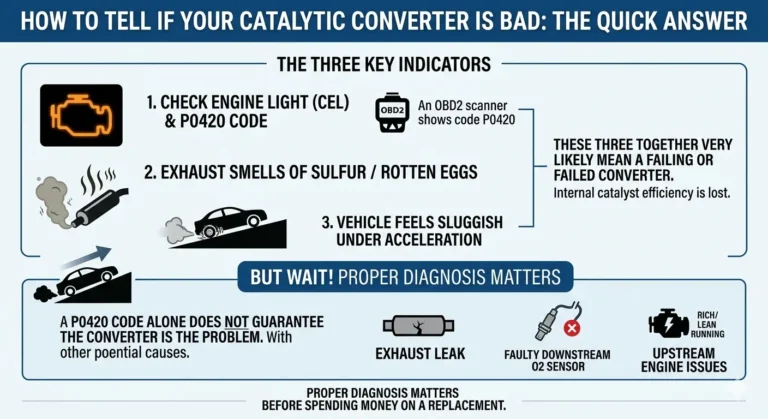
A flashing light usually means an active misfire, where unburned fuel reaches the exhaust and can overheat the catalytic converter. If you are not yet familiar with what a catalytic converter does, what a catalytic converter is and how it works covers that in full detail.
- Ease off the throttle and reduce speed right away.
- Pull over safely and shut the engine off.
- Have the codes scanned before driving any further.
- Do not simply clear the code, because the light returns if the cause remains.
Can You Pass an Emissions Test With a Loose Gas Cap?
Usually not. In most states an illuminated check engine light fails an emissions inspection, and some programs also pressure test the gas cap. Fix the cap, let the monitors finish, and then retest. Rules differ by state, so confirm the details with your state inspection program.
The full picture of failing and passing with a light on is covered in can you pass emissions with a check engine light.
James Mitchell
Senior Automotive Writer
12+ years writing clear, practical guides on vehicle maintenance and emissions systems.
Frequently Asked Questions
Conclusion:
A gas cap check engine light is usually the cheapest check engine problem to fix. Tighten the cap until it clicks, inspect the seal, and drive normally for several days. If the light stays on, scan the code and replace the cap for $15 to $60 before paying for a smoke test. A flashing light is the exception, so stop driving and get it diagnosed.