How to Tell If a Catalytic Converter Is Clogged: Symptoms and Fixes
A clogged catalytic converter is one of the most misdiagnosed problems in automotive maintenance. The symptoms overlap with other exhaust and engine issues, the failure develops gradually, and most drivers do not realize how serious the restriction has become until the engine is already struggling in a noticeable way. Learning how to tell if a catalytic converter is clogged early gives you the best chance of fixing the problem without expensive replacement.
This guide covers every symptom you need to know, explains how to check if a catalytic converter is clogged using five reliable methods, walks through all available fix options, and answers whether you can unclog a catalytic converter without removing it or whether replacement is the only realistic path forward.

James Mitchell
Senior Automotive Writer
12+ years writing clear, practical guides on vehicle maintenance and emissions systems.
How to Tell If Your Catalytic Converter Is Clogged: The Quick Answer
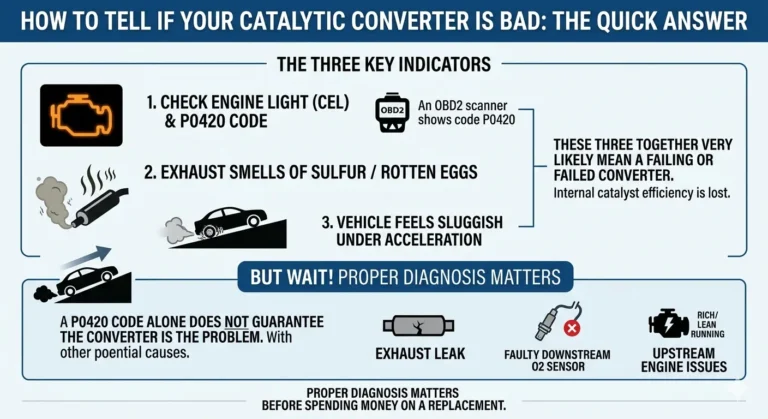
If your vehicle feels sluggish under acceleration, smells of sulfur from the exhaust, and the check engine light is on with a P0420 code stored in the ECM, those three signals together give you strong grounds to suspect a clogged catalytic converter. How to tell if your catalytic converter is clogged without workshop equipment comes down to observing these three symptoms in combination rather than in isolation.
Knowing how to tell if a catalytic converter is clogged rather than simply degraded chemically is where the diagnostic process becomes precise. A single symptom in isolation can have many causes. Power loss could be a fuel system problem. A sulfur smell can come from a rich running engine. P0420 alone can be triggered by a faulty downstream oxygen sensor. But when all three appear together on a vehicle with significant mileage, the converter is almost always involved.
What Are the Symptoms of a Clogged Catalytic Converter?
Understanding what are the symptoms of a clogged catalytic converter in detail helps you describe the problem accurately to a mechanic, conduct the right diagnostic tests yourself, and avoid replacing components that do not need replacing. Each symptom below has a specific internal cause tied to how the blockage affects exhaust flow, combustion quality, and engine management.
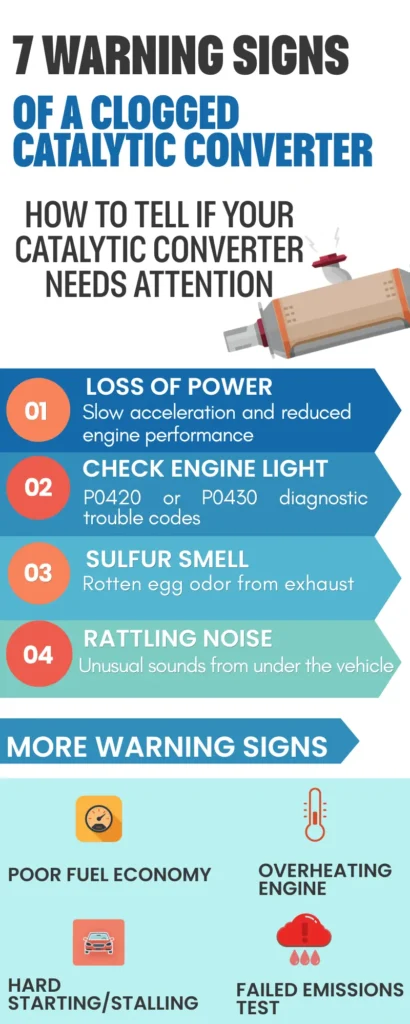
1. Loss of Engine Power and Sluggish Acceleration
The most consistent and disruptive symptom of a clogged catalytic converter is reduced engine power, particularly during acceleration and climbing hills. When the honeycomb substrate inside the converter is partially or fully blocked, exhaust gases cannot escape quickly enough. They accumulate back pressure in the exhaust manifold, which pushes against the piston during the exhaust stroke and reduces the fresh charge drawn into the cylinder on the intake stroke.
The result is an engine that feels progressively weaker. At light throttle and low speed the restriction may be manageable, but under load, at motorway speeds, or when the driver calls for full acceleration, the blockage creates enough back pressure to reduce output noticeably. Many drivers describe the sensation as the engine hitting an invisible wall at higher RPMs, producing a feeling of strain and hesitation rather than smooth power delivery.
2. Check Engine Light with P0420 or P0430 Code
The check engine light is typically the first electronic warning of a clogged catalytic converter. The engine control module monitors converter efficiency by comparing the signal from the upstream oxygen sensor with the downstream oxygen sensor positioned after it. A functioning converter produces a stable downstream signal. When the converter is clogged and chemically degraded, the downstream sensor reading begins to mirror the upstream sensor, prompting the ECM to store P0420 for Bank 1 or P0430 for Bank 2.
P0420 does not exclusively confirm a physical clog. It can also be triggered by a deteriorated catalyst coating, an exhaust leak near the downstream sensor, or a faulty oxygen sensor. Reading all stored and pending codes together, not just P0420 in isolation, gives a much clearer picture of whether the issue is a physical restriction, a chemical degradation, or a sensor fault.
3. Rotten Egg or Sulfur Smell from the Exhaust
Fuel naturally contains small amounts of sulphur compounds. A healthy converter oxidises these during normal operation, converting them into sulphur dioxide which dissipates quickly. When a clogged catalytic converter can no longer process exhaust gases at full efficiency, some sulphur compounds pass through the catalyst surface without being fully oxidised, producing hydrogen sulphide gas — the source of the rotten egg odour that drivers associate with a failing converter.
The intensity of the smell tracks with the severity of the clog. A faint occasional sulphur smell at idle may indicate early-stage buildup that a cleaning method could still address. A strong persistent odour that enters the cabin through the ventilation system suggests the converter is substantially blocked and losing function rapidly.
4. What Does a Clogged Catalytic Converter Sound Like?
What does a clogged catalytic converter sound like in practical terms? The most characteristic sound is a metallic rattling from underneath the vehicle, most pronounced during cold starts and at idle. This rattling is produced when the internal ceramic honeycomb substrate has cracked or fragmented from thermal overload caused by excess unburned fuel reaching the converter, and the loose fragments vibrate inside the steel casing.
What does a clogged catalytic converter sound like as the blockage becomes more severe? The rattling often becomes louder and more constant, and at higher engine speeds you may also notice a hollow resonance or restricted exhaust note. Some drivers report a deep thumping or muffled sound under hard acceleration when exhaust pressure is at its highest.
A simple at-home test: with the engine cold and switched off, tap the converter casing firmly with a rubber mallet. A solid, intact substrate produces a dull thud. A fragmented substrate produces a hollow response with loose material shifting inside. This test takes thirty seconds and reliably distinguishes between a converter that is chemically degraded but structurally intact and one whose internal structure has physically broken apart.
5. What Does a Clogged Catalytic Converter Look Like?
What does a clogged catalytic converter look like from the outside? Under normal circumstances the casing shows uniform heat discolouration, a light straw to bronze colour across the steel surface. A converter that has been running at excessive temperature will show a distinctive blue-grey or dark oxidation pattern on the casing surface. In severe cases the casing will have a warped or blistered appearance.
What does a clogged catalytic converter look like when the situation has reached a critical stage? The converter will glow visibly red or orange during and immediately after driving. This is a clear sign of thermal runaway from internal overheating. Carbon staining around the outlet pipe and any exhaust joints near the converter is another visual indicator of incomplete combustion products passing through a severely degraded unit.
6. Poor Fuel Economy
A clogged catalytic converter creates two independent fuel economy penalties. The first is mechanical: the engine works harder against exhaust back pressure to maintain the same output. The second is electronic: the engine control module detects disrupted oxygen sensor readings and in some cases enriches the fuel mixture, delivering more fuel per combustion cycle than the engine actually needs.
Drivers who monitor their fuel consumption carefully often notice a gradual worsening of fuel economy in the weeks before other clogging symptoms become obvious. A ten to fifteen percent reduction in fuel efficiency that cannot be explained by seasonal temperature changes, tyre pressure, or driving pattern shifts is worth investigating with an OBD2 scan.
7. Difficulty Starting or Engine Stalling
In advanced stages of clogging, the back pressure created by a severely blocked converter becomes significant enough to interfere with the engine completing the exhaust stroke cleanly. This causes rough idling, hesitation at low RPMs, and in extreme cases stalling shortly after startup. In the most severe cases of near-total blockage, the engine may fail to start at all, as back pressure builds so rapidly in the first seconds of cranking that sustained combustion becomes impossible.
Clogged Catalytic Converter Symptoms at a Glance
|
Symptom |
What Causes It |
Severity |
Action Required |
|---|---|---|---|
|
|
|
High |
|
|
|
|
|
|
|
|
|
Moderate to high |
|
|
|
|
High |
Tap test; replacement likely required |
|
|
Thermal runaway from back pressure and heat |
Critical |
Stop driving; address immediately |
|
|
|
|
|
|
|
|
Very high |
|
Can a Clogged Catalytic Converter Cause a Misfire?
Yes, a clogged catalytic converter can cause a misfire, and understanding the direction of this relationship matters enormously for correct diagnosis. The more common sequence is that a misfire causes converter clogging, as unburned fuel from a misfiring cylinder floods the converter and causes thermal damage or carbon buildup. However, the reverse is also real: a severely clogged catalytic converter causes a misfire by creating enough back pressure to disrupt the exhaust stroke and alter the combustion conditions inside the cylinder.
When a clogged catalytic converter causes a misfire through back pressure, the exhaust gases that cannot escape quickly enough remain partially in the cylinder during the intake stroke, diluting the fresh air and fuel charge. Fault codes P0300 through P0308 appearing alongside P0420 therefore need careful interpretation. If misfire codes appeared first and P0420 followed, the misfire likely damaged the converter. If P0420 appeared first and misfire codes followed, the converter clogging may be contributing to combustion instability.
In summary, can a clogged catalytic converter cause a misfire? Yes it can, and it can also be caused by one. This is exactly why reading all fault codes together before condemning either component is critical. Replacing a converter without addressing an active misfire will cause the new converter to fail for the same reason.
Can a Clogged Catalytic Converter Cause Overheating?
A clogged catalytic converter can contribute to engine overheating through two mechanisms. The first is direct thermal radiation. When exhaust gases cannot pass through the converter freely, heat that would normally travel down the exhaust pipe and dissipate at the muffler instead stays trapped in the converter and surrounding exhaust components, radiating through the vehicle floorboard and into the engine bay.
The second mechanism is more significant. When the converter is clogged enough to restrict exhaust flow substantially, the engine must work harder on every combustion cycle to push gases out. This increased mechanical load generates additional heat inside the engine. Over a sustained period of driving with a heavily clogged converter, the combination of reduced exhaust flow and increased combustion load can push engine coolant temperatures above their normal operating range, showing on the temperature gauge as persistent or intermittent overheating.
In the most severe scenario, a clogged catalytic converter that reaches the glowing stage creates a localised fire risk, particularly when the converter is positioned close to heat-sensitive wiring, fuel lines, or plastic underbody components. This is the point at which the situation becomes a safety concern rather than just a performance issue, and driving should stop immediately.

How to Check If a Catalytic Converter Is Clogged: Step by Step
Knowing how to check if a catalytic converter is clogged before spending money on replacement is the most important step in this process. Knowing how to check if a catalytic converter is clogged correctly separates a targeted and cost-effective repair from an expensive guessing game. These five methods progress from the simplest and least invasive to the most technically informative.
Step 1: OBD2 Code Scan
Connect an OBD2 scanner and read every stored and pending code, not just the catalyst-related ones. P0420 and P0430 signal catalyst efficiency problems. P0300 through P0308 indicate misfires that may have caused or been caused by the clog. P0171 through P0175 indicate fuel trim anomalies that suggest rich running. Reading all codes together gives a complete picture that a single code reading cannot.
Step 2: The Tap Test
With the engine cold and off, crawl under the vehicle and tap the converter casing firmly with a rubber mallet. A structurally intact substrate produces a dull solid thud. A fragmented substrate produces a hollow sound with an audible shift of loose material inside. This test is the fastest way to determine whether the converter can potentially be cleaned or whether internal structural failure has already made replacement the only option.
Step 3: Infrared Temperature Test
With the engine fully warmed to operating temperature, use an infrared thermometer to measure the temperature of the exhaust pipe immediately before the converter inlet and immediately after the outlet. A functioning converter generates exothermic heat, so the outlet temperature should be measurably higher than the inlet temperature. If the outlet temperature is equal to or lower than the inlet temperature, the converter is either clogged or no longer catalysing.
Step 4: Vacuum Gauge Test
Connect a vacuum gauge to an intake manifold vacuum port. At idle the reading should hold steadily between 18 and 22 inches of mercury. Ask a helper to snap the throttle open briefly and release it. Vacuum should drop momentarily then recover to the baseline reading within one or two seconds. If recovery takes noticeably longer, exhaust back pressure from a restricted converter is the most likely cause..
Step 5: Direct Back Pressure Test
Remove the upstream oxygen sensor and thread a direct back pressure gauge into the sensor bung. Start the engine and read the pressure at idle, then rev to 2,500 RPM and read again. Back pressure at idle should remain below 1.5 PSI and below 3 PSI at 2,500 RPM. Readings significantly above these thresholds confirm that the converter substrate is blocking exhaust flow to a degree that requires immediate attention.
How to Unclog a Catalytic Converter: All Fix Methods
Can you unclog a catalytic converter at home using simple methods? In many mild cases, yes. Can you unclog a catalytic converter once it has become restricted in a more serious way? The answer depends entirely on what caused the clog and how severe it has become. Here are all available methods ranked from least invasive to most labour-intensive.
Method 1: How to Unclog Catalytic Converter Without Removing It (Fuel Additive Method)
Knowing how to unclog catalytic converter buildup without any mechanical work is the most accessible starting point for most vehicle owners. How to unclog a catalytic converter without removing it is the first question most drivers ask, and for good reason. This method requires no mechanical work at all.
Pour a commercially available catalytic converter cleaner, products such as Cataclean, CRC Guaranteed to Pass, or Sea Foam, into the fuel tank when it contains approximately a quarter tank of fuel. After adding the cleaner, drive the vehicle for a sustained period at highway speeds, maintaining engine RPM between 2,500 and 3,000 for at least 30 minutes. After the drive, reset any stored OBD2 codes and complete a full drive cycle to allow the ECM to re-evaluate converter efficiency.
How to unclog a catalytic converter without removing it only works reliably when the clog consists of light carbon deposits from short-trip driving or mild fuel quality issues. It will not resolve physical substrate damage, oil or coolant contamination, or precious metal depletion.
Method 2: The Italian Tune-Up
This method follows the same principle as the additive approach but without any chemical product. Drive the vehicle on a motorway or open road at sustained higher RPMs, between 2,500 and 3,500, for 30 to 45 minutes. The elevated exhaust temperature burns off light carbon deposits that have accumulated from repeated short-trip city driving where the exhaust never reaches full operating temperature.
This approach works best as a preventive measure or in very early-stage buildup situations. It costs nothing and risks nothing, but it has clear limitations. It will not remove heavy carbon deposits, contamination from oil or coolant, or any damage that has a physical cause.
Method 3: Manual Cleaning After Removal
If the additive method does not restore performance, the next option is to remove the converter and clean it manually. Allow the exhaust system to cool completely before starting. Apply penetrating oil to all converter mounting bolts and allow it to soak for at least 20 minutes before attempting removal. Remove the upstream oxygen sensor before decoupling the converter.
Once removed, shake the converter firmly and listen. If it rattles, the substrate has fragmented and manual cleaning will not restore function. Replacement is required. If there is no rattle, soak the converter in hot water mixed with automotive degreaser for one to two hours, then rinse with low-pressure water from both ends. Allow the converter to dry completely, ideally for 24 hours, before reinstalling. Any residual moisture in the substrate can cause thermal cracking when the converter returns to operating temperature.
Method 4: Professional Ultrasonic Cleaning
Some specialist exhaust workshops offer ultrasonic cleaning for catalytic converters, using high-frequency sound waves in a cleaning solution bath to dislodge deposits from inside the honeycomb channels without mechanical contact. Ultrasonic cleaning reaches areas that pressure washing and chemical soaking cannot, and it is significantly more effective on moderate-to-heavy carbon buildup than DIY methods.
Ultrasonic cleaning typically costs between 100 and 200 USD depending on the facility and converter size, which makes it economically sensible only when the converter still has functional precious metal catalyst material and the clog has not caused substrate damage.
When Cleaning Will Not Work: Replacement Is the Only Option
There are clear conditions under which no cleaning method will restore a clogged catalytic converter to functional performance. Replacement becomes the only option when the converter rattles when tapped, indicating a fragmented substrate. Back pressure at 2,500 RPM exceeding 3 PSI despite cleaning attempts indicates near-total physical blockage. A casing that has been visibly glowing red indicates the substrate has melted and precious metal catalyst sites have been permanently destroyed.
Fitting a new converter into an engine that still has an unresolved misfire, oil consumption problem, rich running condition, or coolant leak will cause the new unit to fail in the same way as the original. The root cause must be identified and resolved before any replacement converter is installed.
Can a Catalytic Converter Unclog Itself?
Can a catalytic converter unclog itself without any intervention? Under a very specific and narrow set of circumstances, yes. If the clog consists entirely of light carbon deposits accumulated from repeated short-trip driving, and if the vehicle is subsequently driven at sustained highway speeds for an extended period, the elevated exhaust temperature generated during that drive can be sufficient to oxidise and burn off those surface-level deposits without any chemical assistance.
Can a catalytic converter unclog itself from more serious contamination or structural damage? No. This self-clearing mechanism only applies to carbon buildup from incomplete combustion. It does not apply to substrate damage from overheating, precious metal depletion from sustained high-temperature operation, oil or coolant contamination, or any physical fragmentation of the ceramic core.
The practical takeaway is that a sustained motorway drive is always worth attempting before investing in any cleaning product or removal procedure, provided the symptoms are mild and the converter shows no signs of physical damage or substrate fragmentation.
How to Fix a Clogged Catalytic Converter: Cleaning vs. Replacement
How to fix a clogged catalytic converter correctly requires an honest assessment of the condition before selecting a method. Use this framework to guide the decision.
|
Condition |
Cleaning Worth Trying |
Replacement Required |
Estimated Cost |
|---|---|---|---|
|
|
|
Not yet |
|
|
|
|
|
|
|
|
|
Very likely |
|
|
|
|
Yes immediately |
300 to 1,500 USD by vehicle |
|
|
No |
Yes immediately |
300 to 1,500 USD by vehicle |
|
|
|
|
|
How to Prevent a Catalytic Converter from Clogging Again
Once a clogged catalytic converter has been cleaned or replaced, the priority shifts to preventing the same problem from recurring. The most important preventive step is resolving any upstream engine issue before it has the chance to damage the new converter. Confirm that spark plugs are in good condition and firing correctly, that fuel injectors are delivering the correct quantity of fuel, that the mass airflow sensor and oxygen sensors are accurate, and that there is no oil consumption or coolant leak entering the combustion chamber.
For vehicles predominantly used on short urban trips, scheduling a periodic 30 to 45 minute motorway drive every few weeks raises exhaust temperature enough to burn off the light carbon deposits that accumulate during city driving before they build up into a meaningful restriction. Using quality fuel and avoiding non-approved fuel additives that contain compounds known to damage precious metal catalyst surfaces also meaningfully extends converter service life.
James Mitchell
Senior Automotive Writer
12+ years writing clear, practical guides on vehicle maintenance and emissions systems.