Check Engine Light Diagnostic: Free Test Options, Cost & Where to Go
A check engine light diagnostic reads the trouble codes your car’s computer has stored and points to the system that triggered the warning. You can get a free check engine light scan at most major auto parts stores in minutes, while a professional check engine light diagnosis at a shop usually costs about $50 to $233 in 2026. The scan names the fault area, and the diagnosis finds the actual cause. That difference decides whether check engine light repair costs you a tightened gas cap or a $1,511 catalytic converter. Below you will find the free options, real costs and the exact steps to follow.

James Mitchell
Senior Automotive Writer
12+ years writing clear, practical guides on vehicle maintenance and emissions systems.
What Is a Check Engine Light Diagnostic?
A check engine light diagnostic is the process of connecting a scan tool to your car’s OBD II port, reading the diagnostic trouble codes (DTCs) stored by the engine computer, and testing the related parts to confirm what failed. The light only says a problem exists. The diagnostic tells you where to look.
OBD II stands for On Board Diagnostics, second generation, the standardized system used broadly on vehicles sold in the United States since the 1996 model year. The computer turns the light on when it detects a fault that affects emissions or drivetrain performance. A diagnostic turns that vague warning into a specific starting point.
What an OBD II Diagnostic Scan Checks
An OBD II scan checks the engine and emissions control systems for stored codes, pending codes, freeze frame data and readiness monitors. It reads what the computer already recorded. It does not physically test parts, so a code points toward a system rather than naming one broken component.
Stored codes are confirmed faults. Pending codes are early warnings that have not yet turned the light on. Freeze frame data is a snapshot of conditions such as engine speed, load and temperature at the moment the fault was logged. Readiness monitors report whether the self tests behind emissions inspections have finished running.
Check Engine Light Scan vs. Full Diagnosis
A scan reads codes in about a minute, while a full diagnosis combines those codes with live data and hands on testing to find the cause. Most shops bill a diagnosis as one to one and a half hours of labor.
A parts store check engine light check gives you the first half of that job. Think of the scan as the symptom list and the diagnosis as the verdict. If a code is simple, such as a loose gas cap, the scan may be all you need.
When Does Your Vehicle Need a Diagnostic Check?
Your vehicle needs a check engine light diagnostic whenever the light comes on or flashes, the car runs rough, fuel economy drops, or an inspection is coming up. You should also schedule one after any repair that involved clearing codes, to confirm the fix held.
Common triggers include the following situations:
- The light is on, steady or flashing, even if the car feels normal.
- Fuel economy falls suddenly, which can happen with a failing oxygen sensor that CarMD says can cut mileage by as much as 40 percent without obvious driving symptoms.
- A state inspection is approaching, because a vehicle with the light on is unlikely to pass.
- You recently replaced a part or cleared codes and want proof that the problem is gone.
How to Diagnose a Check Engine Light
To diagnose a check engine light, plug an OBD II scanner into the port under the dashboard, read the stored and pending codes, review freeze frame and live data, inspect the parts tied to the code, and confirm the root cause before buying anything. Each step narrows the problem.
Connect an OBD II Scanner and Read the Codes
Turn the ignition to the on position, plug the scanner into the port under the dashboard, usually near the steering column, and follow the prompts to read codes. Write down every code exactly as shown, and note whether it is stored or pending, before you clear anything.
A basic code reader costs roughly $20 to $35. Owning one gives you an unlimited engine light check at home, which pays for itself after one or two shop visits.
Check Stored and Pending Codes
Stored codes explain why the light is on now. Pending codes are faults the computer saw on one drive that must repeat on consecutive drives before the light turns on. If a pending fault does not return within roughly 40 to 80 warm up cycles, the computer erases it on its own.
Checking both lists matters because a pending code can reveal a second problem that is building behind the first.
Check Freeze Frame Data and Live Data
Freeze frame data shows how the engine was running when the fault was recorded: speed, load, coolant temperature and fuel trim. Live data streams sensor readings while the engine runs, which lets you watch oxygen sensors, airflow and fuel trims react in real time.
A lean fuel trim that is worst at idle and improves at higher speed, for example, usually points to a vacuum leak rather than a bad sensor. Live data is where a shop earns its fee.
Inspect the Related Parts and Confirm the Root Cause
Start with the free checks: make sure the gas cap clicked shut, look for loose connectors, cracked hoses and exhaust leaks. A loose cap can trigger the light after refueling, and the light usually clears itself after a day or two of driving once the cap is tight.
Replacing the first part named on a report often wastes money. A paid check engine light diagnosis of around $100 can prevent a parts mistake several times that size, because the technician tests the sensor, wiring and system around it before recommending a part.
What Can a Check Engine Light Diagnostic Find?
A check engine light diagnostic can find misfires, fuel and air system faults, oxygen sensor failures, catalytic converter problems, EVAP leaks and electrical or sensor faults. CarMD’s 2026 Vehicle Health Index, built on 2025 repairs, ranks the catalytic converter first, followed by the oxygen sensor and ignition parts.
The same index put the average check engine light repair at a record $554 in 2025, up 33 percent from 2024. The table below links the findings that check engine light diagnostics produce most often to CarMD’s 2025 average repair cost, parts and labor included.
| Diagnostic finding | Typical sign in the scan | Average repair cost (2025 data) |
|---|---|---|
| Catalytic converter | Catalyst efficiency below threshold | $1,511 |
| Fuel injector or injectors | Rough idle, lean or misfire codes | $572 |
| Ignition coil and spark plugs | Misfire codes in the P0300 series | $480 |
| Mass air flow sensor | Airflow reading out of range | $346 |
| Oxygen sensor | Sensor circuit or slow response | $287 |
| ABS wheel speed sensor | Wheel speed signal fault | $314 |
| EVAP canister purge control valve | EVAP flow or leak codes | $172 |
Engine Misfires and Performance Problems
Misfires happen when a cylinder fails to burn its fuel mixture properly, most often from worn spark plugs or a failing ignition coil. The scan shows which cylinder misfired, and freeze frame data shows the conditions. Ignition coil and spark plug replacement averaged $480 in CarMD’s 2025 data, and spark plugs alone averaged $299.
Fuel and Air System Problems
The diagnostic checks airflow, fuel delivery and vacuum integrity. A dirty or failing mass air flow sensor averaged $346 and fuel injectors averaged $572. Cracked vacuum hoses and intake leaks also set fuel trim codes, and those fixes are often far cheaper than replacing sensors.
Oxygen Sensor and Emissions Problems
Oxygen sensors measure how much oxygen remains in the exhaust so the computer can balance the fuel mixture. A failing sensor averaged $287 to replace in 2025. Ignoring it is costly because CarMD says mileage can drop by as much as 40 percent without the car feeling different.
Catalytic Converter Problems
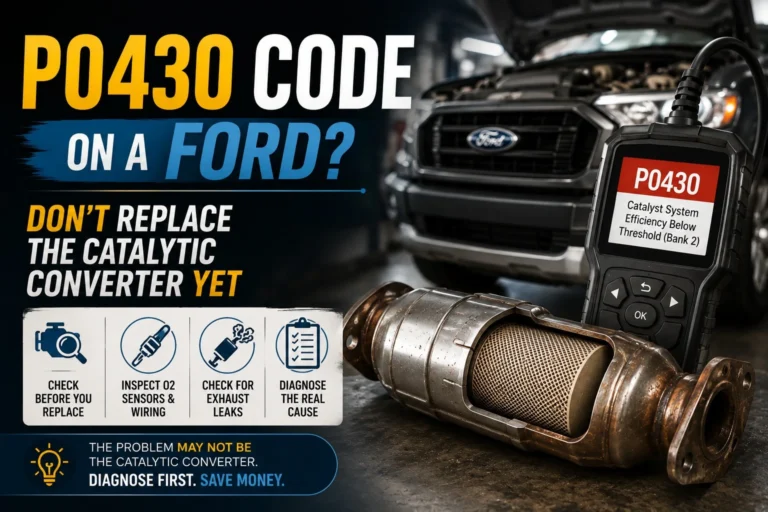
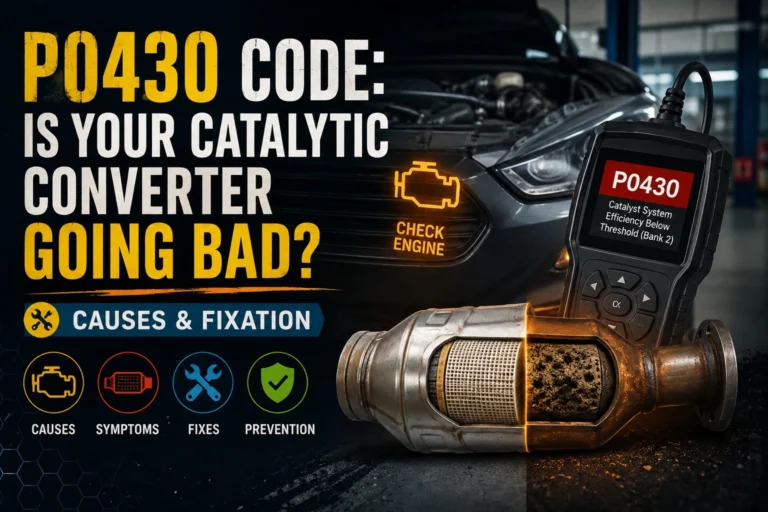
The catalytic converter is the most common and most expensive check engine light repair, averaging $1,511 in 2025. If you are not yet familiar with what a catalytic converter does, what a catalytic converter is and how it works covers that in full detail. CarMD notes that unresolved misfires and faulty oxygen sensors can eventually damage the converter, which is why a proper diagnosis comes before any converter quote.
Picture a 2012 sedan that rolls into a shop with a steady light and a code for low catalyst efficiency. Replacing the converter on that code alone would cost close to the $1,511 average. Instead, the technician opens the live data and finds a pending misfire on cylinder three, and the freeze frame shows it happened at idle. A worn spark plug and a tired ignition coil were letting unburned fuel reach the converter. Replacing them, roughly $480 based on CarMD’s average, and rechecking after a week of driving avoids the larger repair. This is an illustrative example, not a specific customer case.
EVAP System Problems
The EVAP system traps fuel vapor from the tank so it does not escape into the air. Faults usually come from a loose or worn gas cap, a cracked hose or a stuck purge valve. The EVAP canister purge control valve averaged $172 in 2025, and a new gas cap is typically a small fraction of that.
Electrical and Sensor Problems
Wiring faults, failed sensors and weak voltage can all set codes. The ABS wheel speed sensor entered CarMD’s national top 10 for the first time in 2025 at $314, and thermostat replacement averaged $324 because a stuck thermostat keeps the engine from reaching normal temperature.
Can You Get a Free Check Engine Light Diagnostic?
Yes, you can get a free check engine light scan at many AutoZone, O’Reilly Auto Parts and Advance Auto Parts locations, and some NAPA stores and independent shops run similar offers. It is a code reading, not a full diagnosis, but it gives you a solid starting point at no cost.
What a Free Check Engine Light Scan Includes
A free check engine light scan includes a code reading from your car’s computer, and many stores print or text a report. AutoZone calls its version Fix Finder, and O’Reilly calls its version VeriScan, which identifies codes, the systems involved and suggested next steps. The scan itself can take under a minute. O’Reilly can also read ABS, transmission and maintenance lights on many vehicles.
Treat a free check engine light diagnostic as step one. It tells you whether you are dealing with a loose cap, a sensor or something that needs a technician.
Where Free Check Engine Light Scans Are Available
Most parts stores offer this check engine light service at no charge on 1996 and newer vehicles, but availability varies by location. O’Reilly says no appointment is necessary. A free engine light check is easiest to find by calling the nearest store, and some repair shops run seasonal free scan promotions.
Drive to the store only if the light is steady. A flashing light means stop and call for help.
What a Free Scan Does Not Include
A free scan does not include live data testing, component testing, wiring checks or a repair guarantee. It cannot tell you which part has failed. Replacing the first part on a generic report can waste money, so use the report to guide your next question rather than your parts order.
Free Scan vs. Professional Diagnostic Service
The table below compares a free check engine light scan with professional check engine light diagnostics, so you can decide which one your situation needs.
| Feature | Free parts store scan | Professional diagnosis |
|---|---|---|
| Cost | $0 | About $50 to $233, depending on the shop |
| Time | Under a few minutes | One to one and a half hours of labor, sometimes longer |
| Trouble codes | Yes | Yes |
| Live data and component tests | Not typically included | Included |
| Finds the failed part | No, it points to a system | Yes, that is the purpose |
| Repair estimate | General guidance | Specific written estimate |
| Best for | Simple or first look codes | Flashing lights, repeat codes, poor driving |
How Much Does Check Engine Light Diagnosis Cost?
Check engine light diagnosis costs $0 for a basic parts store scan, about $50 to $150 at many independent shops, and $100 to $400 or more at a dealership. RepairPal’s July 2026 estimate for a professional diagnosis is roughly $122 to $233 nationally.
This table summarizes each route and what it buys, so you can compare check engine light diagnostic prices side by side.
| Option | Typical cost | What you get |
|---|---|---|
| Free scan at an auto parts store | $0 | Code reading and a basic report |
| Your own OBD II code reader | About $20 to $35 one time | Unlimited scans at home |
| Independent repair shop | $50 to $150 | Codes plus technician testing |
| RepairPal national estimate (July 2026) | $122 to $233 | Full professional diagnosis |
| Kelley Blue Book national average | $131 to $209 | Full professional diagnosis |
| Dealership | $100 to $400 or more | Brand specific tools and training |
Cost of a Free Check Engine Light Scan
A free check engine light scan costs nothing, and a code reader you own costs about $20 to $35 once. Neither includes technician testing, so budget for a paid diagnosis if the code is complex or the light returns.
Cost of Professional Diagnosis
A professional check engine light diagnostic typically covers 60 to 90 minutes of labor. The fee depends on the shop’s hourly rate, and AAA reports labor rates across its approved shops ranging from $47 to $215 per hour. Many shops credit the fee toward the check engine light repair if you approve the work there.
What Affects Diagnostic Costs
Four factors move the price: the shop’s hourly labor rate, the type of facility, how complex the fault is, and whether the vehicle needs brand specific software. Dealerships cost more because of factory tools and training. Intermittent electrical faults cost more because they take longer to reproduce.
When Paying for Diagnosis Can Save You Money
A check engine light diagnosis pays for itself when the code is ambiguous, the light is flashing, or the car runs poorly. With repair averages of $554 overall and $1,511 for a converter, spending $100 to confirm the cause before buying parts is a sensible trade.
What Check Engine Light Repair Steps Come After a Diagnostic?
After the diagnostic, repair the confirmed fault, clear the codes, complete a drive cycle so the readiness monitors run again, and confirm the light stays off. Clearing codes before the repair only hides the warning and erases the freeze frame data a technician needs.
Identify the Cause of the Problem
Match the code to a tested cause, not a guess. Ask the shop what was tested, what the readings were and why the recommended part is the cause. Keep a copy of the codes and freeze frame data so you can compare if the light returns.
Repair the Underlying Fault
Proper check engine light repair fixes the root cause, not just the part named in the code. Replacing an oxygen sensor on a car with an exhaust leak, for instance, brings the light back within days. Use quality parts that match your vehicle’s specification.
Clear the Diagnostic Trouble Codes
Clear the codes only after the repair is complete and documented. Clearing also erases freeze frame data and resets readiness monitors. If you want the safe way to do it how to reset the check engine light safely explains the methods.
Complete a Drive Cycle
A drive cycle is a pattern of starting, idling, accelerating and cruising that lets the computer rerun its self tests. The correct pattern varies by vehicle, so check the owner’s manual. New York’s DMV describes a generic cycle that begins with about two and a half minutes of idling with the air conditioning and rear defrost on. Readiness monitors must finish before most emissions inspections will accept the car.
Confirm That the Check Engine Light Stays Off
Drive normally for several days, then scan again for pending codes. A clean scan with no pending codes and monitors showing ready confirms the repair worked. If the light returns with the same code, the first diagnosis missed something and the shop should recheck.
Can You Drive Before Getting a Check Engine Light Diagnostic?
A steady check engine light usually allows careful, short driving to a parts store or shop, but a flashing light means pull over and stop. A flashing light signals a serious fault such as an active misfire that can damage the catalytic converter.
When a Solid Check Engine Light May Be Less Urgent
If the light is steady, the car drives normally and no red warning lights are on, you can usually drive to get a free check engine light scan the same day. Check the gas cap first, since a loose cap is a common minor cause. Do not postpone the scan for weeks.
When a Flashing Light Requires Immediate Action and Signs You Should Stop Driving
A flashing light calls for stopping as soon as it is safe, because continued driving can damage the converter and engine. Stop driving if you notice any of these signs:
- The light is flashing while the engine shakes or hesitates.
- The car loses power or stalls.
- You smell burning or see smoke.
- A red oil pressure or temperature warning appears with the check engine light.
Call a tow service instead of risking a larger repair bill.
Why Ignoring the Light Can Make Repairs More Expensive
Small faults often cause bigger ones. CarMD points out that unresolved misfires and failing oxygen sensors can eventually destroy the catalytic converter, turning a repair near $480 into one near $1,511. Delaying check engine light repair also risks failing an emissions inspection and wasting fuel.
James Mitchell
Senior Automotive Writer
12+ years writing clear, practical guides on vehicle maintenance and emissions systems.
Frequently Asked Questions
Conclusion:
The fastest path to check engine light repair is a free check engine light scan at a parts store, followed by a paid diagnosis when the code is complex, the light is flashing or the car runs poorly. Write down every code, ask whether the fee is credited toward repairs, and confirm the cause before buying parts. If the light is flashing today, stop driving and call a shop.