Honda Accord Catalytic Converter: Location, Cost, Symptoms & Scrap Value
A Honda Accord catalytic converter replacement costs roughly $300 to $850 installed with an aftermarket federal converter and $1,050 or more with a genuine Honda part, depending on your engine, model year and state. Four cylinder Accords usually have one main converter near the engine, while V6 models have three. The most common warning sign is a check engine light with code P0420. Below you will find where each converter sits, what failure looks like, costs by option and year, scrap value, theft risk and the rules that decide which part you can install.

James Mitchell
Senior Automotive Writer
12+ years writing clear, practical guides on vehicle maintenance and emissions systems.
Where Is the Honda Accord Catalytic Converter Located?
On a four cylinder Accord, the main converter sits close to the engine near the exhaust manifold, and some versions add a second unit under the floor. V6 Accords have three converters: one on each cylinder bank and a third under the car. Turbocharged 2018 to 2022 models tuck the converter into the engine bay.
If you are not yet familiar with what a catalytic converter does, what a catalytic converter is and how it works covers that in full detail. The table below shows where each converter sits and which trouble code usually points to it.
| Engine | Converter | Position | Usual code |
|---|---|---|---|
| 2.4L four cylinder | Primary | Near the engine, often built into the exhaust manifold | P0420 |
| 2.4L, some emissions versions | Secondary | Under the car, farther back | P0420 |
| V6 (3.0L or 3.5L) | Bank 1 | Rear bank by the firewall, often with the manifold | P0420 |
| V6 (3.0L or 3.5L) | Bank 2 | Front bank by the radiator | P0430 |
| V6 (3.0L or 3.5L) | Third | Under the car after the pipes merge | Rarely sets its own code |
| 1.5L or 2.0L turbo, 2018 to 2022 | Primary | In the engine bay | Scan to confirm |
A bank is one side of a V6, and bank 1 is the rear side. Because each catalytic converter Honda Accord owners shop for is sold by engine and position, confirm yours with the VIN and the emissions label under the hood before buying.
How Much Does a Honda Accord Catalytic Converter Cost to Replace?
Expect roughly $300 to $850 installed for an aftermarket federal converter, $750 to $1,550 for a CARB compliant one and $1,050 to $3,050 for a new Honda original, based on typical labor of $150 to $350. A used original converter runs about $350 to $1,150 installed. Your engine and state rules decide which row applies.
The table below breaks down part prices by option, with labor as its own row.
| Option | Typical part price | Best fit | Watch out for |
|---|---|---|---|
| Aftermarket federal (EPA) | $150 to $500 | Budget repairs outside CARB states | A low metal load can bring the light back |
| Aftermarket CARB compliant | $600 to $1,200 | Cars registered in California, Colorado, New York or Maine | Costs more and may not last like an original |
| Used original (OEM) | $200 to $800 | Best balance when inspected | Reject any unit that rattles |
| New Honda original (OEM) | $900 to $2,700 or more | Exact fit and longest life | Highest cost |
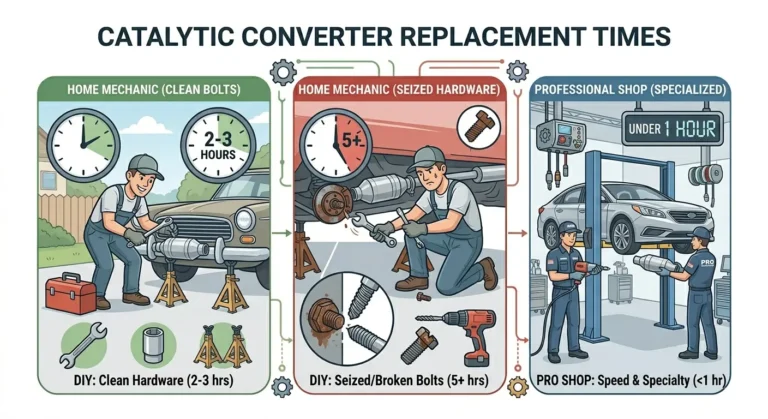
| Shop labor | $150 to $500 | Often $150 to $350 | V6 bank 1 takes longest |
Why Do Online Repair Estimates Show Such Different Prices by Model Year?
Online repair estimators mostly reflect genuine Honda part pricing, so they run higher than aftermarket quotes. For the Accord they span $1,493 to $4,769 by model year, and the newest cars cost the most. Use them as a ceiling, then compare aftermarket and used quotes.
The table below shows the ranges by model year group, and the 2018 to 2022 spread shows how widely sources disagree.
| Model years | Typical engines | Estimated full replacement cost |
|---|---|---|
| 2003 to 2007 | 2.4L four cylinder, 3.0L V6 | $2,844 to $2,925 |
| 2008 to 2012 | 2.4L four cylinder, 3.5L V6 | $1,598 to $1,682 |
| 2013 to 2016 | 2.4L four cylinder, 3.5L V6 | $2,171 to $2,267 |
| 2018 to 2022 | 1.5L and 2.0L turbo | $1,493 to $4,391 |
| 2023 and newer | Latest generation | $4,621 to $4,769 |
Should You Choose a New Honda Part, an Aftermarket Converter or a Used One?
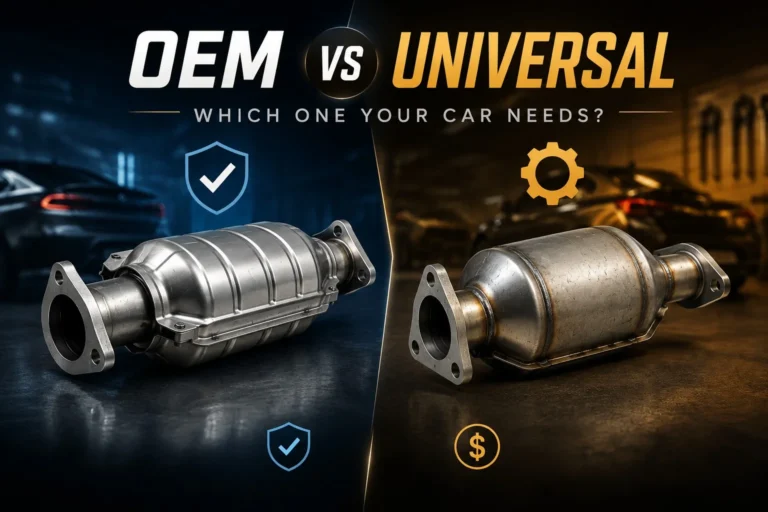
A new Honda converter fits best and lasts longest but costs the most. Premium aftermarket brands such as MagnaFlow and Walker balance price and reliability, while economy units sometimes bring the check engine light back. A carefully inspected used original converter is often the best value.
Honda engine computers are sensitive to converters with a low precious metal load, so a very cheap unit may set P0420 again within months. Buy a direct fit part, which bolts on without cutting or welding, and before accepting a used unit, shake it for rattling and look through both ends for an intact honeycomb.
What Are the Symptoms of a Failing Honda Accord Catalytic Converter?
The most common sign is a check engine light with code P0420, or P0430 on a V6 bank 2 converter. Other symptoms include sluggish acceleration, worse fuel economy, a rattle under the car, a rotten egg smell and a failed emissions test. A clogged converter chokes the engine, so do not drive on it for long.
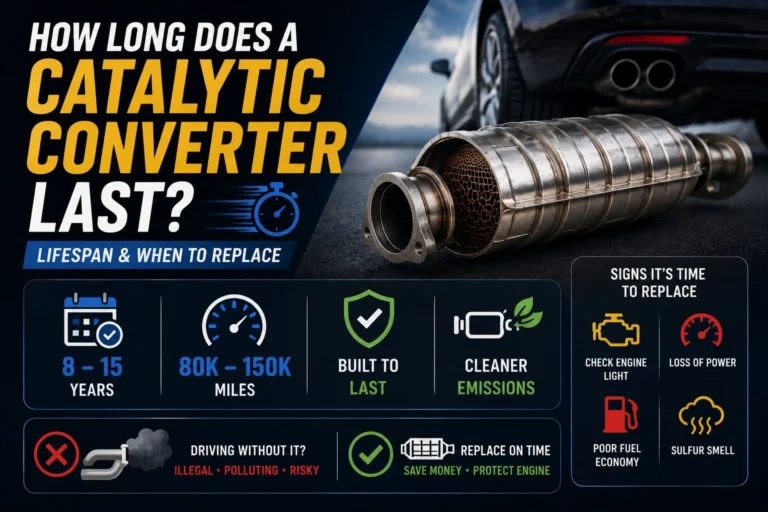
Code P0420 means catalyst efficiency is below the limit. The engine computer compares the oxygen sensors before and after the converter, which measure leftover oxygen in the exhaust, and when their readings start to match, it concludes the converter has stopped cleaning the gases. A rattle at startup usually means the ceramic honeycomb has broken apart, while poor power and mileage point to a blockage. For a full symptom checklist that applies to any car, how to tell if a catalytic converter is bad goes through it in detail.
How Can You Tell Whether the Converter Is Really the Problem?
A P0420 code does not automatically mean the converter is bad. Check for exhaust leaks, a weak downstream oxygen sensor, misfires and fuel trim problems first, then confirm with scan tool data or a temperature test. Replacing the converter without fixing the cause can destroy the new part.
Work through these checks in order before you buy a part:
- Read every stored code with an OBD II scanner and note any misfire, fuel trim or oxygen sensor codes that appear alongside P0420.
- Listen for exhaust leaks between the engine and the converter, because leaking air can fool the sensors.
- Watch live data, where the downstream oxygen sensor should hold fairly steady while the upstream sensor switches quickly, and matching patterns point to the converter.
- Warm the engine and measure the pipe before and after the converter with an infrared thermometer, where the outlet should be at least 100 degrees Fahrenheit hotter than the inlet.
- Ask a Honda dealer to check service bulletins for your VIN, since software updates and extended coverage have applied to some Accords with false catalyst codes.
Picture a 2006 Accord that arrives with a P0420 code and an owner who has already been quoted for a new converter. The technician reads live data and finds the downstream oxygen sensor responding slowly, then spots a leaking exhaust gasket ahead of the converter that is letting air into the pipe. He replaces the gasket and the sensor for a fraction of the converter price, clears the code and rechecks after a week of normal driving. The light stays off. That is an illustrative example, but it shows why a short diagnostic hour often saves a converter that was never failing.
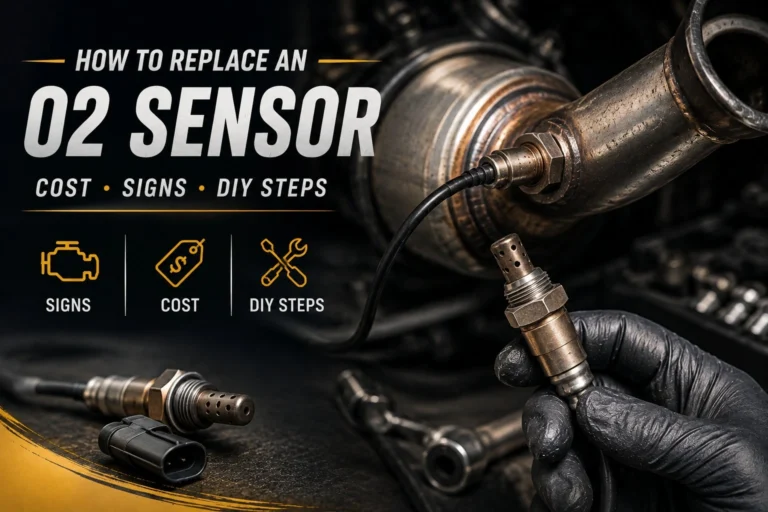
If the tests do point to the converter, replace the oxygen sensors at the same time and fix whatever damaged the old unit, whether a misfire, an oil leak or a rich mixture. A new converter over an unsolved problem often fails within months.
Which Converter Fits Your Model Year and Engine?
Honda Accord converters are not interchangeable across generations. Fitment depends on model year, engine size, bank position and whether the car was built to federal or California emissions rules. Use your VIN and the emissions label under the hood, then match the part to your exact year group below.
Does the 2003 Honda Accord Catalytic Converter Differ From the 2007 Model?
The 2003 to 2007 cars share one generation, so the converters follow a similar layout, but engine size and emissions version still set the part number. A 2003 Honda Accord catalytic converter for the 2.4L four cylinder will not match a 3.0L V6, and California cars need a different unit.
Shoppers comparing a 2004 Honda Accord catalytic converter with a 2005 Honda Accord catalytic converter will mostly find direct fit units that bolt on without welding. Many four cylinder cars from this period build the converter into the manifold assembly, which adds labor. The same applies to the 2006 Honda Accord catalytic converter and the 2007 Honda Accord catalytic converter, but Honda issued a bulletin for some 2007 cars with the 2.4L engine: an engine computer software update may clear P0420 without new parts. Cost guides put the full job for a 2003 Honda Accord catalytic converter, and every car through 2007, at $2,844 to $2,925, so ask a dealer about that bulletin first.
What Changes With the 2008, 2010, 2012 and 2013 Models?
The 2008 to 2012 cars use 2.4L four cylinder and 3.5L V6 engines, and the 2013 redesign moved to different converter part numbers. A 2010 Honda Accord catalytic converter is usually a different part from the one a 2013 car needs, so match year group, engine and position.
The 2008 Honda Accord catalytic converter opens this generation, and aftermarket makers such as MagnaFlow list one direct fit 2.4L converter covering 2008 to 2012, which includes the 2012 Honda Accord catalytic converter. Cost guides list $1,598 to $1,682 for the full job on a 2010 Honda Accord catalytic converter, versus about $2,171 to $2,267 for a 2013 Honda Accord catalytic converter, which sits in a separate 2013 to 2017 parts group. On V6 cars from these years, Honda’s Variable Cylinder Management system can burn oil, foul spark plugs and contaminate the converters, so fix oil consumption first.
Why Is the Honda Accord Catalytic Converter Stolen So Often?
Accords are common, easy to slide under and fitted with converters that contain platinum, palladium and rhodium. A Carfax review of repair records from 2019 to early 2022 ranked 1989 to 2020 Accords as the second most targeted model for converter theft, and thieves can cut one out in under two minutes.
The National Insurance Crime Bureau counted reported converter thefts rising from 3,389 in 2018 to 14,443 in 2020. Parts guides say 2014 to 2017 Accords are easy targets because the converter hangs under the car, while the engine bay placement on 2018 to 2022 cars makes theft harder. A loud roar at startup is the first sign. Park in a well lit area or garage, fit a metal shield or cage over the converter and consider etching your VIN on it.
How Much Is a Honda Accord Catalytic Converter Worth as Scrap?
A used Accord converter is listed at about $78 to $331 on scrap market price trackers, while the National Insurance Crime Bureau says recyclers usually pay $50 to $250 for a standard converter. The final figure depends on the precious metal content, the converter design and the buyer.
Scrap value moves with platinum, palladium and rhodium prices, the converter’s age and whether the ceramic core is intact. Get a written quote from a licensed recycler, be wary of any buyer offering far above these ranges, and confirm your state’s rules for selling used converters first.
Does a Warranty or State Emissions Rule Decide Which Converter You Can Buy?
Yes. Federal rules cover the catalytic converter for 8 years or 80,000 miles, whichever comes first, and California, Colorado, New York and Maine generally require CARB compliant converters. Most other states accept federal EPA converters. Check the emissions label under the hood and your state rules before you order.
A 2018 to 2022 Accord under 80,000 miles may still be covered, so ask a Honda dealer before paying out of pocket. California PZEV vehicles can carry longer coverage, reported as up to 15 years or 150,000 miles. To find your type, check the emission control label on the radiator support or underside of the hood. If it mentions CARB, ULEV or SULEV and you live in a CARB state, buy a CARB compliant converter, because the wrong type can fail inspection. Rules differ by state, so confirm locally.
James Mitchell
Senior Automotive Writer
12+ years writing clear, practical guides on vehicle maintenance and emissions systems.
Frequently Asked Questions
Conclusion:
A Honda Accord catalytic converter problem is rarely solved by the first part you find online. Confirm the code with live data, rule out leaks and weak oxygen sensors, then buy the catalytic converter Honda Accord emissions rules require for your engine, bank position and state. Get quotes for a quality aftermarket unit and a used original before accepting a dealer price, and add a theft shield afterward. Start by scanning your codes this week.