Flashing Check Engine Light: Causes, Risks & Solutions
A check engine light flashing on your dashboard means the engine is misfiring badly enough to damage the catalytic converter, so you should slow down, pull over safely and stop driving. A steady light says to book a repair soon, while a flashing check engine light is an emergency signal from the engine computer. Unburned fuel is reaching the exhaust, where it can overheat the converter within minutes. Most causes are cheap, such as worn spark plugs or a failed ignition coil, but waiting can turn a repair of a few hundred dollars into a bill above $1,500.

James Mitchell
Senior Automotive Writer
12+ years writing clear, practical guides on vehicle maintenance and emissions systems.
What Does a Flashing Check Engine Light Mean?
A flashing check engine light means your engine computer has detected an active misfire severe enough to damage the catalytic converter. The light belongs to the onboard diagnostics system, and it blinks only when the misfire rate crosses a built in damage threshold. Treat it as a stop driving warning, not a service reminder.
A misfire happens when a cylinder fails to burn its air and fuel mix. The unburned fuel burns inside the catalytic converter instead and can melt its internal honeycomb. If you are not yet familiar with what a catalytic converter does, what a catalytic converter is and how it works covers that in full detail.
The computer spots misfires by watching crankshaft speed and stores a code such as P0300 or P0301. A steady light covers dozens of faults, but a flashing check engine light is reserved for the few that cannot wait.
Flashing vs. Blinking Check Engine Light: Is There a Difference?
No, there is no technical difference. A blinking check engine light and a flashing one describe the same warning, and both signal an active misfire that can harm the catalytic converter. The pattern matters more than the word: steady means a stored fault, while intermittent means urgent.
If a check engine light blinking appears only under hard acceleration, it still counts, because engine load is when a misfire is worst. If the flashing stops and the light turns solid, the misfire has dropped below the damage threshold, but the fault remains and still needs repair.
7 Common Causes of a Flashing Check Engine Light
The most common cause of a flashing check engine light is a misfire from worn spark plugs or a failing ignition coil. Fuel injectors, vacuum leaks, fuel delivery faults, internal engine wear and a damaged catalytic converter make up the rest. A scan tool usually shows P0300 or a cylinder specific code from P0301 to P0308.
These seven causes run roughly from most to least common:
- Worn spark plugs lose their electrode and crack their insulator with age, which weakens the spark, and many last only about 100,000 miles.
- Failing ignition coils, which turn battery voltage into the spark, can die from heat, oil leaks or worn plugs and silence a cylinder completely.
- Clogged or leaking fuel injectors flood or starve one cylinder and cause a steady misfire.
- Vacuum leaks and dirty mass airflow sensors upset the air and fuel balance, often with P0171 or P0101 stored beside the misfire.
- Weak fuel pumps, clogged filters or a tank of contaminated gas can starve the engine until the bad fuel is used up.
- Internal engine damage, such as low compression or a jumped timing belt or chain, causes misfires that new plugs will not cure.
- A clogged converter is usually the victim of a misfire, but a blocked one can also choke exhaust flow and trigger one.
Oxygen sensors and loose gas caps normally produce a steady light, so they rarely explain a flashing check engine light on their own.
Check Engine Light Flashing and Car Shaking: What Does It Mean?
A check engine light flashing and car shaking at the same time almost always means a cylinder has stopped firing. The engine runs unevenly because that cylinder adds no power, and the vibration is strongest at idle or under load. Pull over safely and shut the engine off.
Hesitation, weak acceleration, popping from the exhaust and worse fuel economy often accompany the shaking. A dead coil, bad plug or damaged wiring causes most cases, which are cheap to fix when you act quickly.
Here is a typical scenario from the shop floor. A midsize SUV arrives shuddering at every stoplight with the light flashing, and the scanner shows P0303, a cylinder 3 misfire. The technician swaps the cylinder 3 coil with the one on cylinder 2 and clears the code. After a short test drive the code changes to P0302, which proves the coil is guilty rather than the plug or injector. A new coil and fresh plugs fix it for a few hundred dollars. A driver who keeps running errands for a week often comes back needing a converter too.
Is It Safe to Drive With a Flashing Check Engine Light?
No. Active misfires can begin destroying the catalytic converter within minutes, and the car may lose power in traffic. Stop as soon as it is safe, turn off the engine and arrange a tow. Gentle driving is a last resort, and only if the light stops flashing.
Easing off the throttle sometimes calms a blinking check engine light, because the misfire often lessens with less load. If the light turns solid and the engine feels smooth, drive gently to a shop. If it keeps flashing or the engine feels rough, stop. Avoid towing a trailer, climbing hills and highway passing, because heavy load makes misfires worse.
What Should You Do When the Check Engine Light Starts Flashing?
If you see a check engine light flashing, ease off the accelerator, pull over somewhere safe and turn the engine off. Then get the trouble codes read and arrange a tow or repair. These five steps cover the full sequence:
- Ease off the accelerator and avoid hard acceleration until you can stop.
- Pull over, switch on the hazard lights and shut the engine off if the flashing continues or the car shakes.
- Note the symptoms, including shaking, noises, smells, power loss and anything that happened just before, such as a fuel fill up.
- Read the codes with an OBD2 reader from about $20, or ask a parts chain such as AutoZone, which typically scans for free, once the car is safely moved.
- Arrange a tow if the flashing persists, and leave the codes stored so the technician can see what failed.
How Much Does It Cost to Fix a Flashing Check Engine Light?
Most flashing check engine light repairs cost roughly $240 to $500, because spark plugs and ignition coils are the usual culprits. A coil and plug job averages about $480, while catalytic converter replacement averages about $1,500 and can reach $3,500. Vehicle, parts quality and local labor rates drive the difference.
The table below shows typical US prices for the repairs that most often sit behind a flashing light.
| Repair | Typical US cost (2025 to 2026 data) |
|---|---|
| Diagnostic scan, independent shop | $90 to $180 |
| Diagnostic scan, dealership | $122 to $250 |
| Spark plug replacement | About $300 |
| Ignition coil replacement | $240 to $320 |
| Ignition coil and spark plugs together | About $480 |
| Oxygen sensor replacement | $250 to $290 |
| Mass airflow sensor replacement | About $320 |
| Catalytic converter replacement | $900 to $3,500 |
The 2026 CarMD Vehicle Health Index put the average check engine repair at $554 for 2025, a 33 percent jump in a year. The gap between the first and last rows is why a flashing check engine light should never wait. For a full price breakdown by vehicle and part type, see catalytic converter replacement cost.
How to Diagnose a Flashing Check Engine Light
Diagnosing a check engine light flashing starts with reading stored trouble codes through the OBD2 port, the diagnostic socket under the dashboard. P0300 means random misfires, while P0301 to P0308 name the exact cylinder. Inspect the ignition parts first, then fuel and air systems, then engine compression.
This table translates the codes you are most likely to see.
| Code | Meaning | Check first |
|---|---|---|
| P0300 | Random or multiple cylinder misfire | Spark plugs, coils and vacuum leaks |
| P0301 to P0308 | Misfire on a specific cylinder | Plug, coil and injector on that cylinder |
| P0171 | System too lean on bank 1 | Vacuum hoses and mass airflow sensor |
| P0101 | Mass airflow sensor range or performance fault | Sensor dirt and intake air leaks |
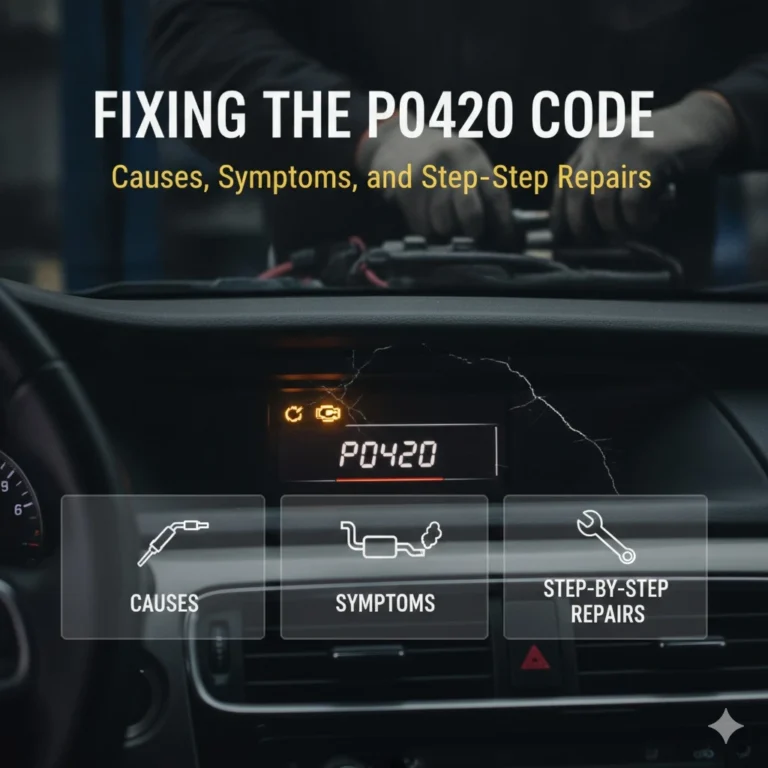
| P0420 | Catalyst efficiency below threshold | Converter damage after long misfires |
| P0440 | Evaporative emission system fault | Gas cap and seal, usually a steady light |
Compare the plug from the named cylinder with the others, swap its coil with a neighbor, then check injectors, hoses and the airflow sensor. A scan tool that shows misfire counters and fuel trims beats a basic reader, because the same code can have several causes and guessing wastes money.
James Mitchell
Senior Automotive Writer
12+ years writing clear, practical guides on vehicle maintenance and emissions systems.
Frequently Asked Questions
Conclusion:
A check engine light flashing is the one dashboard warning you should never drive through. Pull over, shut the engine off and get the codes read before anything else, because most causes cost a few hundred dollars when caught early and more than $1,500 once the converter is damaged. If the car is still flashing, call a tow truck rather than risking the drive to a shop.
2 Comments