How Long Does a Catalytic Converter Last? Lifespan & When to Replace
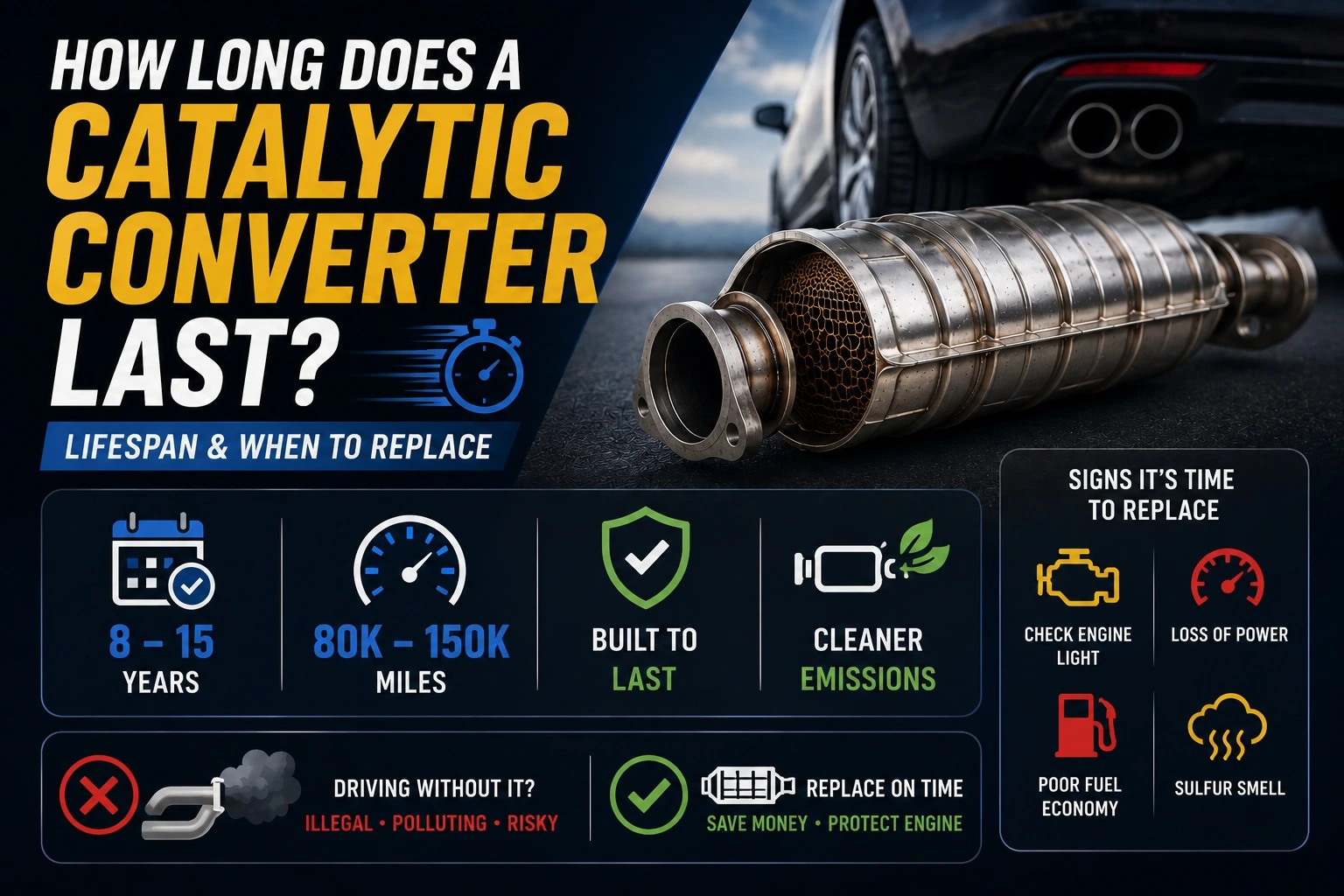
A catalytic converter typically lasts between 70,000 and 100,000 miles under normal driving conditions, though many well maintained vehicles push that number well past 150,000 miles. How long a catalytic converter lasts depends heavily on engine health, fuel quality, and whether other components like oxygen sensors and spark plugs are doing their job correctly. A converter rarely fails on its own, it usually fails because something upstream damaged it first. Understanding what shortens or extends that lifespan gives you a much clearer picture of whether your current converter is nearing the end of its service life or still has years left in it.

James Mitchell
Senior Automotive Writer
12+ years writing clear, practical guides on vehicle maintenance and emissions systems.
Lifespan Of A Catalytic Converter
Average Catalytic Converter Lifespan
How many miles a catalytic converter lasts varies quite a bit by vehicle and driving style, but most owners can expect a converter to survive somewhere between 70,000 and 100,000 miles before its efficiency drops enough to trigger a check engine light or show a P0420 code. Highway driven vehicles tend to land on the higher end of that range because the converter reaches and holds its optimal operating temperature more consistently. Stop and go city driving, short trips that never let the engine fully warm up, and frequent cold starts all push a converter toward the lower end of that range.
Can a Catalytic Converter Last 200,000 Miles?
Lasting 200,000 miles is genuinely possible, and it happens more often than most car owners assume. Converters that reach this kind of mileage almost always belong to vehicles that never suffered from oil burning, coolant leaks into the combustion chamber, or a misfiring cylinder that went unaddressed for weeks or months. In other words, the converter itself is durable. What kills it early is almost always a different problem that was allowed to keep sending contaminants downstream. The best thing you can do is to understand in detail how the catalytic converter works, so you can use it efficiently and increase its lifespan.
Catalytic Converter Warranty and Expected Lifespan
In the United States, catalytic converters are covered under federal emissions warranty for 8 years or 80,000 miles on most passenger vehicles, and some states extend that coverage even further. That warranty length is not arbitrary. Manufacturers set it based on the mileage at which converters are statistically expected to still be functioning correctly under normal use, which gives you a reasonable baseline for how long a catalytic converter lasts before you start budgeting for eventual replacement.
Signs of a Failing Catalytic Converter
Rattling Noise From the Catalytic Converter
The ceramic honeycomb structure inside a converter is fragile once it has been exposed to enough heat cycling or physical impact. When it starts to crack apart, loose pieces rattle around inside the metal housing, and you will hear a distinct metallic shaking sound, especially at idle or when driving over bumps. This is different from a heat shield rattle, which tends to be a lighter, higher pitched buzz rather than a heavier clunking noise.
Loss of Power and Rotten Egg Smell
A clogged converter restricts exhaust flow, which the engine feels as backpressure. That backpressure shows up as noticeably weaker acceleration, especially when trying to merge onto a highway or climb a grade. If you are not yet familiar with what a catalytic converter does inside the exhaust system, this guide covers that in full detail. A sulfur or rotten egg smell, meanwhile, usually points to a converter that is overwhelmed by unburned fuel rather than one that is simply old.
Real-World Example: Misdiagnosing a Failing Catalytic Converter
I had a customer come in about eight years ago with a 2006 Honda Accord that had been misfiring for weeks. Everyone had told her it was the spark plugs. Turned out the catalytic converter had been slowly failing and backing pressure into the engine the entire time. That single misdiagnosis cost her an extra three months of unnecessary repairs, two sets of spark plugs, and a tow bill after the car finally stalled out on the highway during rush hour traffic.
What Causes a Catalytic Converter to Fail?
Oil and Coolant Contamination
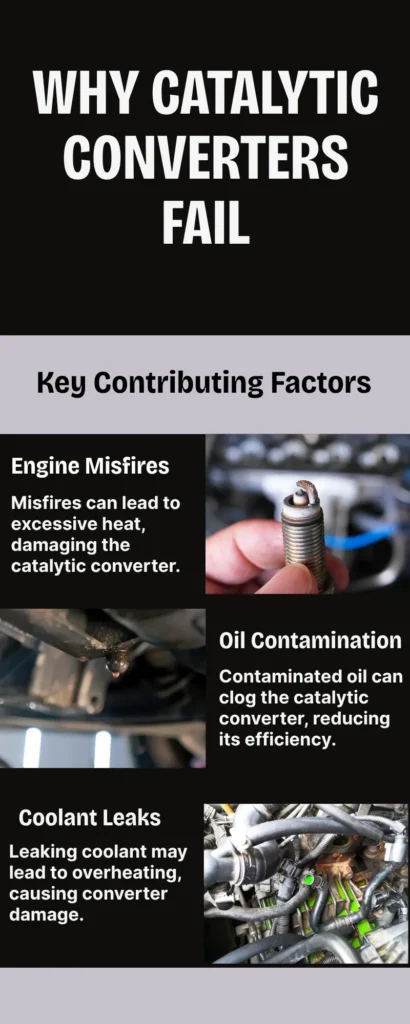
Oil and coolant are the two fastest ways to kill a converter early. When either one burns inside the combustion chamber and passes through the exhaust, it coats the catalyst material and blocks the chemical reaction the converter depends on to function. A worn valve seal, a leaking head gasket, or a failing piston ring can quietly shorten a converter’s life by tens of thousands of miles before the owner ever notices a problem.
Engine Misfires and Unburned Fuel Damage
Worn spark plugs, cracked plug wires, or a failing ignition coil cause incomplete combustion, and that unburned fuel travels straight into the converter. Once inside, it ignites there instead, creating far more heat than the converter was designed to handle continuously. This is one of the most common and most preventable causes of premature failure, and it directly affects how often to replace catalytic converter components across an entire vehicle’s lifetime.
Physical Damage and Corrosion
Converters sit low on the vehicle, which makes them vulnerable to impact damage from speed bumps taken too quickly, curbs, or road debris kicked up at highway speed. In regions that use road salt during winter, rust can also eat through the housing or the mounting brackets, eventually causing a leak or a full separation from the exhaust pipe.
|
Situation |
After How Many Miles |
Resolution |
|---|---|---|
|
Oil burning past worn rings |
40,000 to 80,000 miles |
Address blue exhaust smoke and oil consumption immediately |
|
Coolant leaking into cylinders |
30,000 to 70,000 miles |
Fix head gasket or intake gasket leaks as soon as they appear |
|
Chronic engine misfire |
20,000 to 60,000 miles |
Replace spark plugs and ignition coils on schedule |
|
Physical impact from road debris |
Can occur at any mileage |
Avoid speed bumps at speed and have undercarriage inspected yearly |
|
Rust from road salt exposure |
90,000 to 150,000 miles |
Rustproof the undercarriage in salt belt states |
|
Overheated catalyst from rich fuel mixture |
50,000 to 90,000 miles |
Keep oxygen sensors and fuel trims within normal range |
When Should You Replace a Catalytic Converter?
Don’t Replace a Catalytic Converter Based on Mileage Alone
A converter with 120,000 miles on it that shows no symptoms, passes an emissions test, and throws no codes does not need to be replaced simply because of its age. Replacing a functioning converter wastes money that would be better spent on parts that are actually showing wear. When to replace catalytic converter components should be a decision driven by test results and symptoms, not by mileage on the odometer alone.
Replace the Catalytic Converter After a Failed Emissions Test
If your vehicle fails a state emissions test specifically on hydrocarbon or carbon monoxide readings, and a mechanic confirms the converter itself is the cause rather than an upstream sensor or a vacuum leak, replacement becomes mandatory in most states before the vehicle can be legally registered again.
How to Diagnose a Failing Catalytic Converter
A proper diagnosis involves checking exhaust backpressure, comparing oxygen sensor readings taken before and after the converter, and scanning for stored codes related to catalyst efficiency. This Guide breaks down what a full replacement typically costs by vehicle type once a mechanic confirms the part itself has failed.
James Mitchell
Senior Automotive Writer
12+ years writing clear, practical guides on vehicle maintenance and emissions systems.
Frequently Asked Questions
Conclusion:
A converter that shows no symptoms and passes emissions testing does not need to be replaced regardless of its age, but ignoring a rattling noise, a rotten egg smell, or a catalyst efficiency code will only make the eventual repair more expensive. If you notice any of these signs, get a proper diagnosis before assuming how long a catalytic converter lasts applies the same way to every vehicle, since the real answer depends on how well the rest of the engine has been maintained.