O2 Sensor Spacers & Mini Catalytic Converters: Do They Really Fix P0420?
An oxygen sensor spacer or mini catalytic converter can sometimes switch off a P0420 check engine light, but neither one repairs a worn catalytic converter. Both parts dull the signal from the downstream oxygen sensor so the engine computer believes the converter is healthy. Results vary by vehicle, the code often returns, and in the United States these parts are widely treated as emissions tampering devices. You will see how each part works, what it costs in 2026 next to a real repair, how to choose and fit one for a legitimate purpose, and what to do instead.

James Mitchell
Senior Automotive Writer
12+ years writing clear, practical guides on vehicle maintenance and emissions systems.
What Is an Oxygen Sensor Spacer and How Does It Work?
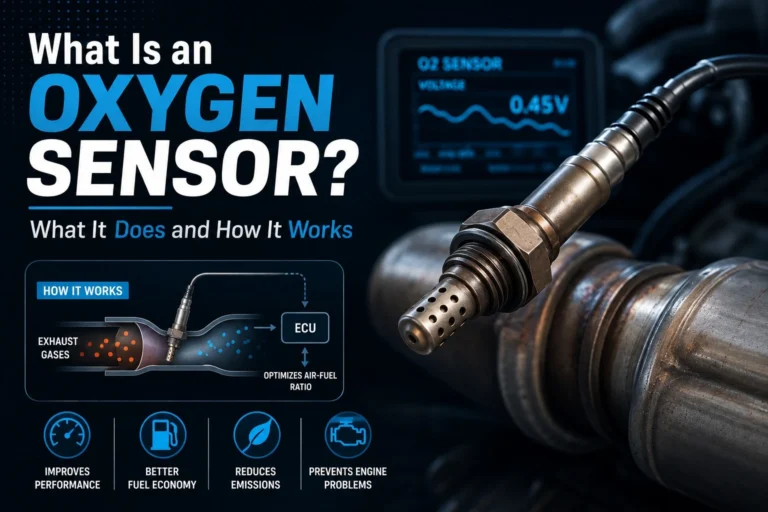
An oxygen sensor spacer is a short threaded adapter that sits between the exhaust pipe and the downstream oxygen sensor. It moves the sensor tip out of the main exhaust flow, which softens and slows its readings. On a borderline converter, that can stop the rear sensor from mimicking the front one and keep the P0420 code from setting.
If you are not yet familiar with what a catalytic converter does, what a catalytic converter is and how it works covers that in full detail. The upstream sensor swings quickly between rich and lean, while the downstream sensor behind a healthy converter stays fairly steady. When the rear signal starts copying the front one, the computer flags the converter, because the OBD II monitor is designed to catch emissions that could reach about 1.5 times the federal limit. A spacer works by flattening that rear signal, not by cleaning the exhaust.
What Does an Oxygen Sensor Adapter Do and Where Is It Installed?
An oxygen sensor adapter changes how the sensor attaches to the exhaust by adding length, changing the angle or holding a small catalyst. It threads into the sensor bung, which is the welded threaded port in the pipe, and the sensor then threads into the adapter. For P0420 and P0430 codes, sellers place it on the downstream sensor after the converter.
Many V6 and V8 engines have one downstream sensor per bank, so listings usually suggest one oxygen sensor adapter for each. An upstream sensor is a different story. It controls fuel mixture, and a spaced upstream sensor can set a slow response code such as P0133.
What Is the Difference Between an Oxygen Sensor Spacer, Extender and Extension?
Very little separates them. Sellers use oxygen sensor spacer, oxygen sensor extender and oxygen sensor extension for the same basic part, a threaded piece that offsets the sensor from the pipe. The real differences are length, angle and whether a catalyst or screen sits inside. An oxygen sensor spacer adapter listing means the same thing.
One European tuning shop describes its angled oxygen sensor extension as moving the sensor about 1.5 inches from the gas stream, and a wideband heat sink extender from Innovate adds 29.7 mm. The longer the offset, the weaker the signal, and heavy offsets can set sensor performance codes such as P0139, according to owner reports. Used legitimately, an oxygen sensor extender also protects wideband sensors from heat on turbo engines.
What Is a Mini Catalytic Converter and Does It Work?
A mini catalytic converter is a small metal canister with a catalyst coating, usually built into an oxygen sensor spacer. Exhaust passes through it on the way to the downstream sensor. It treats a tiny sample of gas rather than the exhaust stream, so it can smooth the sensor signal while the real converter does little.
California’s Bureau of Automotive Repair analyzed one in 2024 and found only trace precious metals: under 0.3 g/ft3 of platinum and palladium and under 0.1 g/ft3 of rhodium. Typical original underfloor converters carry 5 to 30 g/ft3. The analysis indicated the catalyst was not built for emissions control and exists to turn off the check engine light.
How Does a Mini Catalytic Converter Differ From a Standard Catalytic Converter?
A standard converter treats the whole exhaust stream and carries enough precious metal to cut hydrocarbons, carbon monoxide and nitrogen oxides. A mini catalytic converter treats only the gas reaching one sensor. The table compares the two on the points that matter to a car owner.
| Feature | Mini catalytic converter | Standard catalytic converter |
|---|---|---|
| Where it sits | Between the pipe and the downstream sensor | In the exhaust pipe or manifold |
| What it treats | A small sample of gas at the sensor | The full exhaust stream |
| Precious metal load | Trace amounts, under 0.3 g/ft3 platinum and palladium in one analysis | Typically 5 to 30 g/ft3 on original underfloor units |
| Main purpose | Soften the sensor signal and clear the code | Cut hydrocarbons, carbon monoxide and nitrogen oxides |
| Typical price | About $15 to $35 | From about $450 for US made aftermarket, around $1,878 for an OE example |
| Legal status on road vehicles | Treated as a defeat device when it hides a failing converter | Legal when compliant with EPA rules, and CARB rules where required |
When Is a Mini Catalytic Converter Used?
A mini catalytic converter spacer is used mostly after a converter has been removed, replaced with a high flow unit or worn out, when the owner wants a P0420 or P0430 light gone. None of those uses turns it into an approved emissions part, and it does not replace a working converter.
What Types of Oxygen Sensor Adapters Exist?
Most oxygen sensor adapters fall into four groups: straight spacers, angled spacers at 45 or 90 degrees, mini catalytic converter spacers and plug style parts. Straight and angled units differ mainly in clearance. An oxygen sensor plug is either a threaded cap that seals an unused sensor port or an electronic connector that fakes a signal, and both are tampering items on road vehicles.
This table sorts the common designs by shape and typical use.
| Type | Design | Typical use | Main caution |
|---|---|---|---|
| Straight spacer | Short threaded tube, usually M18 x 1.5 | Open bung with room around it | Can hit heat shields or transmission housings |
| 45 degree spacer | Angled body that sweeps the sensor sideways | Moderate clearance problems | Changes wire routing |
| 90 degree spacer | L shaped body | Tight spots near the transmission or heat shield | Confirm thread length and wire reach |
| Mini catalytic converter spacer | Spacer with a small catalyst or mesh | Marketed for P0420 and P0430 | Tampering when it hides a failing converter |
| Heat sink extender | Longer body that cools the sensor | Wideband sensors on turbo engines | Fit only where clearance allows |
| Oxygen sensor plug | Port cap or electronic simulator | Blocks a port or fakes a signal | Defeat device on road vehicles |
Do Oxygen Sensor Spacers Really Fix P0420?
Sometimes, but not the way you want. An oxygen sensor spacer can hide a P0420 code on a borderline converter, yet it does nothing to restore converter efficiency. Owner reports range from codes staying away for 3,000 miles to no change at all, and results depend heavily on the vehicle’s computer.
Why Does the P0420 Code Come Back After Fitting a Spacer?
The code returns when the converter keeps deteriorating or the offset is too small for your computer’s test. A weak converter loses efficiency over time, so the gap between the two sensors widens until the oxygen sensor spacer cannot hide it. Some computers tolerate a spaced sensor and others do not, which is why one owner reports 2,500 clean miles and another sees no change.
Picture a 2009 sedan with 190,000 miles that arrives with a P0420 and an owner who already bought two spacers online. Live data shows the rear sensor swinging almost like the front one, which marks a tired converter. The owner fits a 90 degree spacer anyway and the light stays off for three weeks, then returns as the converter loses more capacity. The spacer bought time, the converter bill was only postponed, and the owner paid for the spacer on top.
P0420 also has cheaper causes, such as an exhaust leak near the sensor or a failing downstream sensor, and how to diagnose a P0420 code covers those checks in detail.
Are Oxygen Sensor Spacers Legal in the United States?
For use on road vehicles, generally no. The federal Clean Air Act prohibits selling or installing parts whose principal effect is to bypass or defeat emissions controls, and California’s Bureau of Automotive Repair lists spacers, emulators and CEL fix eliminators as sensor tampering. Rules and inspections differ by state, so check local requirements. This is general information, not legal advice.
California regulators describe a spacer as simply removing the sensor from the exhaust stream and reducing signal sensitivity, and some state inspectors check visually for extenders or missing sensors. A spacer does not lower tailpipe pollution, so it is not a way to pass a smog test.
How Do You Choose the Right Oxygen Sensor Adapter?
Match four things: the thread size of your sensor bung, the connection between the sensor and the adapter, the clearance around the exhaust location and the number of downstream sensors your engine has. Confirm the part against your vehicle’s service information before you buy any oxygen sensor adapter.
How Do You Check the Oxygen Sensor Thread Size?
Most gasoline vehicles use an M18 x 1.5 sensor thread, the size nearly every universal oxygen sensor adapter lists. Some sensors use a smaller M12 thread, so measure the threaded section of your sensor or check its part specifications before ordering. The adapter needs matching internal and external threads, plus a crush washer or flat face for a tight seal.
How Do You Check Clearance and Vehicle Compatibility?
Hold the sensor next to its bung and measure free space to the heat shield, transmission tunnel and frame. A straight oxygen sensor extension adds roughly 1 to 1.5 inches of length, so crowded spots call for a 45 or 90 degree shape. One owner found a straight spacer would not clear a transmission housing and needed the L shaped type.
How Much Does an Oxygen Sensor Adapter Cost in 2026?
A generic oxygen sensor adapter costs roughly $12 to $16 online, and a mini catalytic converter spacer runs about $15 to $35. Replacing a downstream sensor costs about $150 to $400 installed, and a converter replacement commonly lands between $1,150 and $3,250.
The table lists current ranges for the parts and repairs a P0420 owner usually compares.
| Item | Typical price in 2026 | What drives the price |
|---|---|---|
| Generic oxygen sensor adapters (straight or angled) | $12 to $16 per listing | Material, angle and pack size |
| Mini catalytic converter spacer | $15 to $35 | Brand, angle and claimed catalyst |
| Downstream oxygen sensor replacement, installed | $150 to $400 per sensor | Vehicle, sensor brand and seized threads |
| Aftermarket converter replacement, independent shop | $1,150 to $2,200 | Compliant part, vehicle size and labor rate |
| OEM converter replacement, independent shop | $1,900 to $3,250 | Manufacturer part and labor rate |
| OEM converter replacement, dealership | $2,500 to $4,500 | Dealer labor rate, hybrids and luxury models |
What Else Affects the Total Cost?
Labor rises when the sensor is seized in the pipe, and one price guide puts labor at $400 to $750 when rusted hardware stretches the job past an hour. A V6 or V8 may need two oxygen sensor adapters, and hybrids or engines with several converters can pass $4,000 to $6,000 for a real replacement. Imported converters sold online for as low as $50 are a trap: California data shows US manufactured units start near $450; the cheap imports were not built to meet emissions standards.
How Do You Install an Oxygen Sensor Adapter on the Downstream Sensor?
Fit an oxygen sensor extender or adapter only for a legitimate purpose, such as clearance or heat protection, and always work on a cold exhaust. These five steps cover a standard threaded unit.
- Let the exhaust cool completely, then unplug the downstream sensor connector and spray penetrating oil on rusty threads.
- Remove the sensor with an oxygen sensor socket, turning steadily so you do not damage the bung threads.
- Thread the adapter into the bung by hand to avoid cross threading, then tighten it to the torque your service manual lists for the sensor.
- Thread the sensor into the adapter using sensor safe anti seize unless the sensor already has it, and tighten by hand and wrench, never an impact wrench, to the maker’s torque, which NGK lists as 26 to 33 ft lbs for M18 sensors and 13.2 to 17 ft lbs for M12 sensors.
- Route the wire away from hot parts, reconnect the plug and clear stored codes with a scan tool.
How Do You Check for Exhaust Leaks After Installation?
Start the engine and listen for ticking or puffing at the adapter joint, then look for soot trails around the threads. A leak near the downstream sensor draws in outside air that can mimic converter failure and set a P0420 by itself. Retighten to spec if you find one.
James Mitchell
Senior Automotive Writer
12+ years writing clear, practical guides on vehicle maintenance and emissions systems.
Frequently Asked Questions
Conclusion:
An oxygen sensor spacer or mini catalytic converter is a low cost workaround that can quiet a P0420 light, but it leaves a worn converter in place and carries legal risk on road vehicles. If your light is on, scan the codes, check for leaks, test the downstream sensor, then budget for a compliant converter. Keep adapters for legitimate jobs such as sensor heat protection or clearance.