
Check Engine Light Meaning: Why It Is On & What to Do
The check engine light meaning is simple: your car’s computer has detected a fault in the engine, emissions or transmission system and stored a trouble code. A solid light usually means you can drive to a shop soon, while a flashing light means stop driving as soon as it is safe. When a check engine light came on in your dashboard, the cause is often cheap, like a loose gas cap, but it can also point to a $1,511 catalytic converter replacement. Below you will find every common cause, what each repair costs in 2026, and exactly what to do next.

James Mitchell
Senior Automotive Writer
12+ years writing clear, practical guides on vehicle maintenance and emissions systems.
What Does the Check Engine Light Mean?
A check engine light means your vehicle’s onboard computer found a problem it cannot fix by itself and saved a diagnostic trouble code. The fault can sit in the engine, the emissions system or the transmission. The light never names the failed part, so a code scan is the only way to learn what triggered it.
What Is the Check Engine Light?
The check engine light, officially called the malfunction indicator lamp (MIL), is an amber dashboard symbol, usually an engine outline, that the engine control unit switches on when it detects an emissions or powertrain fault. Some cars label it Service Engine Soon or Check Powertrain.
Drivers also call it the engine check light, the engine warning light or the CEL. The EPA has required onboard diagnostics (OBD2) on cars and light trucks since model year 1996, so every modern vehicle has one. The light should glow briefly when you turn the key on and go out once the engine starts. That flash is a bulb test, not a fault.
Why Did My Check Engine Light Come On?
The light comes on when a sensor reading falls outside the range the computer expects, or when a self test of an emissions component fails. Most faults involve the fuel mixture, ignition, exhaust or evaporative system. On many vehicles a first detection is stored as a pending code, and the light switches on once the fault repeats on a later trip.
That is why a light can appear days after the real problem started.
Check Engine Light vs. Other Dashboard Warning Lights
The check engine light is an emissions and powertrain alert, not a service reminder. A maintenance required light only says an oil change or inspection is due. Red lights for oil pressure and engine temperature warn of immediate danger, while the ABS, tire pressure and battery lights cover separate systems.
Inspection programs treat the MIL as a malfunction signal only, so a car should not use it as a routine reminder. CarMD also reports that the ABS wheel speed sensor warning entered its top ten dashboard light repairs for the first time in 2026. If the symbol on your dash is not an engine outline, check the owner’s manual before assuming it is the same problem.
Why Is My Check Engine Light On?
A check engine light on your dashboard usually traces back to a loose gas cap, a worn oxygen sensor, aging spark plugs or ignition coils, an airflow sensor problem or a failing catalytic converter. CarMD’s 2025 repair data ranks the catalytic converter first by frequency, followed by oxygen sensors and ignition parts.
Common Reasons Your Check Engine Light Comes On
The most common reasons for check engine light warnings fall into four groups. Fuel and air problems include the airflow sensor, injectors and vacuum leaks. Ignition problems include plugs, coils and misfires. Exhaust and emissions problems include oxygen sensors, the converter and the EVAP system. Cooling and software faults, such as a thermostat or module update, make up the fourth group.
Check Engine Light On but Car Is Running Normally
A steady check engine light on with no change in how the car drives is very common. The computer can substitute backup values for a failing sensor, so the car feels fine while fuel economy and emissions quietly get worse. Typical culprits are oxygen sensors, a loose gas cap and small EVAP leaks.
A smooth ride is not a clean bill of health. A bad oxygen sensor or weak ignition coil left alone can eventually damage the catalytic converter, which turns a roughly $287 or $256 repair into a $1,511 one. Book a scan within a few days.
Check Engine Light Came On Suddenly
When a check engine light came on without warning, the trigger is usually recent. A light right after refueling points to the gas cap. A light with shaking, hesitation or a flash under hard acceleration points to a misfire. A light during a cold snap or heavy rain can come from a sensor reacting to moisture or temperature swings, and it may clear itself.
Note the speed, load and weather when it happened. A technician can use that to narrow the cause quickly.
10 Common Check Engine Light Reasons and What Each One Costs
The ten most common check engine light reasons are a loose gas cap, a bad oxygen sensor, a failing catalytic converter, an engine misfire, worn spark plugs or coils, a failing mass airflow sensor, an EVAP leak, a clogged fuel injector, a vacuum leak and assorted other faults. Repair costs run from free to roughly $1,500.
The table ranks these check engine light reasons by national average repair cost, parts and labor combined, from CarMD’s 2026 Vehicle Health Index, which analyzed service records for more than 39 million vehicles in 2025.
| Repair | Typical symptoms | Average cost (parts and labor) |
|---|---|---|
| Replace catalytic converter | Reduced acceleration, sluggish performance, excess heat | $1,511 |
| Replace oxygen sensor | Poor fuel economy | $287 |
| Replace ignition coil and spark plugs | Misfires, hard starting, poor fuel economy | $480 |
| Replace mass air flow sensor | Stalling, hesitation, poor fuel economy | $346 |
| Replace ignition coil | Rough idle, hard starting | $256 |
| Replace EVAP purge control valve | Rough idle, poor fuel economy | $172 |
| Replace fuel injectors | Misfires, poor idle, reduced fuel economy | $572 |
| Replace thermostat | Overheating or slow warm up | $324 |
| Replace spark plugs | Misfires, cold starting trouble | $299 |
| Tighten or replace gas cap | Light appears after refueling | Free to tighten, about $15 to $40 to replace |
Your own bill depends on the vehicle, local labor rates, OEM or aftermarket parts and how many parts are involved. Treat these as national averages for 2025 repairs, not quotes.
Loose or Faulty Gas Cap
A gas cap that is loose, cracked or worn lets fuel vapor escape, and the EVAP system flags the leak. Tighten it until it clicks. If the light stays on after several drive cycles, a replacement cap costs roughly $15 to $40. An OEM cap is the safest choice because the seal matters to the leak test.
Bad Oxygen Sensor
Oxygen sensors measure unburned oxygen in the exhaust so the computer can balance the fuel mixture. A failing sensor typically lowers fuel economy and costs about $287 to replace. Ignoring it can eventually damage the catalytic converter. A slow sensor can also be a symptom of an exhaust leak, so confirm before buying parts.
Failing Catalytic Converter
A failing catalytic converter usually shows up as reduced acceleration, sluggish performance and excess heat, and it is the most expensive common cause at $1,511 on average. Real world quotes commonly span about $900 to $2,500 depending on the vehicle.
If you are not yet familiar with what a catalytic converter does, what a catalytic converter is and how it works covers that in full detail. Converters often fail because something upstream was ignored, and some replacements happen because the part was stolen for its precious metals. For symptom by symptom checks, see how to tell if a catalytic converter is bad.
Engine Misfire
A misfire happens when a cylinder fails to burn its fuel properly, and it is the main reason a check engine light flashes. Code P0300 means random or multiple cylinder misfires, while P0301 and similar codes point to a specific cylinder. Causes include worn plugs, failed coils, clogged injectors and vacuum leaks.
Faulty Spark Plugs or Ignition Coils
Spark plugs ignite the fuel mixture, and coils supply the voltage for the spark. Worn plugs average about $299 to replace, a failed coil about $256, and a combined coil and plug job about $480. Symptoms include misfires, rough idle, hard starting and poor fuel economy.
Mass Airflow Sensor Problems
The mass airflow (MAF) sensor measures how much air enters the engine so the computer can add the right amount of fuel. A failing one causes stalling, hesitation and poor fuel economy, and replacement averages about $346. A code such as P0101 points to the MAF circuit, though a vacuum leak can produce a similar reading.
EVAP System Leak
The evaporative emissions (EVAP) system traps fuel vapor from the tank and burns it in the engine. Leaks in the cap, hoses or valves set codes such as P0442 for a small leak and P0455 for a large one. Replacing the purge control valve averages about $172. Some EVAP self tests only run when the tank is roughly 35% to 85% full, so a repaired leak can take a while to clear.
Fuel Injector Problems
Fuel injectors spray fuel into the engine in a fine, timed mist. When they clog or leak, you get misfires, poor idle and reduced fuel economy. Injector replacement averages about $572, and the bill climbs with the number of injectors replaced.
Vacuum or Intake Leak
A vacuum or intake leak lets extra air into the engine after the airflow sensor. The result is a lean mixture, rough or high idle and codes such as P0171. A hissing sound under the hood is a classic clue. Cost ranges from a cheap cracked hose to an intake gasket that takes real labor.
Other Engine and Emissions Problems
Other reasons for checking engine light warnings include a thermostat that keeps the engine too cool or too hot (about $324, often code P0128), a failing crankshaft position sensor, transmission faults, battery or charging problems and software updates for the powertrain control module. CarMD listed a module reprogram at about $108 in its previous report. The same dashboard symbol can sit on a $108 software fix or a four figure engine repair.
What to Do When the Check Engine Light Comes On
When a light appears, follow these five steps in order:
- Check whether the light is solid or flashing, and pull over safely if it flashes.
- Notice how the car drives, including power, noises, smells and temperature.
- Tighten the gas cap until it clicks.
- Scan the trouble codes with an OBD2 reader or at a parts store.
- Fix the problem or book a repair, and stop driving if symptoms are severe.
Check Whether the Light Is Solid or Flashing
A solid light means to schedule a scan soon. If the engine check light flashes, reduce speed, ease off the throttle and stop in a safe place if it keeps flashing. Turn the engine off and arrange a tow, since an active misfire can damage the catalytic converter.
Check How Your Vehicle Is Running
Look for rough idling, hesitation, shaking, loss of power, stalling, a rising temperature gauge or a sharp drop in fuel economy. Some cars enter limp mode, where the computer limits speed and power to protect the engine. Any of these together with a check engine light on raises the urgency.
Check the Gas Cap
Stop, remove the cap, inspect the seal for cracks and reinstall it until it clicks. If the cap was loose, a check engine light on your dash often clears after a few drive cycles once the EVAP system retests and passes. If it stays on after about a week of normal driving, scan the codes.
Scan for Diagnostic Trouble Codes
Once a check engine light comes on, many auto parts stores, including AutoZone, can read your codes for free, and a basic code reader or Bluetooth adapter is inexpensive if you want your own. The scan gives you a code such as P0420, not a finished diagnosis. Write it down and look up its meaning for your make and model.
Can You Drive With the Check Engine Light On and When to Stop
You can usually drive a short distance with a check engine light on if it is steady and the car runs normally, and many shops advise a scan within a few days. Do not drive with a flashing or red light, or with a steady light plus heavy shaking, overheating or sharp power loss.
There is no universal mileage limit, and online claims of 50 to 100 safe miles are guesses. A loose cap can wait, while a failing sensor can slowly harm the converter. Avoid towing or heavy loads until you know the code. Some reports say a neglected fault can cut fuel economy by as much as 40%.
Check Engine Light Meaning: Solid vs. Flashing Explained
The check engine light’s meaning changes with how it behaves. A solid light means the computer logged a fault that needs diagnosis soon, and a flashing light signals a severe, active problem, usually a misfire sending unburned fuel into the exhaust, and you should slow down and stop driving as soon as it is safe. A red light on some vehicles means stop immediately.
The table compares how each light behavior is usually read.
| Light behavior | Usual meaning | Common causes | What to do |
|---|---|---|---|
| Solid amber | A fault is stored, not an emergency | Gas cap, oxygen sensor, EVAP leak, MAF sensor | Scan within a few days |
| Flashing amber | Active severe fault, often a misfire | Failed coil, worn plugs, clogged injector | Slow down, stop safely, avoid driving |
| Red check engine light (some vehicles) | Critical warning on certain models | Overheating, severe engine or fuel fault | Stop immediately and call for help |
| On at startup, then off | Normal bulb test | None | No action needed |
| Solid with power loss or limp mode | The computer is protecting the engine | Sensor failure, transmission or air supply fault | Reduce load and get a tow or fast scan |
| Comes on, then goes off | An intermittent or resolved fault | Gas cap, moisture, temperature swings, loose connector | Still scan, since a history code is stored |
What Does a Solid Check Engine Light Mean?
A solid light means the computer confirmed a fault and stored a code, but the fault is not wrecking the engine right now. It most often involves emissions or sensors. Scan within a few days and check the gas cap. Do not ignore it for months, since minor faults can become expensive ones.
What Does a Flashing Check Engine Light Mean?
A flashing light means an active misfire is happening and unburned fuel is entering the exhaust. That fuel can superheat and destroy the catalytic converter, a part that often costs $1,000 or more. The light may flash only under load, such as climbing a hill or accelerating hard.
Is It Safe to Drive With a Flashing Light?
It is not safe to keep driving at normal speed with a flashing light. Reduce speed, lighten the throttle and pull over at the first safe spot. If the light turns solid, you may be able to drive gently to a shop, but a tow is the safer call.
Picture a typical case. A driver feels the car shudder on a highway entrance and sees the light begin to blink. The cheap move feels like pushing on to the next exit, then home. A technician reading that car later would likely find a dead ignition coil on one cylinder, a code like P0302 and a converter that ran far hotter than normal. The coil costs roughly $256. The converter that cooked on the way home costs several times that. Pulling over at the first safe spot would have kept it a one part repair.
How to Find Out Why Your Check Engine Light Is On
Plug an OBD2 scanner into the diagnostic port under the dashboard on the driver side, read the stored trouble codes, then look up what each code means for your vehicle. A free scan at a parts store gives you the code. A repair shop adds testing to find the failed part.
Using an OBD2 Scanner
Turn the ignition on, plug the scanner into the port and select the option to read codes. Note every code, including pending ones that have not yet lit the light. Permanent codes stay stored until the system confirms the repair through successful drive cycles. Basic readers show generic codes, while advanced tools also read manufacturer specific codes and live sensor data.
Understanding Check Engine Trouble Codes
Powertrain codes begin with the letter P, followed by four digits. The table lists common codes and what they usually point to. Use it as a starting point, not a final answer.
| Code | Standard meaning | Common causes | First thing to check |
|---|---|---|---|
| P0300 | Random or multiple cylinder misfire | Spark plugs, coils, injectors, vacuum leak | Plugs and coils |
| P0171 | System too lean on bank 1 | Vacuum leak, dirty MAF sensor, weak fuel delivery | Hoses and MAF sensor |
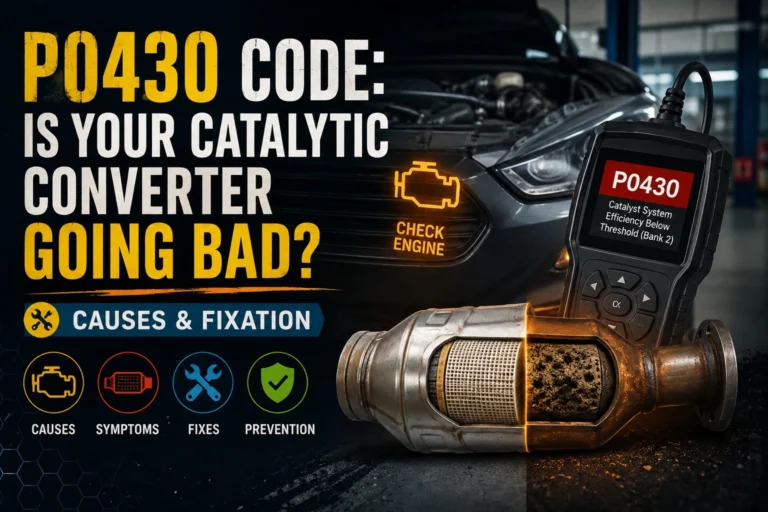
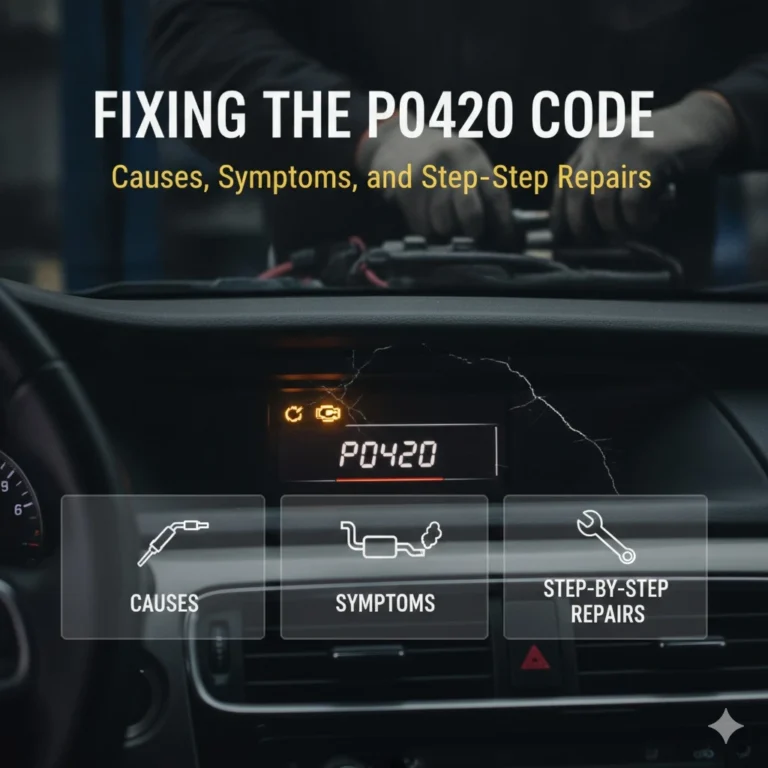
| P0420 | Catalyst efficiency below threshold on bank 1 | Worn converter, bad downstream oxygen sensor, exhaust leak | Oxygen sensors and exhaust leaks |
| P0442 | EVAP system small leak | Loose cap, cracked hose, purge valve | Gas cap and hoses |
| P0455 | EVAP system large leak | Missing cap, disconnected hose, failed valve | Gas cap |
| P0128 | Coolant temperature below thermostat regulating level | Stuck open thermostat, coolant sensor | Thermostat |
| P0101 | Mass airflow circuit range or performance | Dirty or failed MAF sensor, intake leak | MAF sensor and intake |
Why a Code Does Not Always Identify the Failed Part
A trouble code points to a circuit or system that failed a test, not necessarily the part that broke. P0420 can come from the catalytic converter, but a slow oxygen sensor or an exhaust leak can set it too, and replacing the wrong part wastes real money.
A technician checks live data, wiring, vacuum and fuel pressure to confirm the cause. Use the free scan to prepare and compare quotes, then pay for diagnosis before authorizing an expensive repair.
How Much Does It Cost to Diagnose and Fix a Check Engine Light?
A check engine light diagnosis typically costs about $90 to $180 at a shop, and many parts stores read the code for free. CarMD put the national average repair at $554 in 2025, a record, with individual repairs ranging from free for a gas cap to about $1,511 for a catalytic converter.
How Much Does It Cost to Diagnose a Check Engine Light?
A free code read tells you what the computer stored. A shop diagnosis tests the system to find the failed part and usually runs about $90 to $180, often close to one hour of shop labor, with dealers at the higher end. Some shops credit the fee toward the repair if you approve the work.
What Is the Average Cost to Fix a Check Engine Light?
The average repair hit $554 in 2025, up 33% from the prior year, according to CarMD. Parts averaged about 23% higher and labor about 51% higher, and the average U.S. vehicle is now about 12.8 years old. A tightened gas cap is free, a sensor lands in the low to mid hundreds, and a converter pushes past $1,500. Compare two quotes for anything over a few hundred dollars.
Can You Turn Off or Reset a Check Engine Light?
A check engine light turns off by itself after the fault stays fixed for about three consecutive drive cycles, or you can clear it with a scan tool. Clearing without repairing is temporary, because the computer retests and relights it, and it wipes the emissions readiness data an inspection needs.
Can the Check Engine Light Turn Off by Itself?
Yes. The computer usually switches the light off after three consecutive drive cycles in which the failed test runs and passes. A drive cycle means a full warm up from cold, with coolant temperature rising by at least 40 degrees Fahrenheit. The stored history code then typically clears after about 40 more warm up cycles. A light that went away does not mean the cause is gone, so scan the history code if it keeps returning.
How Do I Turn Off the Check Engine Light?
Fix the cause first, then let the light clear on its own or have a scan tool clear the code. Disconnecting the battery for about 30 minutes can also clear it, but if the problem remains the light returns, usually within a few dozen miles.
Clearing codes or disconnecting the battery also resets the readiness monitors, the self tests and emissions inspection checks. Many states fail a vehicle with the light on or with too many monitors not ready, and the limits vary by state and model year. After a repair, drive normally for several trips before the test and confirm your local rules.
James Mitchell
Senior Automotive Writer
12+ years writing clear, practical guides on vehicle maintenance and emissions systems.
Frequently Asked Questions
Conclusion:
The check engine light meaning comes down to one rule: a solid light needs a scan within days, and a flashing light needs you off the road now. Tighten the gas cap, read the code for free at a parts store, and match it to the repair costs above before paying for parts. Acting early keeps a $287 sensor from becoming a $1,511 converter job.
One Comment