3 Way Catalytic Converter: Working & Chemical Reactions
A 3 way catalytic converter reduces nitrogen oxides and oxidizes carbon monoxide and unburned hydrocarbons at the same time, using two connected chemical reactions inside one unit. It earns the name because it targets three regulated pollutants in a single pass through the exhaust stream, something older two way converters could not do. The reactions rely on a precise air fuel mixture and a hot enough exhaust stream to trigger the catalyst coating, which is why the converter only works at full efficiency once the engine reaches closed loop operation.

James Mitchell
Senior Automotive Writer
12+ years writing clear, practical guides on vehicle maintenance and emissions systems.
What Makes a 3 Way Catalytic Converter Different From Older Designs
Older exhaust systems used a two way oxidation only converter that could clean up carbon monoxide and unburned hydrocarbons but had no way to deal with nitrogen oxides. A 3 way catalytic converter solves that gap by combining a reduction stage with two oxidation stages inside one honeycomb substrate, letting a single unit handle all three pollutants covered under EPA tailpipe standards. This design has been standard on gasoline engines since the early 1980s and remains the foundation of modern emissions control.
The Three Pollutants It Targets Simultaneously
A three way catalyst deals with nitrogen oxides, carbon monoxide, and unburned hydrocarbons in that order as exhaust gas moves through the substrate. Nitrogen oxides form when combustion temperatures spike high enough to force nitrogen and oxygen in the intake air to bond together, while carbon monoxide and unburned hydrocarbons are simply leftover fuel that did not fully combust. Treating all three in one pass is what separates this design from earlier converters built for a single pollutant type.
Why a 3 Way Cat Converter Needs a Precise Air Fuel Ratio to Function
The catalyst coating only performs both the reduction and oxidation reactions correctly when the engine runs at or very close to the stoichiometric ratio of 14.7 parts air to one part fuel. Running richer or leaner than that narrow window shifts the exhaust chemistry enough that one reaction starts working while the other stalls, which is why the fuel system spends most of its operating time correcting itself dozens of times per second rather than holding one fixed setting.
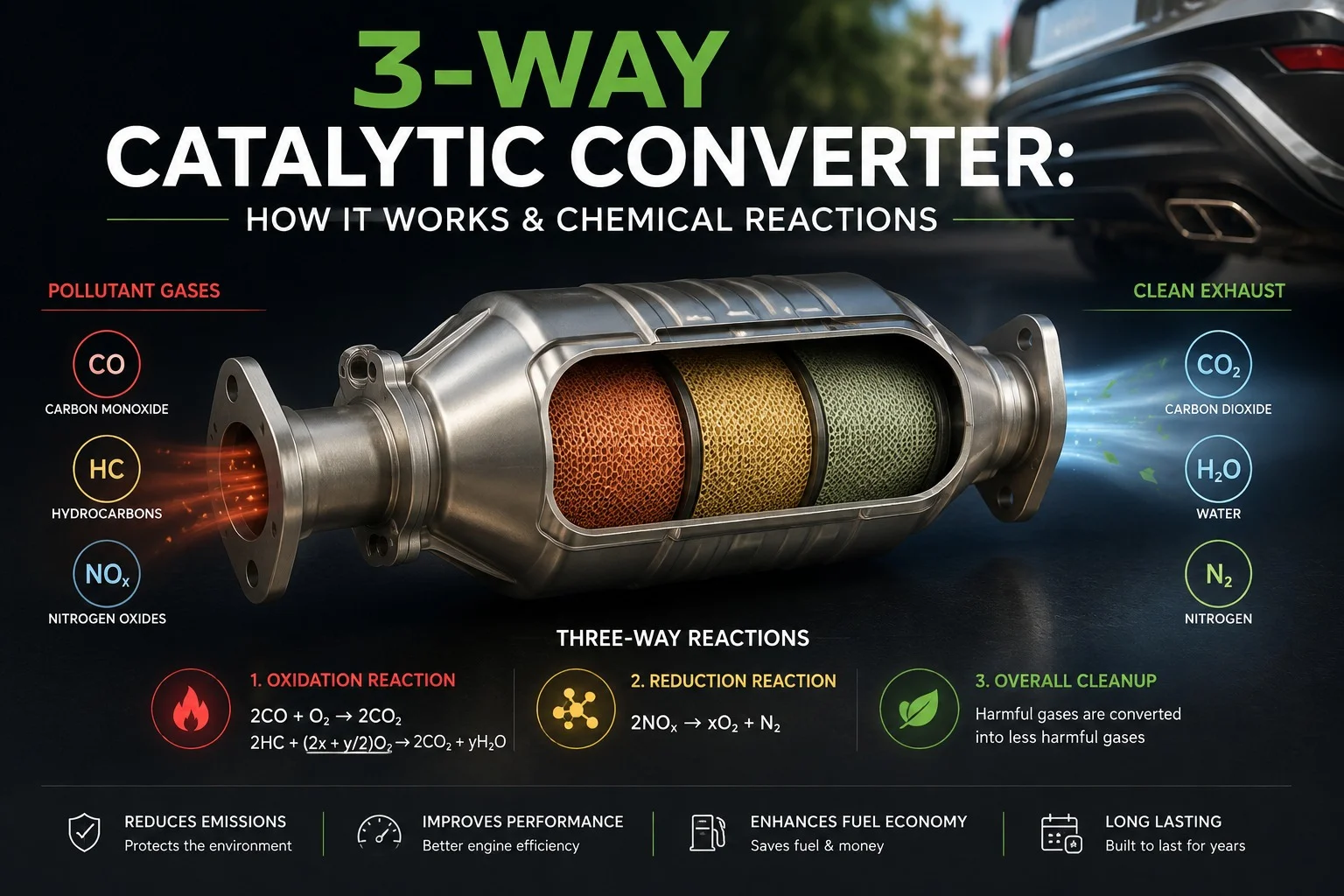
The Chemical Reactions Happening Inside Every 3 Way Catalyst
Two distinct reactions take place inside a 3 way catalyst, one immediately after the other, as exhaust gas passes across the coated substrate.
Reduction Reaction: Breaking Down Nitrogen Oxides
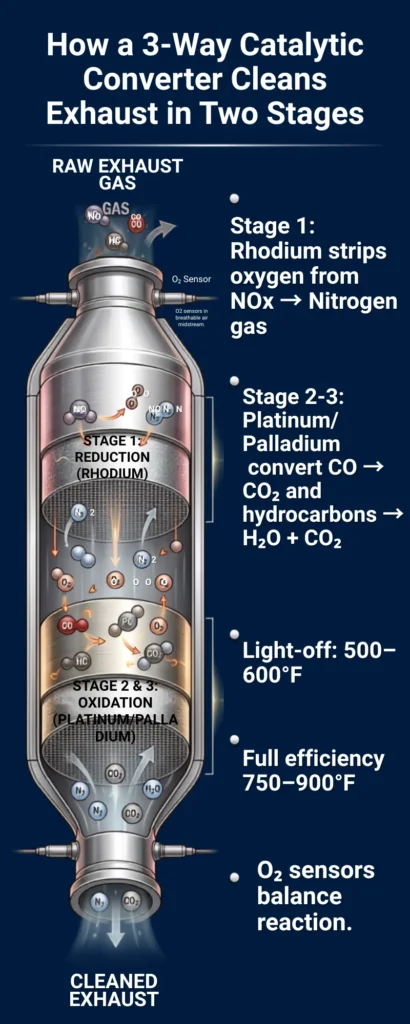
The first stage strips oxygen atoms off nitrogen oxide molecules using a rhodium coating, converting them into nitrogen gas and free oxygen. This catalytic converter chemical reaction happens because rhodium bonds more readily with oxygen than nitrogen does at exhaust temperatures, pulling the molecule apart and releasing plain nitrogen gas, the same gas that already makes up most of the atmosphere.
Oxidation Reactions: Finishing Off CO and Unburned Fuel
The freed oxygen from the reduction stage, along with additional oxygen already present in the exhaust stream, moves on to a platinum and palladium coating where it oxidizes carbon monoxide into carbon dioxide and burns off any remaining unburned hydrocarbons into water vapor and carbon dioxide. These reactions in a catalytic converter only run efficiently once the substrate reaches an operating temperature of roughly 750 to 900 degrees Fahrenheit, which is why a cold start produces more tailpipe emissions than a fully warmed engine.
Inside the Substrate: How Platinum, Palladium, and Rhodium Drive the Reaction
The honeycomb substrate is a ceramic or metallic structure packed with thousands of narrow channels, all coated in a thin washcoat containing platinum, palladium, and rhodium in ratios the manufacturer tunes for that specific engine. This layout creates enormous surface area inside a compact housing, which is what allows the reduction and oxidation reactions to happen fast enough to keep up with exhaust flow at highway speed. A ceria based compound is often blended into the washcoat as well, since it stores and releases oxygen as conditions shift, helping smooth out momentary swings in the air fuel mixture.
I once had a shop customer convinced his converter was defective because a scan tool showed it running below rated efficiency. Once we pulled the heat shield and looked closely at the substrate, the real problem was a coolant leak that let antifreeze wash across the honeycomb every time the engine ran warm. The coating had been chemically poisoned by phosphorus and silicates in the coolant, which shut down the reduction reaction almost entirely while the oxidation stage kept limping along. Replacing the head gasket and the converter together, rather than the converter alone, was the only fix that actually held.
That kind of contamination is a good reminder that the metals doing the work are catalysts in the strict chemical sense. They speed up both reactions without being consumed in the process, which is why a clean, properly matched converter can keep working for well over a decade under normal conditions.
Why a Three Way Catalyst Needs the Engine Running in Closed Loop
A 3 way catalytic converter only reaches peak performance once the engine computer switches from open loop, where it runs a preset fuel map, into closed loop, where it constantly adjusts fuel delivery based on real time sensor feedback. This shift usually happens within one to three minutes after a cold start, once the coolant temperature and the oxygen sensors themselves reach their own operating range.
Role of the Oxygen Sensors in Keeping Reactions Balanced
An upstream oxygen sensor sits ahead of the converter and reports how much oxygen remains in the exhaust before it reaches the catalyst, giving the engine computer the feedback it needs to add or trim fuel dozens of times per second. A downstream oxygen sensor sits after the converter and checks how much oxygen the catalyst itself is storing and releasing, which the computer uses to confirm the reduction and oxidation reactions are actually taking place rather than assuming they are.
What Happens When the Air Fuel Mixture Drifts Too Rich or Too Lean
A mixture that runs too rich floods the catalyst with extra unburned fuel and carbon monoxide, which can overwhelm the oxidation stage and drive substrate temperatures high enough to damage the coating over time. A mixture that runs too lean leaves the reduction stage short on the fuel it needs to strip oxygen off nitrogen oxide molecules, letting more nitrogen oxides pass through untreated. Either condition is commonly flagged with a P0420 or P0430 code once the downstream sensor reports catalyst efficiency below threshold.
How Reaction Efficiency Changes With Temperature
Conversion efficiency for each pollutant is not constant, since every reaction inside a 3 way catalytic converter depends heavily on substrate temperature. The table below shows roughly how each stage performs across a typical warmup and driving cycle.
|
Exhaust Temperature Range |
NOx Reduction Efficiency |
CO Oxidation Efficiency |
HC Oxidation Efficiency |
Converter State |
|---|---|---|---|---|
|
Below 400°F (cold start) |
Under 10% |
Under 20% |
Under 15% |
Not yet active, light off not reached |
|
400 to 600°F |
20 to 40% |
40 to 60% |
35 to 55% |
Warming, partial activity |
|
600 to 750°F |
60 to 80% |
80 to 90% |
75 to 88% |
Approaching full efficiency |
|
750 to 900°F (normal range) |
90 to 98%+ |
95 to 99%+ |
92 to 98%+ |
Full efficiency, closed loop |
|
Above 1200°F (sustained) |
Efficiency drops |
Efficiency drops |
Efficiency drops |
Risk of thermal damage to coating |
What Interrupts These Reactions Most Often
Several common problems can disrupt the chemistry described above well before the converter itself physically fails or cracks apart.
|
Cause |
Reaction Affected |
Why It Happens |
|---|---|---|
|
Coolant leak into a cylinder |
Reduction reaction (rhodium poisoning) |
Phosphorus and silicates in antifreeze coat the substrate |
|
Oil consumption or worn rings |
Both oxidation stages |
Ash from burnt oil physically blocks washcoat surface area |
|
Rich running condition |
Oxidation stage overload |
Excess unburned fuel raises substrate temperature beyond ideal range |
|
Failed upstream oxygen sensor |
Closed loop fuel control lost |
Engine computer cannot adjust fuel accurately without sensor feedback |
|
Leaded fuel exposure (older vehicles) |
Both reactions |
Lead permanently coats the precious metal catalyst surface |
James Mitchell
Senior Automotive Writer
12+ years writing clear, practical guides on vehicle maintenance and emissions systems.
Frequently Asked Questions
Conclusion:
Understanding the chemistry inside a 3 way catalytic converter makes it easier to recognize why efficiency codes show up long before the part physically fails. The reduction and oxidation reactions depend on precise fuel control, sufficient exhaust heat, and a substrate free of contamination, and losing any one of those conditions shows up on a scan tool before it shows up as a mechanical problem. Diagnosing the actual cause first avoids replacing a converter that was never the real issue.