
P0420 Code Toyota: Causes, Fixes & Replacement Cost
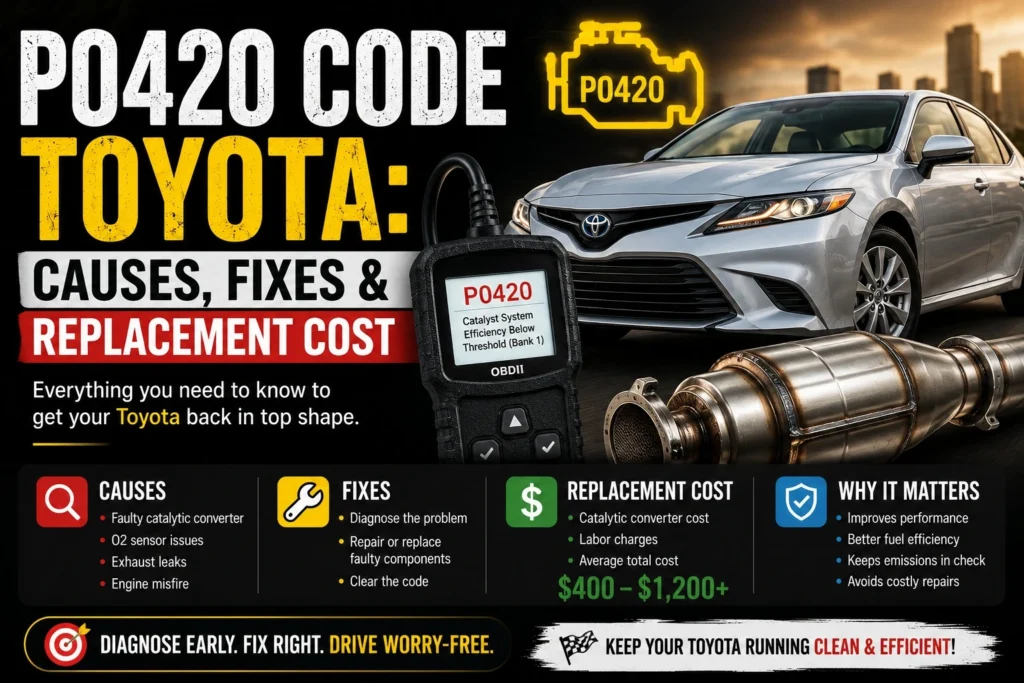
The p0420 Toyota code means your vehicle’s engine control module (ECM) has detected that the catalytic converter on Bank 1 is no longer cleaning exhaust gases efficiently enough to meet federal emissions thresholds. In most cases the fix is a failing or failed catalytic converter, though a bad oxygen sensor or an exhaust leak can trigger the same code. Repair costs range from around $150 for a sensor swap to well over $1,500 if the catalytic converter itself needs replacing, depending on your Toyota model and whether you use OEM or aftermarket parts.

James Mitchell
Senior Automotive Writer
12+ years writing clear, practical guides on vehicle maintenance and emissions systems.
What the P0420 Code Toyota Actually Means
OBD-II (On-Board Diagnostics II) is the standardized system all vehicles sold in the United States since 1996 use to monitor emissions performance. When your Toyota’s ECM stores a p0420 code Toyota, it has compared the signal from the upstream oxygen sensor (before the catalytic converter) with the signal from the downstream oxygen sensor (after the catalytic converter) and found that the downstream sensor is mimicking the upstream sensor too closely. That similarity tells the ECM that the catalytic converter’s wash coat, the chemical layer that converts harmful gases into water vapor and carbon dioxide, is no longer doing its job.
Toyota p0420 Bank 1 and Why It Matters
Understanding Toyota p0420 bank 1 location is straightforward once you know how engines are numbered. Bank 1 always refers to the side of the engine that contains cylinder number one. On most four-cylinder Toyota engines, including the 4-cylinder Camry, Corolla, RAV4, and Tacoma, there is only one bank, so Bank 1 is the entire engine. On V6 and V8 Toyota engines, such as those found in the Tundra, 4Runner, and Sequoia, Bank 1 is the side with cylinder one, which is typically the front-right bank when viewed from the driver’s seat.
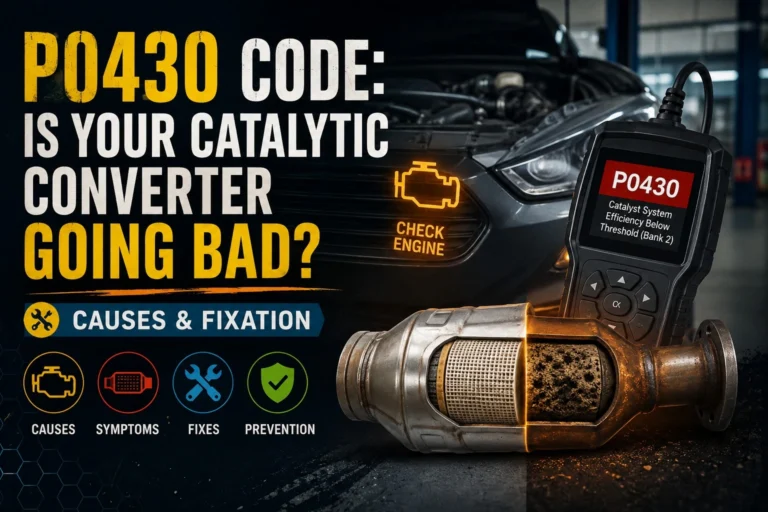
The p0420 bank 1 location on a four-cylinder Toyota will point you directly to the single catalytic converter in the exhaust system. On V6 or V8 models you will also want to check whether a separate P0430 code has been stored, because P0430 covers Bank 2 and indicates the other converter may be failing as well.
How Serious Is a P0420 on a Toyota?
A P0420 is not an emergency that requires you to pull over immediately, but it should not be ignored for months either. The code will not prevent you from driving in most situations, but continued operation with a degraded catalytic converter allows unburned hydrocarbons to pass into the atmosphere, your vehicle will fail an emissions inspection, and the underlying cause, such as a rich-running engine, can quietly cause damage to other components over time.
The Most Common Causes of a P0420 on Toyota Vehicles
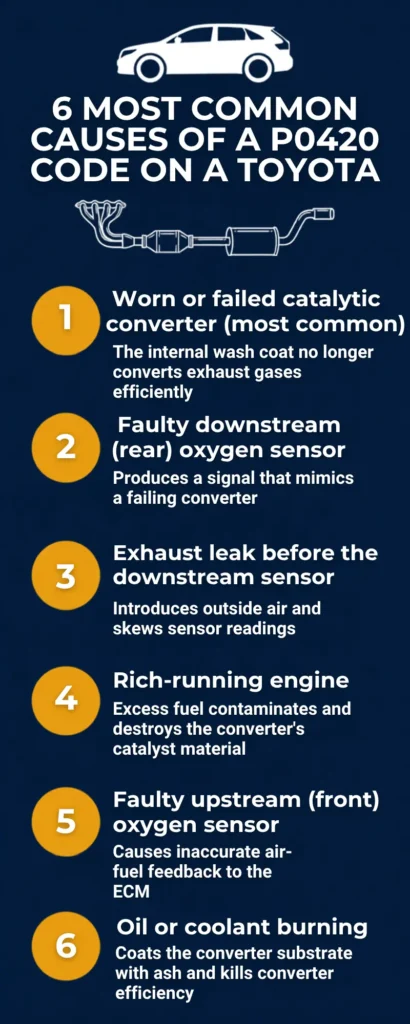
When a Toyota stores dtc p0420 toyota, the root cause is almost always one of a handful of problems. Misdiagnosis is common here, and replacing the catalytic converter when the real culprit is a bad oxygen sensor or a small exhaust leak costs owners hundreds of unnecessary dollars. Work through these causes systematically before ordering any parts. The causes and solution for P0420 code on other automotive brands like Nissan, Chevy and Honda could be different.
|
Cause |
Likelihood |
Typical Diagnosis Method |
|---|---|---|
|
Worn or failed catalytic converter |
Very High |
Oscilloscope or live O2 sensor data showing downstream sensor mirroring upstream |
|
Faulty downstream (rear) oxygen sensor |
High |
Compare sensor voltage patterns; replace and retest before condemning the converter |
|
Exhaust leak before or at the catalytic converter |
Moderate |
Audible tick or hiss; smoke test; visual inspection of gaskets and flex pipe |
|
Rich-running engine contaminating the converter |
Moderate |
Check fuel trims, spark plugs, and MAF sensor readings for rich condition codes |
|
Faulty upstream (front) oxygen sensor |
Lower |
Live data showing sluggish or flat upstream sensor voltage response |
|
Oil or coolant burning (internal engine issue) |
Lower |
Blue or white exhaust smoke, coolant loss, or P0300 misfire codes present |
Why the Catalytic Converter Fails on High-Mileage Toyotas
Toyota’s reputation for reliability is well-earned, but catalytic converters on high-mileage models do eventually reach the end of their service life. The internal honeycomb substrate degrades after years of thermal cycling, particularly on vehicles that take a lot of short trips where the converter never fully reaches operating temperature. Contamination from engine oil burning, coolant leaks past head gaskets, or prolonged rich-running conditions accelerates this process significantly. On many four-cylinder Camry and Corolla models, the catalytic converter is integrated directly into the exhaust manifold, meaning it runs at extremely high temperatures throughout its life.
Oxygen Sensor Failures That Mimic a Bad Converter
A lazy downstream oxygen sensor produces a voltage signal that looks nearly identical to a converter that has lost efficiency. This is the most financially painful misdiagnosis in catalytic converter repair. Before spending $800 or more on a converter replacement, a competent technician should pull live data from both the upstream and downstream sensors and observe the waveforms over several minutes of driving. A healthy downstream sensor should produce a relatively steady, low-voltage output. If it is swinging up and down rapidly like the upstream sensor, you likely have a sensor problem rather than a converter problem.
How to Correctly Diagnose a P0420 Before Spending Any Money
The diagnostic process for a p0420 toyota follows a logical sequence. Skipping steps is how shops end up replacing converters that were perfectly functional.
Step-by-Step Diagnostic Process
Start by connecting a quality OBD-II scan tool and reading all stored codes, not just P0420. Additional codes like P0171 (system too lean), P0172 (system too rich), or misfire codes in the P030X range all point to an upstream engine problem that is poisoning the catalytic converter. Fixing only the converter without addressing those codes will result in the new converter failing within months.
Once you have a clear picture of all stored codes, inspect the exhaust system physically from the manifold back to the rear of the vehicle. Look for cracks, loose clamps, damaged flex pipes, and blown gaskets. Even a small exhaust leak upstream of the downstream oxygen sensor introduces ambient oxygen into the exhaust stream, which causes the sensor to read incorrectly and can set a P0420 on an otherwise healthy catalytic converter.
If the exhaust system is intact, use a scan tool with live data capability to observe the oxygen sensor waveforms. On a cold start, let the engine warm fully and then watch both sensors. The upstream sensor should be switching rapidly between high and low voltage. The downstream sensor on a healthy system should remain relatively flat and low. If the downstream sensor mirrors the upstream sensor, the converter is the likely culprit. If both sensors seem normal but the code keeps coming back, the converter may be marginally degraded, meaning it passes the sensor test at idle but fails under load.
A few years back a customer brought in a 2010 Toyota Camry with 148,000 miles and a freshly installed aftermarket catalytic converter. The shop that did the original job had replaced the converter without scanning for additional codes, and sure enough there was a P0172 rich condition hiding behind the P0420. The engine had a sticky fuel injector dumping excess fuel, which saturated the new converter’s wash coat within six weeks of driving. When the Camry came to me the replacement converter was already dead. We fixed the injector, replaced the converter again with a CARB-compliant unit, and that car has not been back since.
Tools Required for an Accurate Diagnosis
A basic OBD-II code reader is enough to pull the P0420 code, but it will not give you the live oxygen sensor data you need for a proper diagnosis. For that you need a scan tool that supports live parameter identification (PID) data, which most mid-range options in the $100 to $200 range support. If you want to verify converter efficiency directly, a digital multimeter set to read millivolts and placed on the downstream sensor signal wire, or a dedicated exhaust backpressure gauge, can provide additional confirmation.
P0420 Toyota Repair Options: From Cheapest to Most Expensive
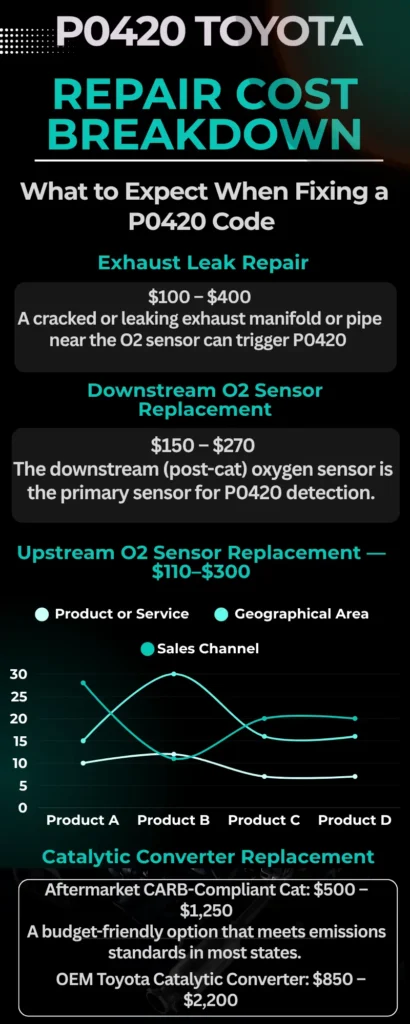
Once you have confirmed the root cause, you have several repair paths available. The right choice depends on your budget, your emissions testing requirements in your state, and how long you plan to keep the vehicle.
|
Repair Option |
Est. Parts Cost |
Est. Labor Cost |
Emissions Compliance |
|---|---|---|---|
|
Downstream O2 sensor replacement |
$50–$150 |
$60–$120 |
Yes, if that was the true cause |
|
Exhaust leak repair (gasket or flex pipe) |
$20–$200 |
$80–$200 |
Yes, if that was the true cause |
|
Upstream O2 sensor replacement |
$50–$180 |
$60–$120 |
Yes, if that was the true cause |
|
Aftermarket catalytic converter (non-CARB) |
$150–$500 |
$150–$350 |
No (not legal in CA and some other states) |
|
CARB-compliant aftermarket catalytic converter |
$350–$900 |
$150–$350 |
Yes in all 50 states |
|
OEM Toyota catalytic converter |
$700–$1,800 |
$150–$400 |
Yes in all 50 states |
Should You Use an OEM or Aftermarket Catalytic Converter?
For most Toyota owners, a CARB-compliant aftermarket catalytic converter from a reputable manufacturer is the most cost-effective solution. These converters meet the California Air Resources Board standards, which are stricter than federal EPA requirements, making them legal and functional in all 50 states. The primary advantage of an OEM part is that it is designed to Toyota’s exact specifications and typically comes with a longer warranty, but the price difference over a quality aftermarket unit rarely justifies the cost for a vehicle with more than 100,000 miles already on it.
Avoid the cheapest no-name converters you can find on online marketplaces. Many of these products contain minimal platinum group metals (the active catalysts inside) and will trigger a P0420 again within a year or two of installation. Look for converters that list their platinum, palladium, and rhodium loading, and choose a brand that offers a meaningful warranty of at least one to two years.
Can You Use a Catalytic Converter Cleaner on a Toyota?
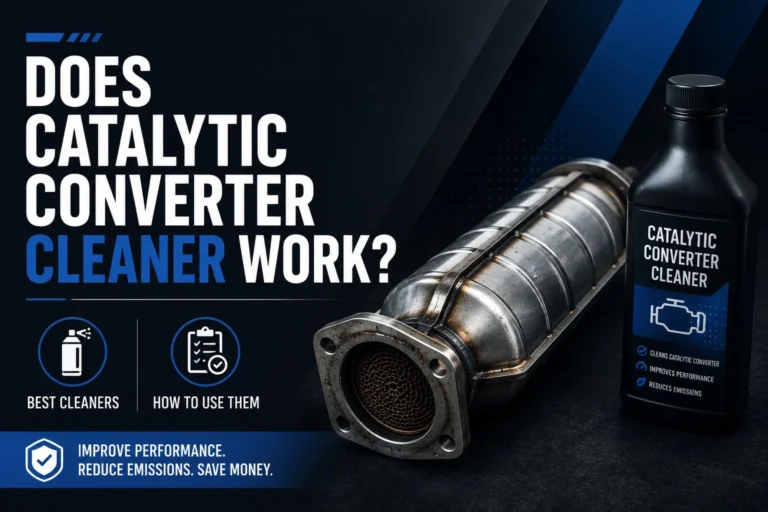
Fuel-based catalytic converter cleaners work by burning off light carbon deposits from the converter substrate. They can be genuinely effective when the converter is only marginally failing, meaning it is triggering a P0420 but is not yet completely dead. They are not effective on a converter that has physically broken down internally, cracked its substrate, or been contaminated with oil or coolant. If you want to try a cleaner before committing to a replacement, use a dedicated catalytic converter cleaner at the manufacturer’s recommended dosage, run the vehicle at highway speeds for 30 to 45 minutes, and then clear the code and see how long it stays off.
P0420 Toyota Replacement Cost Breakdown by Model
Labor rates and parts costs vary by model because the catalytic converter is positioned differently on different Toyota platforms. On the four-cylinder Camry and Corolla, the converter is built into the exhaust manifold assembly, which makes it more labor-intensive to replace than a mid-pipe converter. On the Tacoma and Tundra, access varies significantly by generation.
|
|
Converter Location |
Aftermarket Parts Range |
|
|---|---|---|---|
|
Camry (4-cyl, 2002–2011) |
Manifold-integrated |
$400–$900 |
$600–$1,350 |
|
Corolla (2003–2013) |
Manifold-integrated |
$350–$800 |
$550–$1,200 |
|
RAV4 (4-cyl, 2006–2018) |
Mid-pipe position |
$350–$750 |
$500–$1,100 |
|
Tacoma (2005–2015) |
Mid-pipe position |
$400–$900 |
$580–$1,300 |
|
4Runner / Tundra (V6/V8) |
Dual converters (Bank 1 and 2) |
$400–$900 per converter |
$700–$1,600+ per side |
|
Prius (Hybrid, 2004–2015) |
Manifold-integrated |
$500–$1,200 |
$700–$1,600 |
These ranges are estimates based on typical shop labor rates of $100 to $150 per hour in mid-cost regions of the United States. Dealers and dealerships in high-cost areas such as California or major metro markets will run toward the upper end or above these ranges. Independent shops and mobile mechanics generally land in the lower to middle portion.
Preventing a P0420 From Coming Back After the Repair
A catalytic converter replacement without addressing whatever caused the original failure is money wasted. Before you call the job done, verify the following conditions are met.
Confirm the engine is running at the correct air-fuel ratio by checking both short-term and long-term fuel trims with your scan tool. Both values should be within plus or minus 5 percent at idle and under light load. Values outside that range indicate the engine is running rich or lean and will shorten the life of any replacement converter.
Replace both the upstream and downstream oxygen sensors if they are original and the vehicle has more than 100,000 miles. Oxygen sensors have a recommended service life of around 100,000 miles, and worn sensors are one of the most overlooked contributors to repeated P0420 codes. Replacing them at the same time as the converter is cost-effective because much of the labor overlaps.
Use only quality oil that meets Toyota’s specifications, change it on schedule, and address any oil burning before it becomes severe. Oil ash deposits coat the converter’s substrate and permanently reduce its efficiency over time.
James Mitchell
Senior Automotive Writer
12+ years writing clear, practical guides on vehicle maintenance and emissions systems.
Frequently Asked Questions
Conclusion:
A p0420 toyota code is one of the most misdiagnosed trouble codes in the business, and the cost of getting it wrong adds up fast. Scan for all stored codes before touching anything, inspect the exhaust system physically, and verify both oxygen sensor waveforms with live data before ordering a converter. If the converter is the confirmed culprit, choose a CARB-compliant unit from a reputable brand and address any engine issues that accelerated the original failure. Done correctly, this is a one-time repair.

One Comment