Fixing the P0420 Code: Causes, Symptoms, and Step-by-Step Repairs
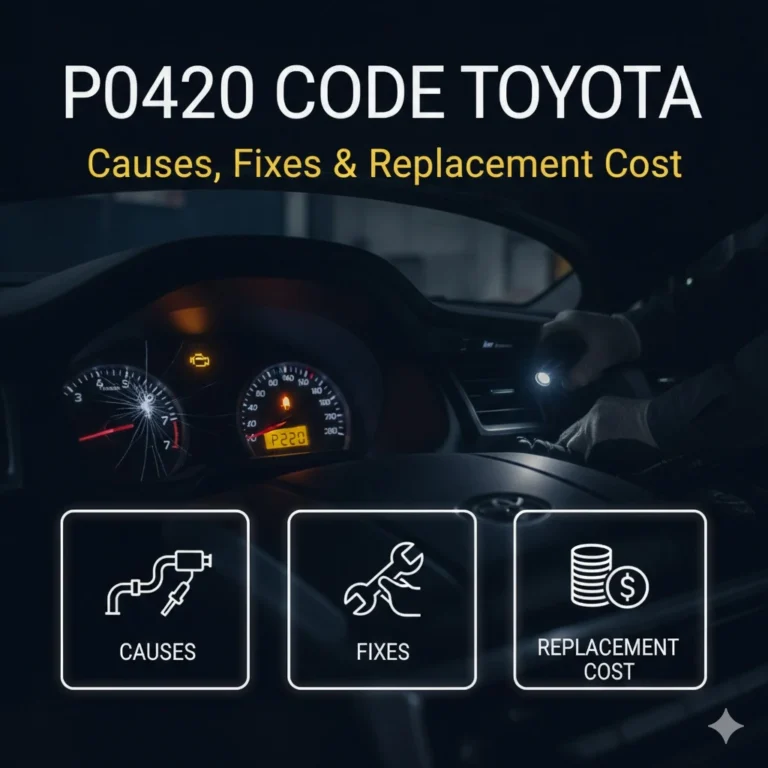
A p0420 code means your vehicle’s engine control unit has detected that the catalytic converter on bank 1 is operating below its required efficiency threshold. In plain terms, the converter is not cleaning exhaust gases well enough to meet the emissions standard your car was built to achieve. This fault appears across virtually every make and model, from a p0420 chevy pickup to a European sedan, and while it always points to the same part of the exhaust system, the root cause and the cost to fix it can vary significantly depending on the vehicle and what actually triggered the code.

James Mitchell
Senior Automotive Writer
12+ years writing clear, practical guides on vehicle maintenance and emissions systems.
What the P0420 Code Actually Means
The p0420 code is an OBD-II diagnostic trouble code (DTC) that stands for Catalyst System Efficiency Below Threshold (Bank 1). Bank 1 refers to the side of the engine that contains cylinder number one, and it applies to both four-cylinder engines, which have only one bank, and V6 or V8 engines with two banks. If Bank 2 is also affected, a separate P0430 code will appear alongside it.
The OBD-II system monitors converter performance by comparing the signal from an upstream oxygen sensor, located before the converter, to a downstream oxygen sensor, located after it. A healthy catalytic converter absorbs oxygen and stores it, causing the downstream sensor to produce a relatively flat, stable voltage signal. When the converter loses efficiency, the downstream sensor begins mimicking the upstream sensor, switching back and forth rapidly. Once the ECU detects that pattern, it stores the dtc p0420 fault and illuminates the check engine light.
Bank 1 vs Bank 2: Why It Matters
On four-cylinder engines, there is only one catalytic converter and one bank, so p0420 always refers to the same component. On V6 and V8 engines, bank 1 and bank 2 each have their own converter. A p0420 chevy V8 truck, for example, will throw this code only for the bank 1 converter, while the bank 2 converter may still be functioning correctly. Replacing the wrong converter wastes money, so confirming which bank is affected before ordering parts is a step worth taking seriously.
Is P0420 the Same as a Bad Catalytic Converter?
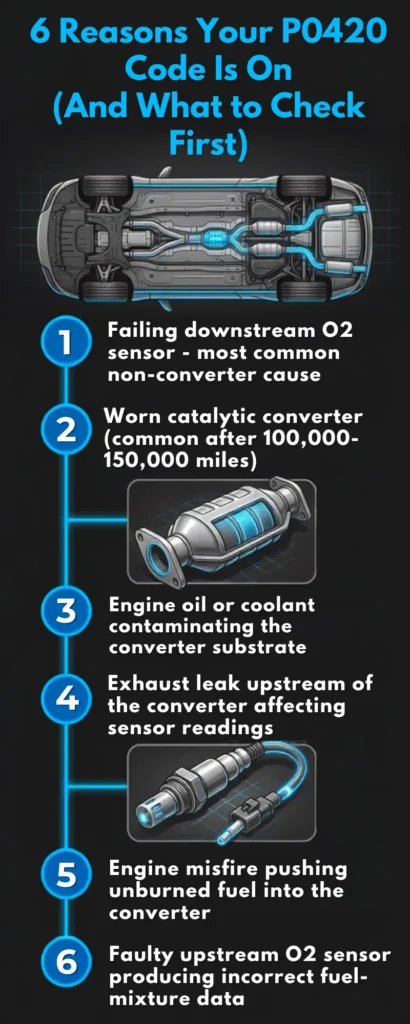
Not always. While the p0420 code is named for the catalytic converter, the code can also be triggered by a faulty downstream oxygen sensor, a failing upstream oxygen sensor giving incorrect readings, exhaust leaks near the sensor bungs, engine coolant or oil burning and contaminating the converter, or even a software issue in the ECU. Replacing the converter without ruling out these other causes is one of the most common and costly mistakes vehicle owners make.
Common Symptoms of a P0420 Code
The most obvious sign is a check engine light combined with a stored p0420 code confirmed by an OBD-II scanner. Beyond that, symptoms range from barely noticeable to clearly affecting the driving experience.
|
Symptom |
Most Likely Cause |
Recommended Action |
|---|---|---|
|
Check engine light on |
P0420 code stored in ECU |
Scan with OBD-II reader |
|
Failed emissions test |
Catalytic converter below efficiency threshold |
Inspect converter and O2 sensors |
|
Rotten egg smell from exhaust |
Failing catalytic converter |
Replace catalytic converter |
|
Reduced fuel economy |
|
Test upstream and downstream O2 sensors |
|
Sluggish acceleration or loss of power |
Clogged or melted catalytic converter |
Back-pressure test, replace if clogged |
|
Rattling noise under vehicle |
Internal substrate breakdown |
Replace catalytic converter |
It is worth understanding that many vehicles will continue to run and drive normally even with an active p0420 code. The converter is a downstream emissions component, not a component the engine relies on to generate power under normal driving conditions. However, a severely clogged converter can restrict exhaust flow enough to cause real performance problems, so the code should never be dismissed entirely.
The Real Causes Behind a P0420 Code: Start Here Before Replacing Parts
The most expensive mistake when dealing with a p0420 code is replacing the catalytic converter without first diagnosing what actually triggered the fault. A brand new converter installed on an engine that is burning oil or has a leaking upstream oxygen sensor will fail again within weeks.
Downstream Oxygen Sensor Failure
This is the single most common non-converter cause of the p0420 code. The downstream oxygen sensor, also called the post-cat O2 sensor, monitors converter performance indirectly by reading exhaust composition after the gases pass through the converter. When this sensor fails or produces an inaccurate signal, the ECU interprets the data as converter inefficiency and stores the fault. Testing this sensor with live OBD-II data before condemning the converter is an essential first step.
Catalytic Converter Contamination or Wear
A catalytic converter contains a ceramic or metalite substrate coated in precious metals such as platinum, palladium, and rhodium. Over time, this coating wears out, typically after 100,000 to 150,000 miles on most vehicles. The converter can also be poisoned by engine coolant from a leaking head gasket, oil from worn piston rings or valve seals, or lead and silicone compounds from fuel or gasket sealers. Once contaminated, no amount of cleaning will restore efficiency and replacement is the only solution.
A customer brought in a 2015 Chevy Silverado with a fresh P0420 code and insisted the catalytic converter was bad. I scanned it, confirmed the code, then pulled up the live O2 sensor data on my scan tool. The downstream sensor was flatlined at around 0.1 volts instead of switching smoothly, which suggested a failed sensor more than a dead converter. I swapped the downstream sensor first, cleared the code, and ran the truck through a drive cycle. The code never came back. Saved that customer about $800 compared to replacing the converter outright.
Exhaust Leaks Upstream of the Converter
An exhaust leak between the engine and the catalytic converter can pull outside air into the exhaust stream, artificially enriching the oxygen reading seen by the sensors. This can cause the ECU to misread converter performance and store the p0420 code even when the converter is in perfectly good condition. Inspect exhaust manifold gaskets, flex pipes, and the connection between the downpipe and the converter housing before assuming the converter itself is at fault.
Engine Misfires or Running Rich
Unburned fuel passing through a misfiring engine enters the converter and ignites, causing extreme heat that physically destroys the internal substrate. A converter that has been overheated by sustained misfires will often rattle because the ceramic honeycomb structure has cracked and broken loose inside the housing. Similarly, an engine running excessively rich, meaning too much fuel and not enough air, will overwhelm the converter with hydrocarbons it cannot fully process. Addressing the misfire or fuel trim issue before replacing the converter is not optional.
How P0420 Shows Up Differently Across Popular Vehicles
While the diagnostic code is universal across all OBD-II vehicles, each manufacturer has slightly different exhaust configurations, sensor locations, and factory calibrations that affect how the fault presents and what the most common fix turns out to be. If you want detailed regarding P0420 codes on Honda, Nissan, Toyota, you can check out our relevant respective blogs.
P0420 on Chevy and GMC Trucks and SUVs
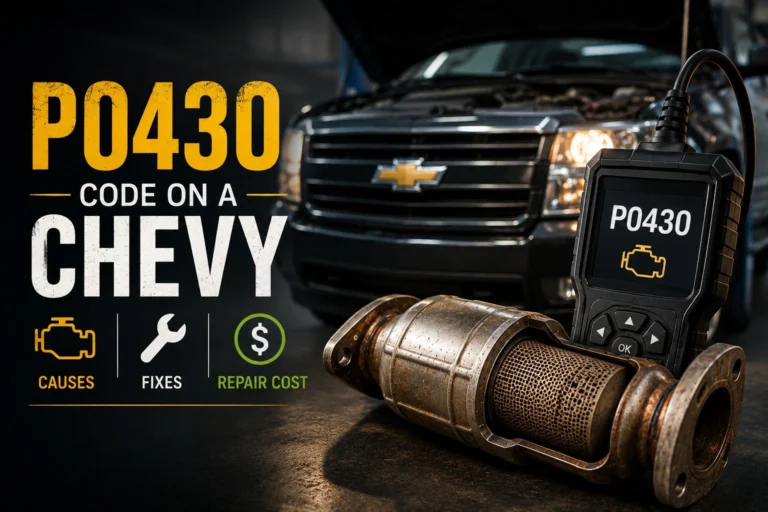
The p0420 chevy code appears frequently on high-mileage Silverado, Tahoe, Suburban, and Equinox models, as well as their p0420 gmc counterparts like the Sierra and Terrain. These GM vehicles share many of the same engine platforms and exhaust designs. On V8 engines, it is common to see the converter on the driver’s side (bank 1) fail before the passenger side. The downstream O2 sensors on these platforms are also known to develop slow response times as they age, often triggering the code before the converter itself is truly spent.
P0420 on Ford Trucks and Cars
The dtc p0420 ford code is particularly common on older F-150 and Escape models with the 3.0 and 3.5 liter engines, as well as on the Focus and Fusion. Ford’s exhaust systems often run the catalytic converter close to the engine, which exposes it to higher operating temperatures and can accelerate wear. On the Ecoboost F-150, oil consumption issues from worn turbocharger seals are a known contributor to premature converter contamination. Always check for blue smoke at startup and monitor oil consumption before replacing the converter on these engines.
P0420 on Jeep, Ram, Audi, Volvo, and Kia
The p0420 jeep code appears regularly on Wrangler and Grand Cherokee models, especially in off-road use where the converter is exposed to water and debris. The p0420 ram 1500 typically shares the same diagnostic pattern as the Dodge-platform engines. On the p0420 audi and other German vehicles, expensive OEM converters and tight packaging make the diagnosis step even more valuable before committing to parts. The p0420 volvo is common on XC60 and S60 models and often turns out to be a downstream sensor rather than the converter itself. On the p0420 kia forte, the code is less common but does appear on higher-mileage examples, usually pointing to the converter itself reaching the end of its service life.
How to Properly Diagnose a P0420 Code Before Spending Money
A proper diagnosis involves more than plugging in a scanner and reading the code. The following steps represent the correct diagnostic sequence used by professional technicians to confirm the actual cause of a p0420 code before any parts are ordered.
|
Step |
Action |
Tool Required |
|---|---|---|
|
1 |
Connect OBD-II scanner and confirm P0420 is stored |
OBD-II scanner / code reader |
|
2 |
Check for additional codes: P0136, P0141, P0137 (downstream O2 sensor faults) |
OBD-II scanner |
|
3 |
Visually inspect catalytic converter for physical damage, cracks, or leaks |
Flashlight, vehicle lift or jack stands |
|
4 |
|
|
|
5 |
Check for exhaust leaks upstream of the catalytic converter that could skew sensor readings |
Visual inspection, smoke machine optional |
|
6 |
Perform a back-pressure test to confirm whether the converter is clogged or restricted |
Back-pressure gauge (vacuum or pressure) |
|
7 |
Confirm repair by clearing codes, driving a full OBD-II drive cycle, and verifying the code does not return |
OBD-II scanner |
Monitoring the downstream O2 sensor waveform is the most informative single step in this process. A healthy converter produces a downstream signal that sits relatively flat between 0.5 and 0.8 volts with minimal switching. If the downstream sensor is switching almost as fast as the upstream sensor, the converter is genuinely losing efficiency. If the downstream sensor flatlines at a low voltage or reads erratically, the sensor itself is the more likely culprit.
P0420 Repair Costs by Vehicle: What to Expect
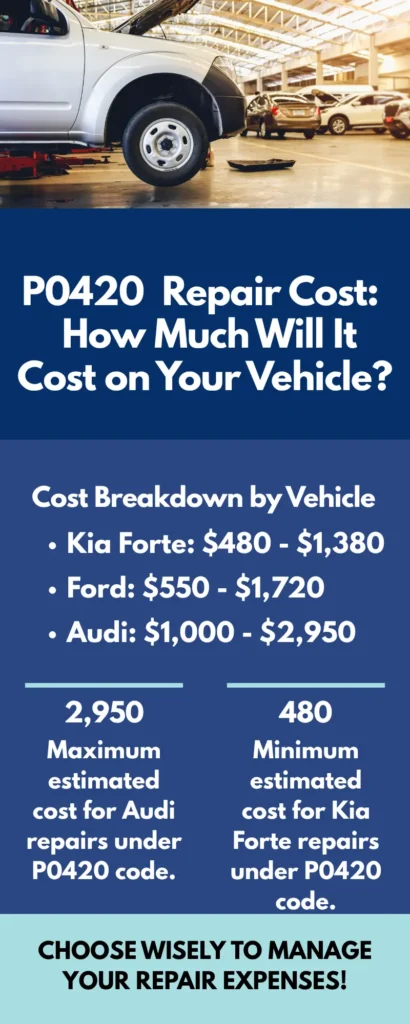
Repair costs for a p0420 code vary widely depending on the vehicle, whether the fix requires a sensor replacement or a full converter replacement, and whether you choose OEM or aftermarket parts. The table below provides realistic ranges across the most common vehicles affected by this code.
|
Vehicle |
O2 Sensor Replacement |
Catalytic Converter |
Total Repair Range |
|---|---|---|---|
|
Chevy Silverado / Equinox |
$150 – $300 |
$400 – $1,200 |
$550 – $1,500 |
|
Ford F-150 / Focus |
$150 – $320 |
$400 – $1,400 |
$550 – $1,720 |
|
Jeep Wrangler / Cherokee |
$160 – $300 |
$500 – $1,500 |
$660 – $1,800 |
|
GMC Sierra / Terrain |
$150 – $300 |
$400 – $1,200 |
$550 – $1,500 |
|
Audi A4 / Q5 |
$200 – $450 |
$800 – $2,500 |
$1,000 – $2,950 |
|
Volvo XC60 / S60 |
$200 – $400 |
$700 – $2,200 |
$900 – $2,600 |
|
Ram 1500 |
$160 – $320 |
$500 – $1,600 |
$660 – $1,920 |
|
Kia Forte |
$130 – $280 |
$350 – $1,100 |
$480 – $1,380 |
Aftermarket catalytic converters are significantly cheaper than OEM replacements, sometimes by 60 to 70 percent, but they do not always meet the same efficiency thresholds. On late-model vehicles or those with tight OBD-II calibrations, some aftermarket converters will allow the p0420 code to return within a short period. States with strict emissions standards, particularly California and other CARB-compliant states, require CARB-certified converters, which cost more but are built to proper specifications. On vehicles like the p0420 audi, using a non-OEM converter increases the risk of the code returning quickly.
James Mitchell
Senior Automotive Writer
12+ years writing clear, practical guides on vehicle maintenance and emissions systems.
Frequently Asked Questions
Conclusion:
The p0420 chevy code and every variant of the p0420 code across Ford, Jeep, GMC, Audi, Volvo, Ram 1500, and Kia Forte vehicles all start in the same place: a downstream oxygen sensor signal that is no longer telling the ECU what it expects to see from a healthy converter. Diagnosis before replacement is the single most important step you can take. If the live O2 sensor data points clearly to the converter, replace it with a quality part that meets your state’s emissions requirements. If data points to the sensor, replace the sensor first. Either way, confirm the repair with a complete OBD-II drive cycle before clearing the code and calling the job done.
3 Comments