When Was Catalytic Converter Invented? History, Inventor & Early Adoption
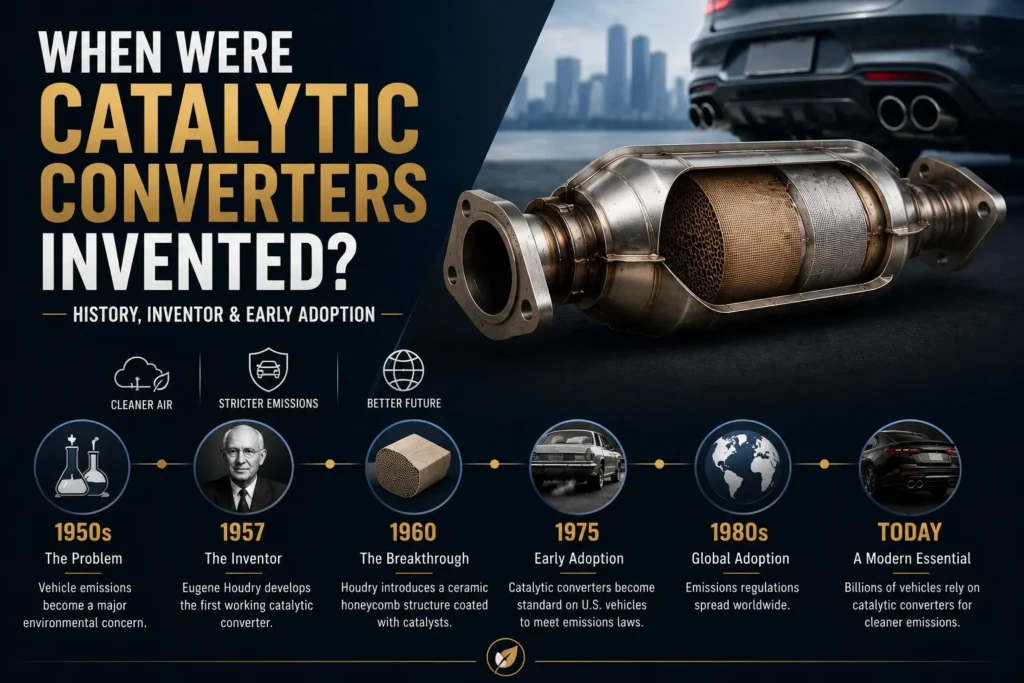
Catalytic converters were invented in the 1950s, when French mechanical engineer Eugene Houdry patented an early exhaust cleaning design, but they did not appear on production cars until the 1975 model year. The gap between invention and adoption came down to one stubborn problem: leaded gasoline destroyed the catalyst before it could do its job. It took new federal emissions law and the shift to unleaded fuel before the technology Houdry pioneered could actually be bolted under a car. Here is how that twenty five year gap played out, and why it matters for anyone trying to date or identify an older vehicle’s emissions equipment.

James Mitchell
Senior Automotive Writer
12+ years writing clear, practical guides on vehicle maintenance and emissions systems.
The French Engineer Who First Designed a Catalytic Converter
The person who first designed the catalytic converter was Eugene Houdry, a French born mechanical engineer who had already made his name in the petroleum industry. Houdry developed a catalytic cracking process in the 1930s that let refineries pull more, higher octane gasoline out of crude oil, a breakthrough that later helped fuel Allied aircraft during World War II. His background in catalysis, the science of using a substance to speed up a chemical reaction without being consumed by it, put him in a unique position to tackle a very different problem a decade later.
Around 1950, early research into Los Angeles smog started pointing at automobile exhaust as a major contributor to the region’s air quality problems. Houdry took notice, founded a company called Oxy Catalyst, and began adapting his refining expertise toward cleaning up tailpipe emissions instead of producing fuel. By the mid 1950s his team had secured a patent, U.S. patent 2,742,437, for an early catalytic converter design built around the same basic principle still used today: pass exhaust gas over a catalyst, usually a precious metal like platinum, and trigger reactions that turn toxic compounds into less harmful ones.
Why Automakers Needed a Solution for Exhaust Pollution
A Growing Smog Problem in American Cities
Catalytic converters were developed because of a public health problem that got harder to ignore through the 1950s and 1960s. Postwar car ownership exploded, and cities like Los Angeles began experiencing thick, eye irritating smog that scientists eventually traced back to a mix of unburned hydrocarbons, carbon monoxide, and nitrogen oxides pouring out of vehicle tailpipes. Regulators and researchers spent the next two decades searching for a practical way to clean up that exhaust without redesigning the internal combustion engine from scratch.
The Leaded Gasoline Problem That Stalled Early Designs
Houdry’s original converter concept could not go into mass production yet, because nearly all gasoline sold at the time contained tetraethyl lead, an additive used since the 1920s to boost octane and reduce engine knock. Lead compounds coat and poison a catalyst almost immediately, stripping away its ability to trigger the reactions a converter depends on. Until refiners found a way to raise octane without lead, any catalytic converter installed on a production car would have stopped working within a few thousand miles.
When Catalytic Converters Actually Became Standard Equipment
The Clean Air Act Amendments of 1970
Catalytic converters were invented as a workable, mass market technology with a cleaner answer than the original 1950s patent suggests: the real turning point was the Clean Air Act Amendments of 1970, which set strict new tailpipe emissions targets and effectively forced automakers to find a device capable of meeting them. That law is what pushed the auto industry, working alongside catalyst manufacturers, to finally solve the lead poisoning problem and turn Houdry’s decades old concept into something that could survive daily driving.
The 1975 Model Year Turning Point
Manufacturers first started using catalytic converters on a wide scale in the 1975 model year, once unleaded gasoline became widely available at gas stations across the country. Cars like the 1975 Buick Regal rolled off the line with a catalytic converter as standard equipment, and within a couple of model years nearly every new gasoline vehicle sold in the United States had one. This is also the point where the familiar EPA compliance requirement that still governs converters today first took effect.
I had a customer bring in a number matching a 1974 model a few years back, insisting his shop manual was wrong because there was no converter anywhere in the exhaust. There was nothing wrong with the car. It was built the model year before converters became mandatory, so it left the factory without one, and federal law does not require an owner to retrofit an exhaust system that predates the requirement. That conversation comes up more than people expect once they start dating cars by emissions equipment instead of just model year.
How Early Catalytic Converters Differed From Today’s Design
The converters that debuted in 1975 were two way units, meaning they only handled two of the three main pollutants, oxidizing carbon monoxide and unburned hydrocarbons into carbon dioxide and water. They did nothing to reduce nitrogen oxides, which needed a second, separate stage. Engineers at catalyst manufacturers, including Engelhard Industries, spent the following years refining that early design into the three way catalyst that became standard by the early 1980s, capable of treating all three major pollutant groups in a single unit.
A Quick Timeline of Catalytic Converter History
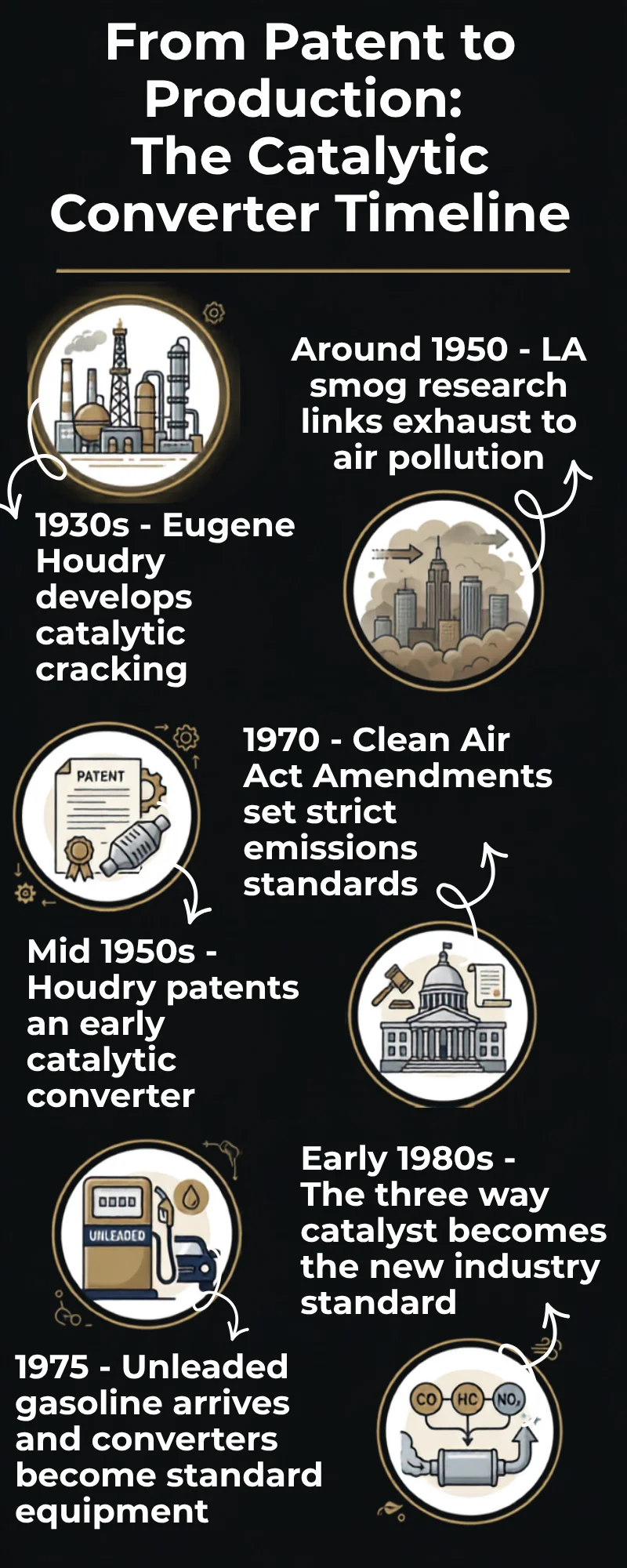
Seeing the key dates side by side makes it easier to understand why there is often confusion between when the technology was invented and when it actually became mandatory.
|
Year |
Milestone |
|---|---|
|
1930s |
Eugene Houdry develops catalytic cracking, a refining process that later informs his converter work. |
|
Around 1950 |
Los Angeles smog research links automobile exhaust to air pollution, prompting Houdry to found Oxy Catalyst. |
|
Mid 1950s |
Houdry patents an early catalytic converter design, U.S. patent 2,742,437. |
|
1970 |
The Clean Air Act Amendments set strict new emissions standards for automakers. |
|
1975 |
Unleaded gasoline becomes widely available and catalytic converters become standard on new U.S. cars. |
Where the Technology Went After 1975
Once converters became mandatory, the technology kept evolving rather than standing still. Catalyst formulations shifted from mostly platinum to blends including palladium and rhodium, cell densities increased for better flow and faster warm up, and onboard diagnostics eventually added sensors that monitor converter efficiency in real time. What started as Houdry’s patent from the 1950s is now one of the most tightly regulated, closely monitored components on any gasoline powered car.
James Mitchell
Senior Automotive Writer
12+ years writing clear, practical guides on vehicle maintenance and emissions systems.
Frequently Asked Questions
Conclusion:
Catalytic converters were invented in the 1950s by Eugene Houdry, but the technology sat mostly dormant until the 1975 model year, when the Clean Air Act and unleaded gasoline finally made it practical. If you are trying to date a vehicle’s original emissions equipment, treat 1975 as the real dividing line rather than the original patent date, and check the underside of any pre 1975 car before assuming it should have a converter at all.