Is a Catalytic Converter Covered by Warranty or Insurance?

James Mitchell
Senior Automotive Writer
12+ years writing clear, practical guides on vehicle maintenance and emissions systems.
Is a Catalytic Converter Covered by Warranty or Insurance?
A catalytic converter replacement can run anywhere from $800 to well over $3,000 depending on the vehicle, which makes understanding your coverage options genuinely urgent the moment something goes wrong. The challenge is that coverage is not governed by a single rule. Whether a catalytic converter is covered under warranty depends on which type of warranty applies, whether the failure was caused by a manufacturing defect or by something else entirely, and whether the vehicle is still within the protected window. Whether your insurance picks up the tab after theft depends entirely on whether you are carrying the right type of auto policy.
Drivers who do not understand these distinctions before trouble strikes often end up paying thousands out of pocket for a repair or replacement that should have been covered. This guide addresses every scenario clearly, from the federal emissions warranty that applies to all new vehicles to the nuances of extended warranty plans, and from comprehensive insurance theft coverage to the steps you need to take the moment a converter goes missing.
Coverage at a Glance: Warranty vs. Insurance for Your Catalytic Converter
|
Situation |
Coverage Type |
Conditions That Apply |
|---|---|---|
|
|
|
Within 8 years or 80,000 miles; defect must be confirmed |
|
|
|
|
|
|
|
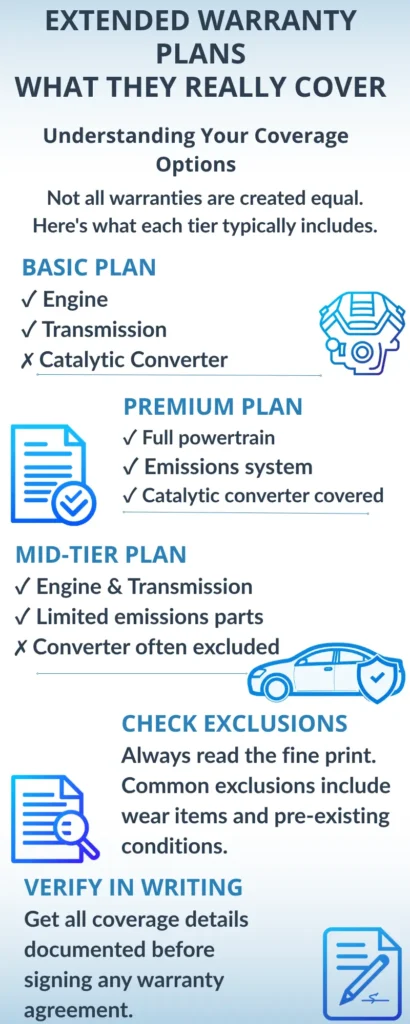
Emissions components often excluded on basic plans |
|
|
|
Converter itself typically not covered directly |
|
|
Aftermarket manufacturer warranty |
Usually 2 to 5 years; read terms carefully |
|
|
|
Maintenance-related failures are universally excluded |
Is a Catalytic Converter Covered Under Warranty? The Federal Emissions Warranty Explained
What the Federal Emissions Warranty Actually Covers
Every new vehicle sold in the United States since 1975 comes with a federally mandated emissions warranty that applies specifically to major emissions control components. The catalytic converter is classified as a major component under this law, which means the manufacturer must warrant it for eight years or 80,000 miles, whichever comes first. This coverage is separate from the bumper-to-bumper warranty and the powertrain warranty, and it applies regardless of which automaker produced the vehicle. Understanding this distinction is the starting point for anyone asking whether a catalytic converter is covered under warranty on their vehicle.
The federal emissions warranty operates through two mechanisms. The Performance Warranty is triggered when a vehicle fails an official government-administered emissions test during the warranty period and the failure is traced back to the catalytic converter. In this situation, the manufacturer must repair or replace the converter at no cost to the owner. The Design and Defect Warranty applies when the converter fails due to a flaw in its materials or construction before the mileage or time threshold is reached. Both routes require that the vehicle has been maintained according to the manufacturer’s schedule and that the failure resulted from the converter itself rather than from misuse, neglect, or an upstream mechanical fault.
How Long Is a Catalytic Converter Covered Under Warranty?
The standard federal protection runs for eight years or 80,000 miles on the catalytic converter. California applies an even stricter standard through the California Air Resources Board, extending emissions warranty coverage to fifteen years or 150,000 miles on certain major components for vehicles sold in the state. Drivers in California, as well as in states that adopt California emissions standards including New York, Massachusetts, and several others, may have significantly longer protection than the federal baseline.
One important nuance is that the warranty clock starts at the vehicle’s original in-service date, not the date of any subsequent ownership change. If you purchased a used vehicle with 60,000 miles already on it and two years have passed since the original sale, you would have six years and 20,000 miles of federal emissions coverage remaining, not a full eight years from your purchase date. Verifying the exact start date using the vehicle identification number is worth doing before assuming coverage is still active.
What the Federal Warranty Does Not Cover
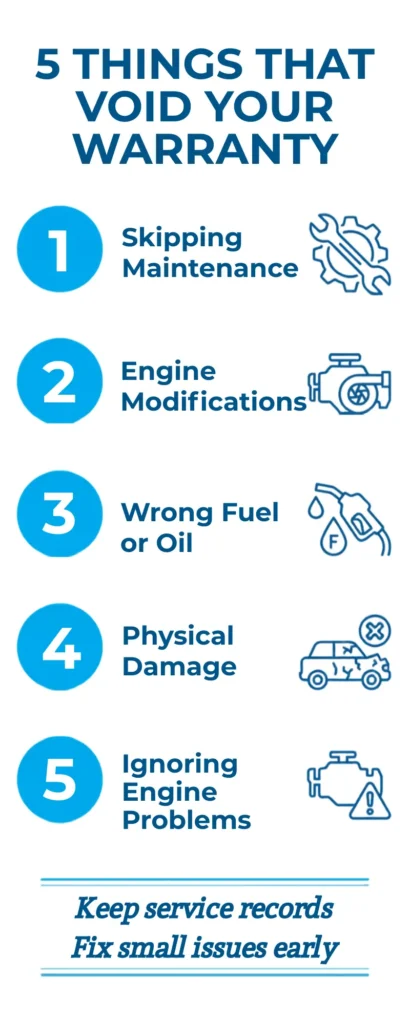
The federal emissions warranty is not a blanket guarantee against every possible converter failure. It excludes failures caused by misuse, unauthorised modifications to the engine or exhaust system, use of incorrect fuel types or oil grades, and physical damage from road impacts or accidents. Critically, it also excludes converter damage caused by an upstream engine fault, such as oil burning from worn piston rings or coolant entering the combustion chamber, even if the vehicle is still within the protected mileage window. In these cases the manufacturer may cover the engine fault itself under a separate warranty, but damage the fault caused to the converter is treated as consequential and is typically not covered. Theft is also explicitly excluded from all factory warranty coverage, which is an insurance matter entirely.
Does Powertrain Warranty Cover Catalytic Converter Failures?
Why the Powertrain Warranty Does Not Include the Catalytic Converter
This is among the most persistent misconceptions in vehicle ownership, and it costs drivers money every year. The answer to whether a powertrain warranty covers catalytic converter components is almost always no. A powertrain warranty is specifically designed to cover the mechanical systems that move the vehicle, which means the engine internals, transmission, driveshaft, axles, and differential. The catalytic converter belongs to the emissions system, a category that vehicle manufacturers and warranty providers treat as entirely separate from the powertrain. Powertrain warranty documentation universally classifies emissions components under a different warranty category, which is why the federal emissions warranty exists as a standalone protection.
Drivers who assume powertrain coverage handles all engine-related issues often discover this distinction only when a claim is denied. If your service adviser tells you the powertrain warranty does not cover your converter, they are almost certainly correct. The question to ask in that situation is whether the root cause of the converter failure, such as a valve seal leak or a failed injector causing a rich fuel condition, is itself covered under the powertrain warranty and whether covering that root cause repair also triggers coverage for the converter.
When a Powertrain Fault Leads to Converter Damage
There is a scenario where powertrain warranty coverage and converter failure intersect in a useful way. If a confirmed powertrain fault, covered under the active warranty, is directly responsible for destroying the converter, some manufacturers will replace the converter as part of the repair in goodwill, even though the converter itself sits outside the powertrain warranty’s scope. This is not guaranteed and depends heavily on the manufacturer, the dealership service department, and how well the failure chain can be documented.
The practical approach is to have the dealership diagnose the failure in writing, confirm what the root cause is, and ask directly whether the converter replacement will be included in the warranty repair. If the service department declines, escalating to the manufacturer’s customer relations team with the written diagnosis often produces a different outcome, particularly on vehicles with low mileage or on models with known emissions-related service bulletins.
Does Insurance Cover Catalytic Converter Theft?
Which Type of Insurance Actually Covers Converter Theft
The answer to whether insurance cover catalytic converter theft hinges on a single distinction in your auto policy. Comprehensive coverage is the type that handles non-collision losses, meaning events that happen to your vehicle that are outside your control, including theft, vandalism, fire, flooding, and falling objects. A stolen catalytic converter is a theft event and falls squarely under comprehensive coverage. If you carry comprehensive as part of your policy, a converter theft claim can be filed and processed after your deductible is applied.
If your policy only carries liability coverage, or a combination of liability and collision, you have no protection against theft of any kind. Does car insurance cover catalytic converter theft for a liability-only driver? No. Liability coverage exists to pay for damage you cause to others in a fault scenario. It has no application to theft events involving your own vehicle. The same limitation applies to collision coverage, which handles crash damage only. Drivers in high-theft areas who carry only the minimum state-required liability coverage are fully exposed to the cost of converter replacement if theirs is taken.
Does Auto Insurance Cover Catalytic Converter Theft When the Deductible Is High?
Whether auto insurance covers catalytic converter theft in a financially meaningful way depends on how your deductible compares to the replacement cost. Common comprehensive deductibles run from $250 to $1,000. Average converter replacement costs range from $800 to $2,500 on standard vehicles, and significantly higher on hybrids and luxury models. On a mid-range vehicle with a $500 deductible and a $1,400 repair bill, filing a claim recovers $900 after the deductible. On a hybrid with a $500 deductible and a $2,200 repair, the net recovery is $1,700.
The decision of whether to file is also shaped by the potential premium impact. Comprehensive theft claims are generally treated more favourably than at-fault collision claims from a premium perspective, and many insurers do not raise rates for a single comprehensive theft claim. However, this varies by provider and by how many claims you have filed previously. Before filing, call your insurer and ask directly whether this type of claim is likely to affect your rate. If the net recovery is modest and a rate increase is probable, paying out of pocket may make more financial sense.
Does Insurance Cover a Stolen Catalytic Converter? Step-by-Step Claim Process
When you discover your converter has been taken and you are asking does insurance cover a stolen catalytic converter on your policy, the process to follow is consistent across most major insurers:
Do not drive the vehicle
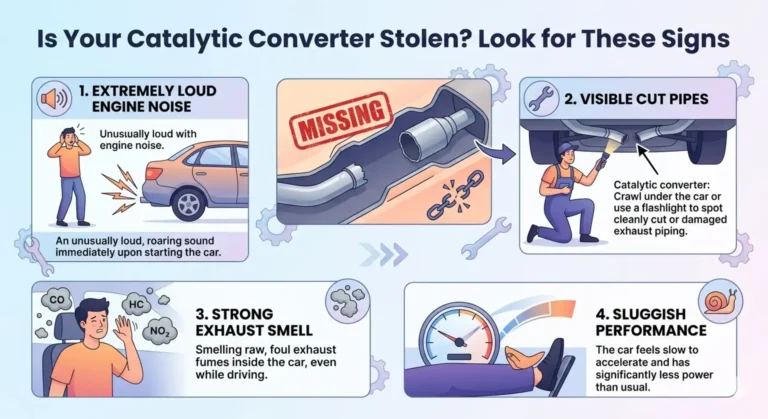
A missing converter removes the exhaust seal from the system. Driving without it allows harmful gases including carbon monoxide to enter the cabin and can damage the engine over time. If the vehicle needs to move, have it towed.
Confirm the theft visually
Get underneath the vehicle or have a mechanic do so to confirm the converter is missing rather than simply damaged. Thieves occasionally leave a cut pipe in a way that is not immediately obvious from above.
File a police report immediately
This is a standard requirement for theft claims. File it at your local police department or online through your department’s portal. Obtain the report number before contacting your insurer.
Photograph all damage
Document the area where the converter was removed, including any cut exhaust pipes, severed oxygen sensor wires, damaged heat shields, and cut hangers. This evidence supports the claim and ensures all damage is captured in the repair estimate.
Contact your insurer and open a claim
Provide your policy number, the police report number, and the vehicle details. Ask specifically whether your comprehensive deductible applies and request clarification on how a theft claim affects your premium.
Obtain a detailed repair estimate
Take the vehicle to a reputable exhaust specialist or dealership. The estimate should itemise every component damaged during the theft, not just the converter itself, so the full scope is included in your claim.
Will Insurance Cover a Stolen Catalytic Converter Including Collateral Damage?
A question many drivers do not think to ask is whether insurance will cover stolen catalytic converter damage that extends beyond the converter itself. Thieves typically use reciprocating saws or angle grinders to remove converters quickly, which routinely cuts through the exhaust pipe, severs oxygen sensor wires, damages heat shields, and destroys exhaust hangers in the process. Comprehensive coverage extends to all damage directly caused by the theft event, meaning the full repair bill for all these connected components is covered after the deductible, not just the converter replacement alone. Ensuring your repair estimate captures every damaged component before submitting the claim is therefore worth the extra time at the shop.
Is a Stolen Catalytic Converter Covered by Insurance? Policy Type Comparison
|
Policy Type |
Covers Converter Theft? |
What It Covers Instead |
|---|---|---|
|
|
|
Damage you cause to others in an at-fault accident |
|
|
|
|
|
|
|
No theft or vandalism protection at all |
|
|
|
Theft, vandalism, fire, weather, falling objects |
|
|
Yes |
Comprehensive portion handles the theft claim |
If My Catalytic Converter Is Stolen Will Insurance Cover It on an Older Vehicle?
How Vehicle Age Affects Insurance Coverage for Theft
Yes, the coverage rule is identical regardless of vehicle age. Comprehensive coverage applies to theft events irrespective of how old the vehicle is. The variable is not coverage eligibility but whether carrying comprehensive on an older, lower-value vehicle makes financial sense in the first place.
Many owners of older vehicles drop comprehensive coverage to reduce their monthly premium, which leaves them fully exposed to converter theft costs. If you drive a vehicle that is a known high-theft target, such as a Toyota Prius, Honda Element, Ford F-Series, or certain Toyota trucks, and you have dropped comprehensively to save money, re-evaluating that decision is worth doing. The cost of adding comprehensively to an older, lower-value vehicle is often surprisingly modest, and on vehicles where converter replacement can exceed $1,000 or more, the protection can pay for itself very quickly.
Is a Stolen Catalytic Converter Covered by Insurance When the Car Has a High Deductible?
When asking if a stolen catalytic converter is covered by insurance in practical terms, the deductible mathematics matter enormously. If your comprehensive deductible is $1,000 and the converter replacement on your vehicle is $900, no claim is worthwhile because the repair cost does not exceed the deductible threshold and the insurer would pay nothing. Conversely, on a hybrid vehicle where replacement costs exceed $2,000, even a $1,000 deductible leaves a meaningful net recovery of $1,000 or more from the insurer.
Reviewing your deductible level in the context of your specific vehicle’s converter replacement cost is a practical step every driver should take. If you drive a high-value converter vehicle and currently carry a $1,000 comprehensive deductible, lowering it to $500 for a modest additional annual premium may significantly improve your financial position in the event of a theft.
What Voids Your Catalytic Converter Warranty Coverage?
Maintenance Gaps and Neglect
The most common reason warranty claims are denied is an inadequate maintenance history. Both factory and extended warranty providers require evidence of regular servicing performed at the manufacturer’s recommended intervals. Oil changes, air filter replacements, spark plug service, and other scheduled maintenance items all contribute to the service record that supports a warranty claim. If you cannot produce documentation showing consistent maintenance, a provider can deny the claim on the grounds that neglect contributed to the failure, even if the converter failure itself was genuinely defect-related.
Keeping physical or digital records of every service visit, whether performed at a dealership, an independent shop, or at home, is the simplest way to protect your warranty position. Date-stamped receipts from parts purchases for DIY services are acceptable documentation in most cases.
Engine Modifications and Unauthorised Alterations
Aftermarket modifications that affect fuel delivery, air and fuel mixture, exhaust flow, or engine management calibration can be cited as contributing factors to converter damage and used to deny warranty coverage. This category includes performance engine tunes, non-approved cold air intake systems, exhaust modifications that alter back pressure, and catalytic converter bypass pipes. Even modifications that seem unrelated to the emissions system can be cited if an assessor determines they affected engine operation in a way that contributed to the failure.
If you have modified your vehicle and are making a warranty claim, be prepared for scrutiny. Having documentation showing the modification was performed by a licensed installer and that it was approved for your specific vehicle can help, but cannot guarantee coverage is maintained.
Physical Damage, Incorrect Fuel, and Contamination
A converter damaged by a road impact, a collision with a speed bump, or off-road use is treated as accidental damage and is excluded from the emissions warranty. These failures are not manufacturing defects and do not qualify for coverage under any factory warranty.
Similarly, the use of leaded fuel, contaminated diesel in a petrol vehicle, incorrect oil grades that contribute to oil burning, or unapproved fuel system additives that reach the converter substrate all constitute misuse. The precious metal catalyst coating inside the converter is highly sensitive to contamination, and any evidence that the failure was caused by an inappropriate substance entering the exhaust system is grounds for a denied claim.
James Mitchell
Senior Automotive Writer
12+ years writing clear, practical guides on vehicle maintenance and emissions systems.