Are Your Catalytic Converters CARB Compliant? The Ultimate Legal Guide
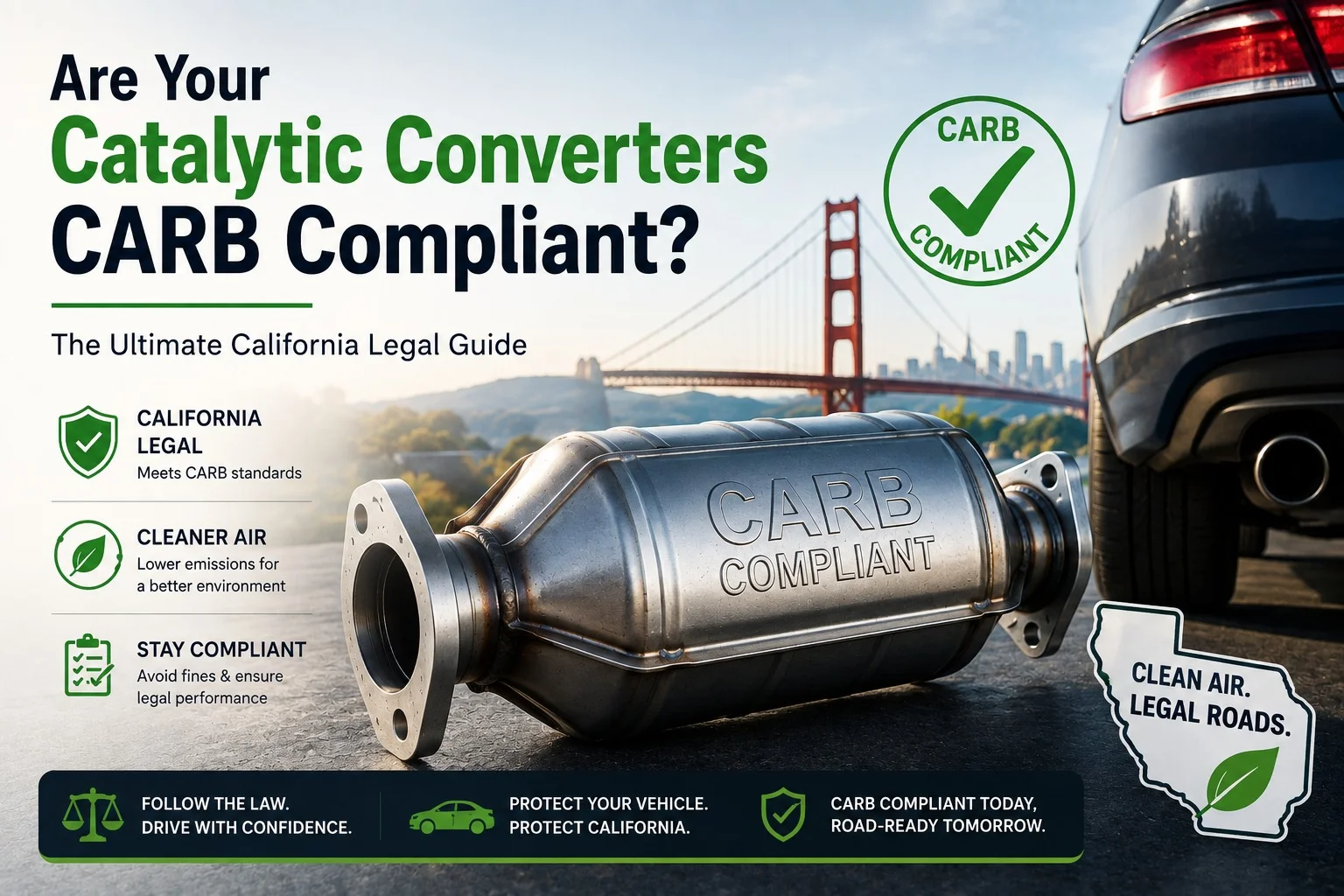
A carb compliant catalytic converter is one tested and approved by the California Air Resources Board, carrying an executive order number stamped on the shell that proves it meets the state’s stricter emissions standards. If your converter lacks this stamped EO number and you drive in California, it is not legal for installation regardless of how well it performs on an emissions test. This distinction matters most when replacing a converter, since installing a non compliant unit can fail smog check, void a warranty, or result in a citation. The rules apply to any vehicle registered in California, even ones bought or repaired in another state.

James Mitchell
Senior Automotive Writer
12+ years writing clear, practical guides on vehicle maintenance and emissions systems.
What Makes a Catalytic Converter CARB Compliant
A converter earns carb compliant status only after passing California’s own emissions certification process, which is separate from and generally stricter than federal EPA approval. The California Air Resources Board tests each design for how well it reduces hydrocarbons, carbon monoxide, and nitrogen oxides across a durability cycle meant to simulate years of real driving. Once a design passes, CARB assigns it an executive order number, and every unit built to that certified design must carry the same number stamped or etched into the shell.
The Executive Order Number Explained
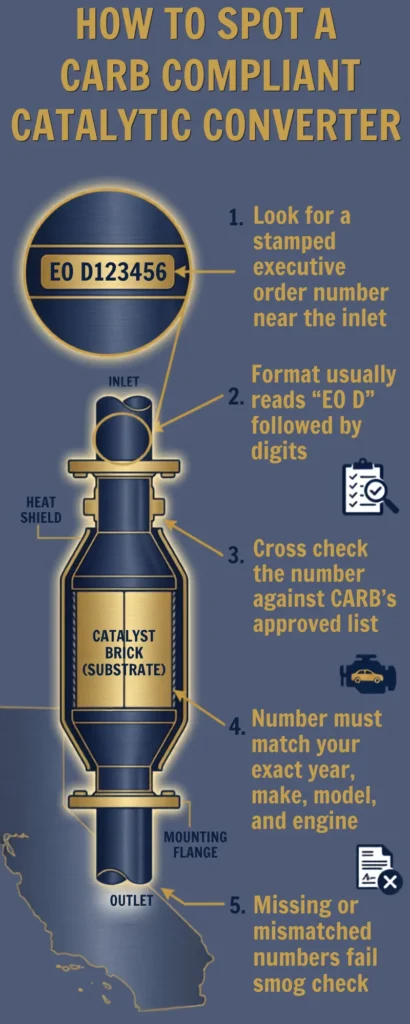
The executive order number, usually written as something like D 744 or EO D 194, is the single detail that separates a carb legal catalytic converter from one that only looks similar. This number is stamped directly onto the converter body, typically near the inlet or on a metal tag welded to the shell, and it links the specific unit back to CARB’s approved design database. A smog technician checking your vehicle looks for this number first, since a missing or unreadable stamp is treated the same as having no compliant converter installed at all.
Why Federal Converters Do Not Automatically Qualify
Many aftermarket converters sold nationwide meet federal EPA standards and work perfectly well mechanically, yet still lack CARB certification because the manufacturer never submitted that specific design for California testing. This is not a quality issue in most cases. It reflects the added cost and time manufacturers spend certifying a design specifically for California, which not every converter maker chooses to do for every part number they produce. A California catalytic converter installed on a vehicle registered outside the state does not need this certification, which is part of why confusion around the rule is so common.
Where Do CARB Catalytic Converter Rules Apply?
California’s converter rules apply to any vehicle registered within the state, regardless of where the vehicle was purchased, where the repair work was performed, or where the converter itself was manufactured. If your car carries California plates, a smog inspector will check for a carb compliant catalytic converter during any required smog check, and this applies equally to a vehicle bought from another state once it gets registered locally.
California Registered Vehicles
Every vehicle with active California registration that requires a biennial smog check is subject to this rule, with limited exceptions for the newest model years that are not yet due for their first inspection. A shop that installs a carb compliant catalytic converter is required to provide a compliance sticker and invoice referencing the executive order number, and keeping that paperwork is worth doing since it can resolve a dispute at inspection time far faster than tracking down the shop again later.
Vehicles Brought In From Other States
A vehicle relocated to California with a non compliant converter already installed is not automatically grandfathered in. Once the car is registered in the state and comes due for a smog check, the existing converter must meet the same standard as one installed locally, which surprises many new residents who assumed a converter legal in their previous state would carry over.
Finding a California Approved Catalytic Converter List
CARB publishes and updates an official list of every executive order number it has approved, organized by manufacturer and vehicle application, and this California approved catalytic converter list is the only reliable way to confirm a part before buying it. Cross checking a converter’s stamped number against this list takes a few minutes and avoids the far more expensive mistake of installing a part that fails inspection.
|
Brand |
Common EO Series |
Typical Price Range |
Risk Level |
Notes |
|---|---|---|---|---|
|
MagnaFlow California |
EO D 780 series |
Wide domestic and import coverage |
250 to 500 dollars |
Widely stocked at parts chains |
|
Walker California |
EO D 660 series |
Strong Ford and GM coverage |
200 to 450 dollars |
OEM style replacement fit |
|
Catco California |
EO D 744 series |
Broad import coverage |
220 to 480 dollars |
Popular for Honda and Toyota |
|
AP Exhaust California |
EO D 320 series |
Domestic truck focused |
230 to 520 dollars |
Common for larger trucks and SUVs |
|
Eastern California |
EO D 415 series |
Mixed domestic and import |
210 to 460 dollars |
Budget friendly certified option |
Prices shift with vehicle size and metal content, and confirming coverage for your specific year, make, and model before ordering saves a return shipment later.
How to Buy a California-Legal Aftermarket Catalytic Converter
An aftermarket catalytic converter california legal for your vehicle must list your exact year, make, model, and engine size on the box or product listing, since CARB certification is tied to specific vehicle applications rather than a converter design in general. A part certified for a four cylinder sedan is not automatically legal for a six cylinder version of the same model, even though the converters may look identical.
A regular customer once installed a converter he found online that was marked CARB compliant, then failed his smog check two weeks later anyway. Pulling the paperwork showed the executive order number on the box matched a four cylinder application, but his car used the six cylinder engine, a detail the listing buried in fine print. The converter itself was legitimate and properly certified, just not for his specific vehicle. He ended up paying for a second converter and a second smog retest, a cost that a two minute check against the vehicle application list would have avoided entirely.
What Happens If Your Converter Is Not CA Compliant
Failing to install a carb compliant catalytic converter on a California registered vehicle creates a chain of practical problems beyond a single failed inspection, ranging from being unable to renew registration to facing a citation during a routine traffic stop in some jurisdictions.
|
Consequence |
Trigger |
Typical Outcome |
Resolution |
|---|---|---|---|
|
Smog check failure |
Non compliant converter detected during required biennial test |
Vehicle cannot pass, registration renewal blocked |
Install a CARB certified replacement and retest |
|
Registration hold |
Smog failure not resolved within the grace period |
DMV places a hold on renewal |
Complete compliant repair, submit new smog certificate |
|
Citation risk |
Visible tampering or missing converter found during a stop |
Fix it ticket issued in many counties |
Show proof of compliant repair within the deadline given |
|
Warranty denial |
Non compliant part installed at a dealership serviced vehicle |
Manufacturer denies related emissions warranty claims |
Replace with a certified unit before requesting warranty work |
|
Resale complications |
Buyer’s independent smog check reveals non compliance |
Sale delayed or price renegotiated |
Resolve compliance before listing the vehicle for sale |
Most of these outcomes are avoidable simply by confirming the executive order number before a converter is ever installed, rather than discovering the problem at inspection time.
CARB Compliant Catalytic Converter Costs
A carb compliant catalytic converter typically costs more than an equivalent federal only part, usually by 50 to 150 dollars, reflecting the additional certification testing and the higher grade platinum, palladium, and rhodium loading CARB standards often require. Buying from an established parts retailer that specifically lists California legal inventory, rather than a generic marketplace listing, reduces the risk of receiving a part with a mismatched executive order number.
James Mitchell
Senior Automotive Writer
12+ years writing clear, practical guides on vehicle maintenance and emissions systems.
Frequently Asked Questions
Conclusion:
Confirming that your carb compliant catalytic converter carries the correct executive order number for your exact vehicle is the single step that prevents failed inspections, registration holds, and wasted money on a part that has to be replaced twice. Before buying or installing anything, check the stamped number against CARB’s approved list and keep the paperwork from the installation. That documentation is the fastest way to resolve any question a smog technician or DMV clerk raises later.